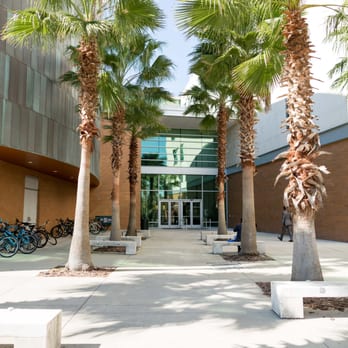
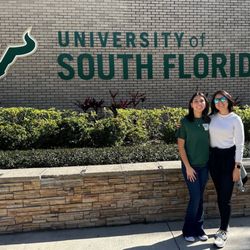
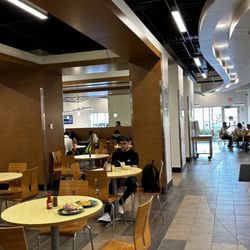
The Marshall Student Center at the University of South Florida is arguably the vital lifeblood of the campus. This center comfortably rests on the scales between learning and relaxation. Its numerous winding corridors are host to various rooms utilized for learning and professional meetings; however, the center is also home to a video game lounge, food courts, art collective, and massage center. Since I was on a quest for a place that didn't quite fit into a standard binary, I knew I had to begin my journey for the unusual here.
As I approached the Marshall Student Center, I passed through a lengthy archway laced with pink blossoms. I stopped, but only for a moment, and fell silent. The air was laced with pollen and the quiet whispers of students sitting on the benches nearby. I inhaled deeply and proceeded to sit down underneath the towering arch. I began to wonder why the arch was constructed in such an odd place--between soothing water fountains and the busy sidewalks near the heart of campus. The only explanation I could muster was that its intended purpose was to reconnect stressed students to the calming, serene effects that nature holds over us. Upon further inspection, I noticed that above my head, lingering in the archway's crest was a nest. I began to realize that this archway' s intended purpose was solely based on the perspective of those with the power to dictate its use. From the viewpoint of the construction workers and faculty that erected the archway, it was little more than a pretty place to sit down and relax in between classes. But for the birds, squirrels, and blossoms, the arch provided a shelter and source of protection from outside entities. Regardless of its intention, the arch simply thrived despite its lack-luster, unfamiliar environment. I began to think of the immediate desire and need for a connection to nature and I referred to a quote from Linda Nash on the concept of the ecological body, "...this body is characterized by its "permeability," "a constant exchange between inside and outside, by fluxes and flows, and by its close dependence on the surrounding environment". Although I had previously passed under the archway countless times throughout the years, I had never thought of its power over me--the innate rush of calmness the rustic wood supplied me, the desire and longing the blossoms flushed into my eyes--what kept me coming back for more? My dependence and need to feel a connection to something other than my experiences certainly persuaded me to stop for a moment and ponder these ideas. But I couldn't help but wonder if this simple arch had become part of me in that moment. How else could I explain my overpowered senses and sudden relaxation? Had I allowed the arch to permeate my flesh and fill a void I hadn't previously noticed? My experience here was merely an example of the permeability of the body and the true lack of power that we hold over our own flesh. I began to feel as though I was engaging with my surroundings rather than passively acknowledging them.
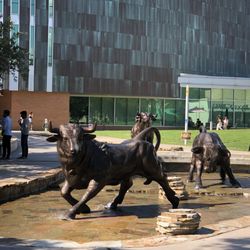
I glanced past the archway and noticed the large metallic bull shaped sculptures. These pieces of art were chiseled with great attention to detail--its muscles were bulging and impeccably shaped, its eyes were gleaming at all who passed, and its overall bronzed complexion was flawless. This vibrant piece of metal which demanded acknowledgement for its brute strength and magnificence was not an immovable, cold, lifeless entity but was instead emanating effervescence from its imitation of life itself. What I may have once perceived as an impressive, silent sculpture was in actuality bursting with vitality. I remembered how Jane Bennett's close inspection of the curves and nonuniform ridges of metal coupled with the "quivering of free atoms at the edges between the grains of the poly crystalline edifice" disagrees with the notion of the lifelessness of metal. According to Bennett, a life is not the "activity of formed bodies as they move through a void in space" but is instead more of an "activeness that is not quite bodily and not quite spatial". Her ideologies on non organic life led me to question what should constitute a life beyond the corporeal. The essence that this sculpture held originated from its proper source of inspiration and transcended from a more corporeal, organic body to a non corporeal, non organic entity that supersedes any specific restraint of time, place, or being. read more