1. Little Red Schoolhouse

0

Palm Beach, FL

Cancel

Open app

Search

Little Red Schoolhouse

4.3 (3 reviews)
Closed • Closed

Little Red Schoolhouse Photos

More like Little Red Schoolhouse

Recommended Reviews - Little Red Schoolhouse

Your trust is our priority, so businesses can't pay to alter or remove their reviews. Learn more about reviews.
Yelp app icon
Browse more easily on the app
Review Feed Illustration
Photo of Mark M.
496
3984
28423

5 years ago

Helpful 4
Thanks 0
Love this 5
Oh no 0
Photo of Ariel W.
4019
6180
108242

8 years ago

Helpful 8
Thanks 0
Love this 3
Oh no 0

11 years ago

Helpful 11
Thanks 0
Love this 12
Oh no 0

Verify this business for free

People searched for Landmarks & Historical Buildings 252 times last month within 5 miles of this business.

Verify this business

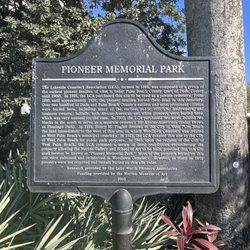
Pioneer Memorial Park

Pioneer Memorial Park

5.0(2 reviews)
4.3 mi

Discovered this old cemetery and this is where many of the pioneers were buried. Many have been…read moremoved but forty remain.The list of pioneers from 1873 to1886 are. H Hammon W Moorse H Dye C Moorse H Pierce M Dimick F Dimick J McFarland E Bradley V Spencer A Wilder J Brelsford W Lainhart F Lennon E Dimick I Hendry A Geer C Lane D Brown G Potter M Spencer R Moore B Lainhart C Haight U Hendrickson C Cragin E Brelsford G Gale G Charters J Porter J Hoagland O Porter E Heyser J White W Lainhart R Potter J Davidson J McKenna E Gale A Garnett R McCormick G Rowley
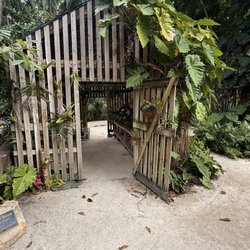
Pioneer Memorial Park is also known as Lakeside Cemetery. It is the final resting place of the…read morepioneer families of West Palm Beach. The cemetery was maintained by the Lakeside Cemetery Association until it became too small to meet the needs of the community. Woodlawn Cemetery opened across the street on land deeded by railroad tycoon Henry Flagler, and the Lakeside Cemetery Association deeded the land to the city in 1921. The Association had three requirements for the land, it be kept as a park, a plaque naming the pioneers buried there be maintained, and that the Lake Worth Pioneers Association be allowed to hold their meetings there. When Ralph and Elizabeth Norton wanted the land to build an art museum the association dropped the requirement of keeping it as a park. If families could be contacted for permission than the graves were moved across the street to Woodlawn. Norton Museum was built on top of the remaining graves. The 1902 grave of Richard Hone who was murdered and his two infant sons lie in the northwest corner of the gallery in a crawl space under the auditorium. A plaque was placed on the Norton Gallery by the Palm Beach Arts League who built the museum. It is dedicated "in memory of those whose names appear below." It is unclear which of the names on the plaque of the 40 people still remain beneath the museum. If you visit the cemetery all you will see are the signs. There is a historical sign posted outside with the cemetery information. Many people pass it everyday without bothering to read it. Although it is not a secret that bodies lie under the museum not many people know about it. This is not an uncommon phenomenon in South Florida. The African-American section of Lakeside Cemetery now lies under the Flamingo Park neighborhood. So next time you are at the museum pause for a moment of respect for the Palm Beach. Pioneers who lay beneath your feet.
Photos
Pioneer Memorial Park

See all

Grandview Heights Historical District

Grandview Heights Historical District

5.0(1 review)
5.3 mi

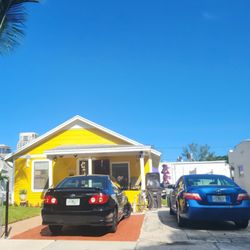
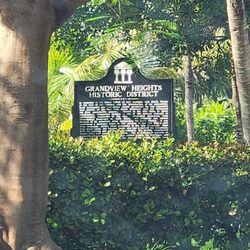
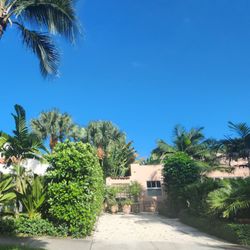
Grandview Heights is one of Palm Beach's oldest historical districts having been established in…read more1910. It was built as an extension of the Palm Beach Heights Neighborhood. Grandview Heights is bordered by Park Place, Alabama Ave, M Street, and Lake Ave. Most of the construction took place between 1910 and 1925. The homes were purchased by ministers, merchants, and construction workers who were building the luxury hotels in the area. The houses were designed in many different architectural style including, Spanish Mission, Craftsman Bungalow, American Four Square, Art Deco, Mission Revival, Dutch Colonial Revival, and smaller Mediterranean Revival homes. At the time it was built, Grandview Heights had the highest elevation in the area and residents had a view of the Lake Worth Lagoon. In the 1980's Palm Beach had the highest crime rate for a city of it's size in the nation. Crack and prostitution were an epidemic. In 1989 the city used eminent domain to complete an urban revitalization project for the downtown area that resulted in all of the Palm Beach Heights neighborhood and part of Grandview Heights neighborhood being torn down. The houses that were razed became City Place, The Kravis Center, and the Palm Beach Convention Center. The remaining houses were restored in the 1990's when people were looking for affordable housing close to downtown. Today the neighborhood consists of mostly single family homes, townhomes, and apartments. Also in this neighborhood are two historic churches, several bed and breakfasts, and small businesses. Grandview Heights is one of thirteen historic districts in West Palm Beach and it was added to the National Register of Historic Places in 1999. I love walking around this neighborhood. So many of the homes have been recognized by the West Palm Beach Historic Preservation Board and display a plaque with the date they were built. While this area has full time residents it also attracts tourists seeking a reasonably priced Airbnb close to the attractions of downtown. There are so many cute places to rent for a vacation. It is fortunate that Grandview Heights was spared from complete destruction.

Photos
Grandview Heights Historical District

See all

College Park Historic District

College Park Historic District

5.0(1 review)
1.0 mi

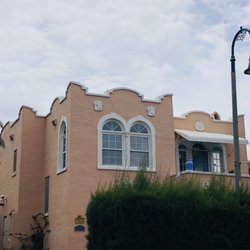
I love a historical architectural tour and there is a great neighborhood on the northeast edge of…read moreLake Worth called The College Park Historic District, also known as College Park Residential Neighborhood. It was one of the first established neighborhoods in Lake Worth. Edgewood Realty Co. of West Palm Beach created the neighborhood in 1924 during Florida's land boom years in the 1920's. This subdivision was created by plats filed between December of 1924 and May of 1925. Within 3 hours 90 percent of the plats were sold. The developer wanted the neighborhood to be upscale so a minimum lot width of 50 feet was required and all new dwellings had to cost at least $5,000. The neighborhood is called College Park because the streets are named after a prominent colleges or universities like Harvard, Duke, and Princeton. Typical architectural styles are Mediterranean Revival and Mission style. The land boom ended in 1928 due to hurricanes and the Great Depression. The neighborhood saw another increase in construction after WWII when vets returned home and sought the warmer climate of Florida. Houses built during this time were single story, slab on grade masonry houses in Masonry Vernacular, International and Ranch architectural styles. John Price who served as county commissioner in Lake Worth was a resident of College Park. He was able to get the state and developers to donate more than 1,000 acres of land in the 1930's and 1940's which became John Prince Park, Palm Beach State College's Lake Worth campus, and the Lantana Airport. College Park was designated a U.S. historic district on February 9, 2001. Ninety historic homes and building reside in the boundaries of Maryland Drive, North Federal Highway, 19th Avenue North, and North Dixie Highway. Spillway Park located on the C-51 Canal is also located in this historic neighborhood.

Photos
College Park Historic District

See all

Seaboard Air Line Station

Seaboard Air Line Station

5.0(1 review)
5.2 mi

Henry Flagler first laid railroad tracks to West Palm Beach in 1894. The Seaboard Air Line Railroad…read moreput down tracks to West Palm Beach between 1921 and 1924. The Seaboard Air Line Railroad was an American railroad which existed from April 14, 1900, until July 1, 1967 when it merged with the Atlantic Coast Line Railroad. AIr Line does not refer to air travel but instead is a common term for the shortest distance between two points. The railroad operated 4,000 miles of track running from Richmond, Virginia down through Jacksonville and ending in West Palm Beach. Solomon Davies Warfield, chairman of the Seaboard Air Line Railroad at the time, extended the railroad further into South Florida to Miami in 1925 and to Homestead in 1927 where it ended. Solomon Davies Warfield was the uncle of Bessie Wallis Warfield Simplson, the woman whose love affair with King Edward forced him to abdicate the throne. This train station, like all of the Seaboard Air Line Stations, was designed by architect L. Philipps Clarke. It opened on January 25, 1925 with the arrival of the Orange Blossom Express, a train that ran from 1925 to 1953 between New York and Miami in the winter. This was one of 40 stations built around this time frame for the railroad. The Mediterranean Revival style building was built by the largest firm in Palm Beach, Harvey & Clark. The train station was added to the National Register of Historic Places on June 19, 1973. In 1988 the City of Palm Beach purchased the building. After a 4.3 million dollar renovation the station was reopened in a ceremony attended by Florida's governor in 1991. Only two of the Seaboard Air Line Stations have been destroyed. The Boynton Beach station was torn down in 2006 and the Delray Station was destroyed by arson a few months ago. Thanks to the care taken by the City of West Palm Beach, this majestic station still maintains it's beauty today while serving Amtrak and Tri Rail travelers.

Photos
Seaboard Air Line Station

See all

Little Red Schoolhouse - landmarks - Updated October 2026

Loading...
Loading...
Loading...