Cancel

Open app

Search

Lewes Railway Station

5.0 (1 review)

Lewes Railway Station Photos

Recommended Reviews - Lewes Railway Station

Your trust is our priority, so businesses can't pay to alter or remove their reviews. Learn more about reviews.
Yelp app icon
Browse more easily on the app
Review Feed Illustration
Photo of Fox E.
4535
16891
49976

5 years ago

Helpful 15
Thanks 0
Love this 14
Oh no 0

Verify this business for free

Get access to customer & competitor insights.

Verify this business

Lewes - Walkway to overbridge to platforms 3-5

Lewes

4.0(2 reviews)
0.0 mi

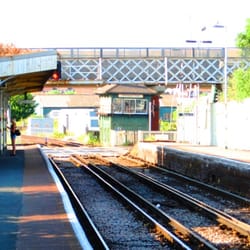
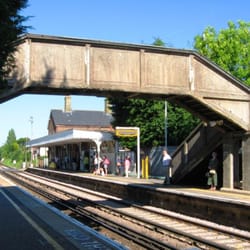
Lewes has one of the best preserved - and attractively restored - stations on the British Railways…read morenetwork. Serving the ancient County town of East Sussex, it is a perfect example of how Victorian buildings can be successfully adapted to modern purposes. The station has a complex history. The first line to Lewes, from Brighton, opened in 1846. Other lines soon followed, making Lewes and important junction: 1846 Lewes - St Leonards (to Hastings 1851) 1847 Lewes - Newhaven (extended to Seaford 1864) 1847 Lewes - Wivelsfield (on the London-Brighton main line) 1858 Lewes - Uckfield 1882 Lewes - East Grinstead The original station at Friar's Walk was a terminus, and trains from Brighton to Hastings had to reverse here until a new station was built closer to the old Priory in 1868. The present station was built in 1888, and sits in the 'V' of the junction between the lines from London and Brighton. The station buildings are constructed in attractive yellow stock brick, with red-brick detailing, all in a domestic Italianate style, with traditional platforms canopies, and an extensive glazed roof. The track junction is immediately East of the platforms, and has an attractive Victorian signalbox. Until 1969 the line to Uckfield diverged north from here, alongside the river. The line to East Grinstead closed in 1958, but has been partially reopened as the preserved 'Bluebell Railway' from Sheffield Park northwards. The line to Uckfield also closed, in 1969, though there is political pressure to reopen it. Nevertheless, Lewes remains an important interchange, with 2.5 million pasengers a year, and a further 350,000 changing trains here. The week-day off-peak service pattern is: London - Eastbourne/Hastings/Ore - hourly London - Eastbourne - hourly Brighton - Eastbourne/Hastings/Ore - hourly Brighton - Eastbourne/Hastings/Ashford - hourly Brighton - Newhaven/Seaford - every 30 minutes Brighton - Lewes (terminates) This provides four trains an hour to Eastbourne, two to London and five to Brighton. Facilities include a newsagents, taxi rank, toilets and baby-changing facilities, public wi-fi access, and cycle-storage with CCTV. The station is fully accessible (step-free access) via ramps and lifts. There is also a large car-park on the north side of the station.

I would agree with the other reviewer that Lewes train station is a attractive, well restored…read moreVictorian building, however, on my visit there to meet connecting pick-up bus from the outside of the building I couldn't find anywhere to sit whilst waiting. I looked inside at the ticket office area; no seats, nothing outside either. It was a very hot day and I had a long wilting wait for my lift...it wasn't good. The only seating area appeared to be in the Costa coffee concession, and I didn't want the obligation of having to buy a drink just to sit down.

Photos
Lewes - Lewes signalbox and junction, looking towards Eastbourne/Newhaven

Lewes signalbox and junction, looking towards Eastbourne/Newhaven

Lewes - Ramp from platforms 2 and 3

Ramp from platforms 2 and 3

Lewes - Main entrance on Station Road

See all

Main entrance on Station Road

Polegate Station

Polegate Station

4.5(2 reviews)
10.7 mi

Polegate station serves the town of the same name on the northern edge of the Eastbourne…read moreconurbation, and is served by trains on the West Coastway line. It handles around 0.9m passengers a year. The first station on the site opened in 1846 on the Lewes to St Leonards railway line. It became the junction for Eastbourne and for the line northwards to Hailsham in 1849, with the Hailsham line being extended northwards to Eridge on the Uckfield-Groombridge Junction line in 1880. In 1881, to avoid Eastbourne-Hailsham trains having to reverse, a new station was opened further east. The Hailsham line closed in 1968, and the short direct line to Hastings has also closed, necessitating the reversal of all eastbound trains at Eastbourne. In 1986, the 1881 station was closed (it is now a restaurant) and a replacement opened on the site of the original 1846 station, on Polegate High street, and this is the station in use today. It has two platforms, with the main buildings on the north, Eastbourne-bound line. Facilities include a car park, ticket office, waiting rooms or shelters, ticket machines, and cycle storage, but no toilets. There is step-free access both to the ticket office and via short steep ramps to each platform. Between the platforms, there is a footbridge: level access is via the High Street level crossing (allow 5 minutes). Services are provided by Southern; there are two trains an hour to each of Brighton and London Victoria, both via Lewes; and four eastbound to Eastbourne, two of which continue to Hastings and Ore, and one to Ashford.

Just your average train station. Nice long and wide platforms with two waiting rooms (which are…read moreheated!) Good barrier system, although I was sad when the old signal box was removed. Great direct links to London, Brighton, Eastbourne and many more. Staff are nice, there are three (I think) ticket buying machines and two kiosks inside the station. Information packs readily available, you can buy Railcards from here too. I like the welcoming feeling of this station, which also has a night gate for late exits when the barriers are off. I'd recommend this to families, commuters and just about anyone due to the wide platforms and nice service.

Photos
Polegate Station
Polegate Station
Polegate Station

See all

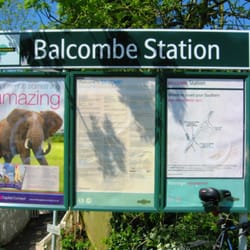
Balcombe Railway Station - The main station noticeboard at London Road

Balcombe Railway Station

4.0(1 review)
14.3 mi

It's a surprise to find a station serving as a small village as Balcombe, especially on a main…read moreline. However, the lack of good roads to and from the village, and its proximity to London, ensures a healthy flow of commuter traffic, with Balcombe acting as a rail-head for several villages around - it is used by just over 100,000 passengers a year. It's an attractive small station, the east side nestling in a cutting, and surrounded on all sides by mature trees and shrubs, and is very popular at week-ends with walkers exploring the surrounding woodlands. The station opened on 12 July 1841 as an intermediate station on the then London and Brighton Railway, later amalgamated into the London, Brighton and South Coast Railway. The 1841 census shows that there were 550 railway labourers living in the village at the time - which must have been challenging for the locals! The station has been rationalised over the years, but retains a small building on the down (Brighton) platform, complete with Victorian canopy, ticket office and toilet. The office is only open at peak times (the toilet is also closed when the office is shut). If this is the case, you need to buy a 'permit to travel' from the machine and buy a ticket on board. The up platform (for London) has a small waiting shelter with step-free access from the car park, and there are car parking spaces and a cycle rack on this side of the station. A footbridge provides access between the platforms, and also provides the exit to London Road at the top of the cutting. Note that there is no step-free access to the Brighton platform. An oddity is the extension of the Brighton platform under the small tunnel at the south of the station: this is only used to board and alight from trains, and a sign warns not to enter the tunnel when a through (ie non-stopping) train is approaching which they do, at some speed. The service is fairly sparse: off-peak, Monday to Saturday there is one train an hour in each direction, on the First Capital Connect service from Bedford to Brighton via London Bridge. On Sundays, an hourly service is provided by Southern on the Brighton to London Victoria line. Additional services stop during rush hours in both directions. To the north of the station is Balcombe tunnel, 800 yards long, and to the south the famous Ouse viaduct, the first long railway viaduct in southern Britain. At 1,475 ft (450m) long, faced with Caen stone and with four Italianate pavilions at each end, it is regarded as one of the most attractive in the UK.

Photos
Balcombe Railway Station - A fast through train for Brighton rushes past platform 2.

A fast through train for Brighton rushes past platform 2.

Balcombe Railway Station - Main station building on platform 2 (for Brighton). It contains a ticket office, sheltered seating and toilet.

Main station building on platform 2 (for Brighton). It contains a ticket office, sheltered seating and toilet.

Balcombe Railway Station - A Bedford-bound train leaves platform 1.

See all

A Bedford-bound train leaves platform 1.

Haywards Heath Station - General view with a Victoria train leaving platform 3

Haywards Heath Station

3.3(3 reviews)
10.6 mi

Haywards Heath is one of the principal stations on the main line between London and Brighton,…read moreserving the commuter town of the same name which has grown up around it. It's not an architectural gem, but it's functional and has a good range of train services. The station opened in July 1841 as the temporary southern terminus on the London to Brighton Railway, and became a through station when the line to Brighton opened in its entirety in September of that year. In 1847 a line was opened from Wivelsfield, just south of Haywards Heath, to Lewes, providing direct lines to Newhaven and Hastings, and 1864 another line opened, to the north, towards Horsted Keynes on the Lewes to East Grinstead line. The line to Horsted Keynes closed in 1963. The station was rebuilt with two long, spacious island platforms in 1933, when the Brighton line was electrified. The street-level buildings are in an unremarkable version of the Modernist style, of brick with concrete canopies. The platforms level buildings are similarly functional and have deep awnings. Since electrification the station has become an important station for dividing trains heading respectively on the lines east towards Lewes and west to Hove and the 'West Coastway' line (avoiding Brighton) and for the same trains joining when heading north. Indeed, it is now the busiest station for this practice in the UK. The station has a regular off-peak service each hour as follows: Northbound Bedford via London Bridge and St Pancras 4 per hour London Victoria 2 per hour Watford Junction - hourly Southbound Brighton 5 trains per hour Littlehampton via Hove and Worthing 2 per hour Eastbourne 2 per hour (one extended to Hastings and Ore) Note: the half-hourly fast Victoria-Brighton trains do not stop here in the off-peak. In the peak hours all Brighton trains call here, providing an intensive service. All northbound trains stop at Gatwick Airport. The station is staffed 24 hours a day, and has a ticket office, waiting rooms, toilets and a large buffet, and step free access is available across the whole of the station (via lifts). There is also storage for over 60 bicycles and a 630-space car park. A limited number of local buses call at the station: see http://www.compass-travel.co.uk .

Whilst I may be living in Haywards Heath, I spend much of my time in Brighton for study,…read moresocialising and shopping. Hence, I am a frequent user of the station. It's one of the main connectors of the south, so is a featured stop for fast services as well as the stop at every station trains. This makes it handy for getting to Gatwick, Brighton and London and you end up waiting less time for a train than at other stations in the area. I think that this is a reason why Haywards heath has become such a popular commuting town and the large station car park attests to this claim! Being a busier station, you also find coffee/snack bars and waiting rooms that are actually open. Now whilst not a fault of the station I do find that a higher percentage of trains get delayed than I would like, so these waiting features are really appreciated. The station staff are helpful for any traveling inquiries or suggestions of cheaper way to get from a to b (sadly, I never seem to qualify for such savings). There are also 3 self service ticket machines if you want to save some time or are cutting your arrival a bit fine before your train departs. There is also a covered area to store bicycles if you are feeling like a healthy commute. All in all, you could do far worse if you have to kill 15-20 minutes waiting for a train than Haywards Heath!

Photos
Haywards Heath Station - General view of the station, with the long canopies over the platforms.

General view of the station, with the long canopies over the platforms.

Haywards Heath Station - Taken by me

Taken by me

Haywards Heath Station - The 18:46 Southern service to Hastings leaves Haywards Heath on 4th July 2008.

See all

The 18:46 Southern service to Hastings leaves Haywards Heath on 4th July 2008.

Brighton Railway Station - Outside

Brighton Railway Station

3.7(36 reviews)
7.3 mi

I hope this review will be able to Brighton your day a little bit…read more Brighton understandably has a massive railway station that dates back to 1840, and it's been increased many times in terms of volume and capacity, partly because 17 million passengers a year makes Brighton number 7 on the list of the most busy stations in the country - not including the many many busy ones in London itself. It's huge and has a big old Victorian roof that will remind you of a London Station. It's one of only 70 grade two listed buildings, partly because people absolutely love it. It's a massive modern hub, but also part of History. It's hard not to love the station and I really do. It's also the southern terminus of many national trains, although trains don't really stop here without having to then turn back on themselves, which is interesting. It's been made to look mostly white and blue - kind of like the Pavilion - so it does have a little local Seaside feel, and The Concourse has been completely redesigned so now it looks totally modern, and honestly you would think you were in London sometimes. The blue motif pushes it over the edge, and it's easily five stars - in fact if I could give six stars the station would get six.

This station is inevitable. You take the train from London to Brighton and end up here. It's not…read morethe greatest station but it's a necessity. The surrounding areas of this station aren't they great either. Occasionally you're welcomed by some druggies sitting outside on the benches. An upgrade is overdue but alas.

Photos
Brighton Railway Station - Departure Boards

Departure Boards

Brighton Railway Station

See all

Newhaven Town - View along platform 1, for Lewes, Brighton and London trains

Newhaven Town

3.5(2 reviews)
5.6 mi

Newhaven is a quaint, old train station located at the port area of New Haven. Although the…read moreNewhaven Harbour station is closer to the port proper, this station is very convenient to those passengers needing access to the DFDS ferry port office at New Haven. Served by Southern, the station has two platforms, a ticket machine, ticket office, and a free to use toilet. The mid 1800's station serves over 300k passengers each year and is served by the Seaford Branch Line of Southern's East Coastway Line. If you are arriving by boat from Dieppe, France, this makes it very easy to hop over to Brighton in no time. During off-peak times, there are two trains heading westward to Brighton. There is also a morning train that connects to London Victoria Station. The ticket counter staff are very friendly, and the inside waiting room has three quite comfortable leather couches. Overall the station is a nice place to lounge in while waiting on your train and is a significant foil to the bare bones bus stop and ferry terminal located nearby.

Newhaven Town is the larger of this small Channel port's stations, and is a short walk from the…read moretown centre across the swing bridge over the harbour. Opened from Lewes in 1847 by the London, Brighton and South Coast Railway, the aim was to turn Newhaven into 'the Liverpool of the south'. Although it became a bustling port, with regular ferry services to Dieppe, it never quite grew as early promotional material suggested. The town eventually had three stations, Town, Harbour and Marine, the largest of which, by far, was Marine, used for passengers transferring to the ferry service to Dieppe. This is now closed and in a very sorry state, and Harbour station - used by foot passengers for the ferry - is just a halt. The station has a small stone building on the London-bound side with a short canopy, although it only has rather mean pedestrian access, owing to work under way on the port area behind. The Seaford platform has a basic bus-type shelter. There is a footbridge, but many choose to cross using the busy level crossing at the Lewes end. (This also provides level access to both platforms). The basic off-peak weekday service is every half hour on the Brighton to Seaford, with a few through London trains in the peaks. Aside from level access, the station has a mornings-only ticket office - and that's about it for facilities.

Photos
Newhaven Town - Another view of platform 1, under the canopy.

Another view of platform 1, under the canopy.

Newhaven Town - A view of the tracks - in rather poor condition - looking towards Seaford and Newhaven Harbour.

A view of the tracks - in rather poor condition - looking towards Seaford and Newhaven Harbour.

Newhaven Town

See all

Angmering

Angmering

4.0(2 reviews)
22.1 mi

I hope my review of Angmering isn't Angering you…read more This is not too far from Brighton, about 15 miles away in the countryside, and it's right next to a secondary school so Aletta (not Aletta but I'm in love with Aletta so)... a lot of... students use it to get to their little country houses and whatnot. How nice it must be to be middle class or rich in the suburbs of Sussex. Looking at you, Keane. It's a cute little station in the middle of nowhere with a nice dark brown house with a couple of chimneys on top of it. There's a level crossing right at the station which adds to the beauty for a nice element.

Angmering is a small station situated on the outskirts of Littlehampton, serving the suburb of East…read morePreston and the pretty village of Angmering to the north. It is on the 'West Coastway' line between Brighton and Chichester. The station was opened on 16 March 1846 when the London, Brighton & South Coast railway line was extended from Worthing to Ford Junction, before its extension onwards to Chichester. The present building was built in the 1860s. The station has a traditional but rather plain brick-built building with a generous awning on the eastbound platform (to Brighton/London). Facilities include a staffed ticket office, ticket machine, and a privately-run food outlet selling sandwiches, snacks, confectionery and hot and cold drinks. (NB No toilets). There's a decent sized car-park with two disabled parking bays, and cycle racks behind the building and also on the westbound platform. There's a privately run taxi-office just behind the main station building as well. There is level access to both platforms, via the road level crossing at the west end of the station. Off-peak, it's served by the half-hourly London-Littlehampton service, as well as the hourly Brighton-Portsmouth and Brighton-Southampton services. In the evenings there are also some local Littlehampton to Brighton all-stations services.

Photos
Angmering

See all

Lewes Railway Station - trainstations - Updated May 2026

Loading...
Loading...
Loading...