Lewes Photos


Recommended Reviews - Lewes
Start your review...



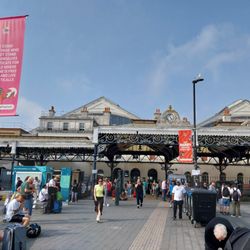
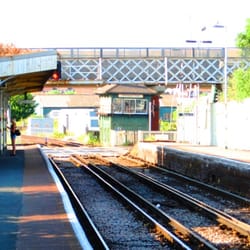
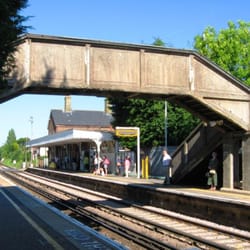
Lewes has one of the best preserved - and attractively restored - stations on the British Railways network. Serving the ancient County town of East Sussex, it is a perfect example of how Victorian buildings can be successfully adapted to modern purposes. The station has a complex history. The first line to Lewes, from Brighton, opened in 1846. Other lines soon followed, making Lewes and important junction: 1846 Lewes - St Leonards (to Hastings 1851) 1847 Lewes - Newhaven (extended to Seaford 1864) 1847 Lewes - Wivelsfield (on the London-Brighton main line) 1858 Lewes - Uckfield 1882 Lewes - East Grinstead The original station at Friar's Walk was a terminus, and trains from Brighton to Hastings had to reverse here until a new station was built closer to the old Priory in 1868. The present station was built in 1888, and sits in the 'V' of the junction between the lines from London and Brighton. The station buildings are constructed in attractive yellow stock brick, with red-brick detailing, all in a domestic Italianate style, with traditional platforms canopies, and an extensive glazed roof. The track junction is immediately East of the platforms, and has an attractive Victorian signalbox. Until 1969 the line to Uckfield diverged north from here, alongside the river. The line to East Grinstead closed in 1958, but has been partially reopened as the preserved 'Bluebell Railway' from Sheffield Park northwards. The line to Uckfield also closed, in 1969, though there is political pressure to reopen it. Nevertheless, Lewes remains an important interchange, with 2.5 million pasengers a year, and a further 350,000 changing trains here. The week-day off-peak service pattern is: London - Eastbourne/Hastings/Ore - hourly London - Eastbourne - hourly Brighton - Eastbourne/Hastings/Ore - hourly Brighton - Eastbourne/Hastings/Ashford - hourly Brighton - Newhaven/Seaford - every 30 minutes Brighton - Lewes (terminates) This provides four trains an hour to Eastbourne, two to London and five to Brighton. Facilities include a newsagents, taxi rank, toilets and baby-changing facilities, public wi-fi access, and cycle-storage with CCTV. The station is fully accessible (step-free access) via ramps and lifts. There is also a large car-park on the north side of the station. read more




8 years ago