Legs Photos


Recommended Reviews - Legs
Start your review...



2 years ago
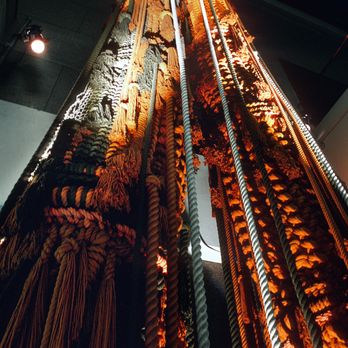
In 1978, artist Barbara Shawcroft installed a massive piece of art on the eastern wall of BART's Montgomery Street Station platform. The vortex of rope and other fabric hung fifty feet from the mezzanine down through the Muni Metro and BART platforms, and it weighed 7,000 pounds. Fittingly for the era, it looked like one of the macramé potted-plant holders you could find by the dozens in most young people's homes. Also fittingly for the late '70s, it was orange and white. The first time I came across Legs, I didn't know what to make of it. By that time (2012 or 2013), all that was left were shades of dark gray and black. I might have been able to see where parts of it were once orange, but all of the white was gone. It was hard for me to believe that Muni or BART or the SFMTA or the City and County of San Francisco had ever commissioned such an ugly, dirty-looking monstrosity to hang silently in a transit station for decades. What was I doing spending time next to this thing? Well, I worked in Berkeley at the time and rode BART to work every morning. As the BART platforms at Civic Center Station and eventually Powell Street Station got seedier and seedier, I started either riding the 21-Hayes bus all the way to Montgomery Street Station or taking the first train that came at Civic Center. If that train wasn't headed in the right East Bay direction, I'd get off at Montgomery Street and head to the end of the platform, where I could score a place in the coveted first car. As I waited here more often, I started really to pay attention to Legs and to wonder at its haggard existence. It was ugly, but in a vaguely satisfying industrial way, like a prop from The Empire Strikes Back. It was definitely disgusting. Decades of hanging in a dirty place probably meant it weighed probably an additional 500 pounds from all the brake dust and other debris it had collected. It was so strange and eerie, though, that it also ensured that no one really got anywhere near it, so it was a safe place for me to wait for my train. When I read that BART was going to go through the trouble and expense of packing it up and shipping it back to Shawcroft, I thought the agency had lost its mind. They were going to spend $300,000 to return a piece of public art to its creator? Shawcroft and BART had argued over the years about the maintenance of Legs. BART was supposed to follow specific instructions to clean it every few years, which they apparently didn't do. Shawcroft was upset about its condition and had rebuffed its return to her many times; she claimed that her original contract with the agency meant it was to remain in the station. In the mid-2010s, BART boxed up Legs and returned it to Shawcroft. Apparently, the artist later repurposed parts of Legs in other smaller pieces. Shawcroft died earlier this decade, and at least one of the people who had bought one of these repurposed pieces from Legs at Shawcroft's estate sale really appreciated the fact that he now owned a piece of art history. I'm sad that I'll never get to stand next to Legs again. It was grisly in many ways, but it also stood as living (dying?) proof of the lack of foresight and planning when it comes to siting public art. Yes, it was dirty, and it smelled bad. But it was also fascinating in its brooding muteness. It actually still swayed gently as trains went by, and while it may have more obviously served a purpose shortly after its installation in 1978, it now just hung there, ignored by most, even if they knew it was there. Art is supposed to be looked at, but what about old, decaying art? That's what was fascinating about Legs: It had an entire second act as a piece of art, but most people ignored it, because they didn't like how it looked--and possibly how it made them feel. In other words, it was an effective piece of art, because it made people think. read more