This village northeast of Verdun in the Meuse is a "non-place", a former community of 422 farmers…read moreand woodsmen that was utterly destroyed during the World War I Battle of Verdun, from February through October, 1916.
The hero of Verdun, Henri Pétain, was a hero in part because he favored artillery over human bodies as a defensive strategy. So for all the frightful casualties of this campaign - 100,000 bodies were later found littering the fields of this sector alone - things might have gone worse for the French poilus, if Pétain had not used artillery to hold the German advance. But the cost was the complete obliteration of nine villages, Fleury-devant-Douaumont among them.
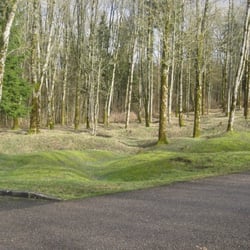
Today, you reach the village by a road through a forest where not one single tree pre-dates the battle. On the right, there is a restricted zone where tank crews train. Where the road peters out, you come upon a moonscape with markers for streets and houses and young trees sprouting out of shellholes. It is a sobering place, to say the least.
After the war, the French Premier Henri Poincaré came through here and thanked the villages of "la Zone rouge" for their sacrifice. When you stand at the junction in this ghost village, Poincaré's gesture rings well-intentioned but a bit pointless.