JULIA TUTTLE STATUE · YELP ASSISTANT
Ask Yelp Assistant
Julia Tuttle Statue Photos


More like Julia Tuttle Statue
Recommended Reviews - Julia Tuttle Statue
Start your review...



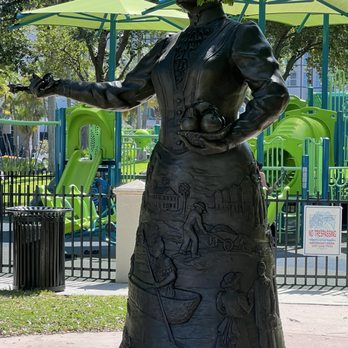
Bayfront Park in downtown Miami is more than just your typical park. It is also a culturally important outdoor museum, with art and monuments that add beauty and historical perspective. One of my favorite statues in the park, next to the children's playground, is that of Julia Tuttle (January 22, 1849 - September 14, 1898), who is known as the Mother of Miami. She was the only woman to have founded a major American city. This statue of her was dedicated on July 28, 2010, on Miami's 114th birthday. Julia Tuttle relocated from Cleveland to Fort Dallas, now known as Miami, in 1891. She arrived as a widow with two children to claim land that had been left to her by her parents as an inheritance. She purchased 640 acres on the north side of the Miami River for her home. Where others saw only swampland and a few orange groves, Julia saw the potential to turn the land into a city, but she knew that a railroad would be necessary for development. Julia Tuttle convinced railroad magnate and industrialist Henry Flagler to extend his railroad to Miami by offering him half of her land, 320 acres on the north bank of the Miami River. This, combined with an additional 100 acres for a hotel and railroad terminal, sealed the deal. Legend has it that Julia sent Henry a bouquet of orange blossoms during the severe winter freeze of 1894-1895 to show that Miami was frost free. While the flowers make for a great story, it was really her business acumen that brought the railroad to South Florida. On April 22, 1896, the Florida East Coast Railway train service came to the area. A few months later, on July 28, male residents voted to incorporate a new city: Miami. Ironically, it was a vote that Julia, as a woman, was not allowed to participate in. Julia was instrumental in establishing early infrastructure, including setting up the town's first laundry, bakery, and dairy. She passed away in 1898 at the young age of 49 from meningitis. She is buried in the City of Miami Cemetery. The project to commemorate Julia Tuttle began in 1996 through the efforts of the Miami Commission on the Status of Women. It took 14 years, along with joint efforts from the Miami-Dade County Commission for Women, to raise the necessary funds. Artists Eugene Daub and Rob Firmin were chosen to create the 10-foot-tall bronze statue. Julia is depicted looking toward the horizon and the future while holding a basket of oranges in one hand and an orange blossom in the other. Her skirt is adorned with symbols of Miami's history, including images of local flora and fauna, the train that connected Miami to Florida, Tuttle shaking Flagler's hand, and the Native Americans and African Americans who were among the area's first settlers. This is a sculpture that requires you to stop for a few minutes and truly look at it to appreciate its full impact. Julia Tuttle was both a savvy businesswoman and a landowner, which was quite a remarkable achievement for a woman of her era. Her vision and foresight left a legacy in Miami that can still be felt today. read more


Come see what Julia Tuttle looked like. We all have a lot to thank her for. who is she though? Julia DeForest Sturtevant Tuttle, A landowner who was key to the development of Miami, Julia Tuttle was born in Cleveland, Ohio. She married in 1871, bore two children, and visited Miami for the first time in 1875. After her husband's death in 1891, she moved there permanently. Tuttle bought a square mile of land at the mouth of the Miami River, more than half of which she donated to induce others to settle there. She convinced rail executive Henry Flagler to extend train service from Palm Beach to Miami by sending him orange blossoms during the great freeze of 1894-95 after the orchards further north had frozen. Known as 'the Mother of Miami,' Julia Tuttle died there at age 50, two years after the railroad arrived. 'It is the dream of my life,' she had written, 'to see this wilderness turned into a prosperous country.' read more