Cancel

    Open app

    Search

    Josephinum

    4.4 (7 reviews)
    Open 10:00 am - 6:00 pm

    Josephinum Photos

    Recommended Reviews - Josephinum

    Your trust is our priority, so businesses can't pay to alter or remove their reviews. Learn more about reviews.
    Yelp app icon
    Browse more easily on the app
    Review Feed Illustration

    16 years ago

    Helpful 0
    Thanks 0
    Love this 0
    Oh no 0

    Josephinum Reviews in Other Languages

    Verify this business for free

    Get access to customer & competitor insights.

    Verify this business

    Kunsthistorisches Museum

    Kunsthistorisches Museum

    4.7(124 reviews)
    1.8 kmInnere Stadt

    This is pretty much the main reason why I went to Vienna. I've been a fan of Pieter Bruegel since…read morehigh school and this museum has the largest collection of his art in the world. I pretty much spent an hour sitting and looking at their exhibition of his paintings. While most of the art here is Renaissance or just after (and mainly Dutch, German, Italian, and French), there's other good stuff as well. If you like Spanish paintings, there's a lot of Diego Velasquez. Many of the exhibits have German and English descriptions of the art, but there are some that just have German, especially the ancient Greek/Roman and Egyptian parts of the museum. Of course, there are exhibits on relics from the Austro-Hungarian empire. The second (or kinda third) floor of the museum does not have much in terms of exhibits but has an extensive coin collection from that former empire. I liked some of the model ships they had to entertain the royalty during their long dinner parties. Knowing that I would go to other museums, I opt-ed for the 7 Museums annual pass for 53 Euros (as of this writing). It's worth it only if you go to at least two other museums. Just going to the Neue Hofburg across the street and the Imperial Treasury further down will equal the price you paid. I went to those, along with going to Kunsthistorisches another time and Imperial Carriage Museum at Schoenbrunn Palace. You also get re-entry privileges in case you wanted to get some food, because the cafe seemed pretty "touristy" here. Note, this pass does not get you into the Sisi Museum (or related ones) There aren't a ton of restrooms at this museum, so plan accordingly. You could probably cover this museum in about 90 minutes.

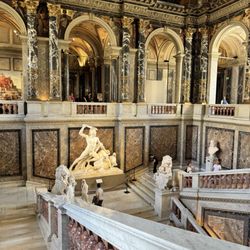
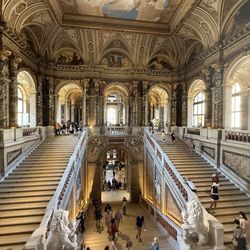
    We visited this museum in the afternoon of the same day when we had visited the Belvedere Museum in…read morethe morning. If I had it to do over again, I think I'd split up the two art museums on different days. This museum is adjacent to the Hofbrug palace. It was designed as a museum originally, and the Hapsburgs spared no expense on the interior decor. I think I bought tickets in advance, but they were not assigned a time (or even a date). It was just 'one entry'. I suppose that is thanks to the museum's interior size - rooms are generally huge so crowding probably isn't much of an issue. You enter from the front stairway and have your ticket checked. As at the Belvedere, you need to check large bags in lockers that cost 2 Euros but which return your coin at the end. The lobby is a circular tower. There is a hole up through several floors. The 2nd level is a cafe and you can take an elevator up to a 3rd level and have interesting views back down to part of the ground floor. The layout of the museum is on 2 floors. Most people ascend to the upper floor first as that is where the more famous works are located. Here you'll find paintings from the 1600s forward. You'll see works by Velazquez, Caravaggio, Vermeer, Rembrandt, and Reubens (among others). The audio guide here had the 'select a number' when you encounter a numbered work you wanted to learn more about. It was worthwhile. The rooms are large and the paintings are spread out enough to allow a good flow. I never felt claustrophobic in here. The main stairway up to this floor is breathtaking as well. The ground floor had Egyptian, Greek, and Roman stuff on one side. This also had the largest collection of Roman jewelry I've seen too (maybe the only large set of it). There was at least one room dedicated to all manner of rings, necklaces, etc.). On the other side / wing of this floor is an odd collection of small statues and other odds and ends from the Hapsburgs. This was my favorite art museum in Vienna. I would definitely recommend a visit.

    Photos
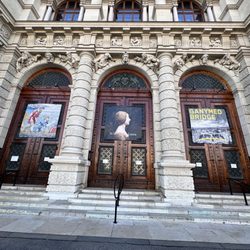
    Kunsthistorisches Museum - Entrance

    Entrance

    Kunsthistorisches Museum
    Kunsthistorisches Museum - Roman busts

    See all

    Roman busts

    Prunksaal der Österreichischen Nationalbibliothek - Stairs up to the library main hall

    Prunksaal der Österreichischen Nationalbibliothek

    4.5(36 reviews)
    1.6 kmInnere Stadt

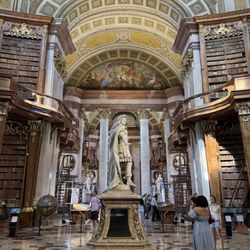
    My jaw dropped when I walked into the Prunksaal (state hall) of the Austrian National Library. Vast…read morevaulted domed ceilings illuminated by sunlight kept the atmosphere open and airy, wall to wall open shelving for books spanned upwards of two stories high. Ceilings blanketed in colorful frescos, marble columns and lacquered wooden cabinets trimmed with gold flourishes, ivory marble statues posed in life-like poses, ground level display cases featured special exhibits, contrasting colors of marble inlaid in patterns cover the floors,...I'm veering into run-on sentence territory and that's how my mind felt as my eyes flitted from one detail to the next.* Begun as an imperial treasure trove which included books and manuscripts of rulers, credit goes to the Duke of Albrecht (1350-95) for directing translations of Latin works into the country's language, and establishing a book illumination workshop at court. The oldest book now owned by the National Library is one from his collection, a Gospel Book written in gold letters and illuminated with bohemian book illustrations The current form of the building in Josefsplatz was initiated by Emperor Charles VI in 1722, and built by Joseph Emanuel Fischer von Erlach, following his father's designs, between 1723 and 1726, during the Baroque era, with interior and fresco decorations completed post 1730 or so. The Prunksaal is the main attraction though it's note when purchasing tickets that there are multiple museums in the same building of the Hofburg palace complex. These each have slightly different opening hours so best to check exactly when you plan to be there, as not all 4 may be open at the same time. Free for children under 19. - State Hall €11 for adults - Literature Museum €9 for adults - Papyrus Museum €6 for adults - Globe & Esperanto Museum €6 for adults My recommendation if you're in Vienna as a tourist and are interested in visiting multiple museums and/or attractions, is to do some research and purchase tickets via one of many bundled passes. If you are interested in all the museum above you can buy a single ticket on the library website for €21, valid for 7 days. There are also various museum and city passes which include admission here. Recommend about 30-40 minutes at the state hall (really just to stare at everything) and other museums are smaller. For more info: https://www.onb.ac.at/en/ https://www.onb.ac.at/en/opening-hours *It's funny because as much as I was uber impressed by this library, I only managed to take some very boring straight-on photos of the hall and ceilings, I think I was so intimidated by all the details I kept trying to capture them all in wider angle shots!

    My friend and I visited the Prunksaal (State Hall) of the Austrian National Library when we were in…read moreVienna a week or so ago. It was beautiful, and I'm glad we included a visit to the State Hall on our Vienna itinerary. (FYI: There are several ticket options at the National Library - some that include access to museums - and a guided tour option as well. We chose the ticket that only allows access/entry to the State Hall.) The Austrian National Library is the largest library in Austria, with more than 12 million items in its collections. The library is a part of the Hofburg complex in Vienna, and its buildings date back to the 18th century. The State Hall is the library's central structure. Its filled with books (obviously), sculptures, statues of emperors, and frescos. It's really beautiful; I took tons of photographs. When we visited, the State Hall was also hosting a photography exhibit: "A Century in Pictures: Austria 1925-2025," which was incredible. My friend and I are pretty dedicated bibliophiles, so bookstores and libraries are our jam. We try to visit bookstores and libraries when possible on travels. But I think almost anyone visiting Vienna would enjoy a visit to this library: the architecture, the high ceilings, the art, the wood, the books... it's an incredibly beautiful space, with so much history, too.

    Photos
    Prunksaal der Österreichischen Nationalbibliothek - Statue of Emperor Charles VI stands in the middle of the hall

    Statue of Emperor Charles VI stands in the middle of the hall

    Prunksaal der Österreichischen Nationalbibliothek - Stairs up to the library main hall - a lot of people

    Stairs up to the library main hall - a lot of people

    Prunksaal der Österreichischen Nationalbibliothek - One more pic from the front

    See all

    One more pic from the front

    Schatzkammer - Tapestries and more clothing
    Schatzkammer

    4.5(32 reviews)
    1.6 kmInnere Stadt

    I don't know I'd go out-of-my-way for this museum, unless you're really interested in the subject…read morematter, but it was a very nice spot to see artifacts and bling from the Holy Roman Empire and until the Austro-Hungarian empire. I thought the crowns and the various ceremony attire displayed were the most interesting of the items. The museum also contains several religious relics as well. I had the multi-museum pass, so that was the main reason why I came. While I thought this was an interesting visit, if you're pressed for time, you can skip this one.

    There are several different museums within the Hofburg complex, all of which are close to each…read moreother but require separate admissions. This was one of them. It seemed like it might be interesting, and online photos play up the 'crown jewels' type aspects. I bought tickets online. This was not one where you had a timed entry, so it had some flexibility. I don't recall if they required you to check backpacks, as we left ours at the hotel that day due to another associated museum's prohibition on them. My verdict on this was that it was not as interesting as I'd hoped. Their breakdown is roughly: 20% crowns, swords, and jewels. 25% religious items like reliquaries. 50% robes (coronation, etc.). 5% miscellaneous. By far, the most common thing you'll see are robes / clothes. They did have a good audio guide (for a nominal extra charge). But if I'd known exactly what to expect, I don't think I'd have come here. It depends on what you are personally interested in, of course. However, given that most trips have a limited time budget, I think I'd have spent that time at some other museum / attraction instead. We spent about an hour touring the whole place, which was not small.

    Photos
    Schatzkammer - In diesem eher unscheinbaren Schrank befinden sich Schlüssel zu den Särgen in der Kapuzinergruft

    In diesem eher unscheinbaren Schrank befinden sich Schlüssel zu den Särgen in der Kapuzinergruft

    Schatzkammer - Ceremonial church garments

    Ceremonial church garments

    Schatzkammer - Back train

    See all

    Back train

    MAK

    MAK

    4.4(26 reviews)
    2.2 kmInnere Stadt

    MAK is an excellent Museum of Applied Arts. They do an excellent job getting guest curators and…read moreartists to engage with the collection in inventive and dynamic ways to highlight various items & how they relate to each other. This makes the collection come alive, and it becomes much more interesting to experience, compared to the standard, more static, approach I see in many museums. One highlight was the stunning 1907 gesso panels, Seven Princesses by Margaret Macdonald Mackintosh. You need to see it in person to appreciate its subtle beauty and impressive scope. Apparently, the Seven Princesses only survived WW1 because a curator hid the piece to keep it safe. The curator brought it down to the museum's basement, put the panels into three crates along the wall, then built a brick wall in front of them, which was painted to match the existing walls. They stayed hidden like this until they were discovered in 1990. Another highlight was an installation from Superflux called Invocation for Hope, which featured hundreds of dead trees burned from a forest fire that were installed around some live plants & moss around a 'pool'. When I visited, they also had a lot of environment & sustainability related projects on display -- there were some really interesting projects there. The building itself also has lovely architectural features.

    I happened to go to MAK on free night which is Tuesday from 6 PM to 10 PM so I had a really good…read moretime. Does it compare to the Victoria & Albert in London, NO.... but then again what does. Also this museum building has a lot of space, a lot of space that they don't really utilize very well. There could be a whole lot more on display. But anyway my favorite part was the permanent collection which is on the top floor, lots of decorative items from around 1890 into 1940's.
    Photos
    MAK - Reise nach Jerusalem?

    Reise nach Jerusalem?

    MAK
    MAK

    See all

    Josephinum - museums - Updated May 2026

    Loading...
    Loading...
    Loading...