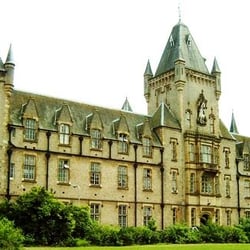
Tucked away at the far north of Wandsworth Common, behind the Fitzhugh housing estate, is one of…read moreSouth London's most remarkable buildings: on the scale - and in the style - of a baronial castle, it has variously been a school, hospital, interrogation centre and a college, and was nearly pulled down. It is now a Grade II-star Listed Building.
History
The building was paid for by the Royal Victoria Patriotic Fund, established to provide for the widows and orphans of soldiers killed in the Crimean War. The building was intended as a girls' school and opened in 1859. A boys' school was built to the rear in 1872. The original building - designed by Rhode Hawkins - incorporated a number of innovative building techniques, that nearly caused its later downfall.
Life for the orphans was extraordinarily hard: from pumping water to the roof cisterns to having their heads shaved to counter lice, they were assembled to be hosed down with cold water every morning in the courtyard. Scandals which involved physical and sexual abuse by staff - and the death of an orphan - nearly resulted in the institution being closed down. The innovative heating system didn't work, so conventional fireplaces were provided for the staff - but not the orphans.
Things had improved somewhat by the First World War (for example, central heating had been installed), when it was used as a hospital for injured troops, who arrived at a specially-built temporary railway station close by. After the end of hostilities, it resumed life as a girls' school under 1939.
During World War II, it became the London Reception Centre, used by MI5 to process non-British aliens entering the country. After the war it became a teacher training college, and then a comprehensive school, before the decaying fabric - many problems arising as a result of the techniques used to build it - forced them out.
The building was sold and gradually restored by its present owners, who had to endure, among other things, a fire in the Great Hall just before it was handed over. Building works took 7 years.
The building now contains flats, studios and workshops for businesses in the creative industries, a drama school and a wine bar.
The building
The main building is built in a Scottish Baronial Gothic style, with Gothic, Jacobean and French elements, in yellow brick with stone dressings. The main façade has an imposing central tower, with matching smaller corner towers.
The plan includes two central courtyards, a separate Chapel and various outbuildings, but the main feature is the huge Great Hall, with a hammer-beam ceiling decorated with the coats of arms of towns across Britain and the Empire which contributed to the original funds.
The whole edifice really is an astonishing sight, especially as it has now been surrounded on the north side by comfortable suburban housing.
Practicalities
There is pedestrian access from Fitzhugh Grove, but vehicular access is via Windmill Lane and John Archer Way.
Unless you are visiting a business or a resident in the one of the flats, the only public access inside is to the wine bar (the restaurant in the cafe recently closed down).