Cancel

Open app

Search

Queen Charlotte's Cottage

4.5 (2 reviews)

Queen Charlotte's Cottage Photos

Recommended Reviews - Queen Charlotte's Cottage

Your trust is our priority, so businesses can't pay to alter or remove their reviews. Learn more about reviews.
Yelp app icon
Browse more easily on the app
Review Feed Illustration
Photo of Josy A.
341
810
2473

10 years ago

Helpful 1
Thanks 0
Love this 3
Oh no 0

18 years ago

Helpful 0
Thanks 0
Love this 0
Oh no 0

Verify this business for free

People searched for Landmarks & Historical Buildings 106 times last month within 5 miles of this business.

Verify this business

Kew Palace

Kew Palace

4.0(3 reviews)
1.1 mi•Kew

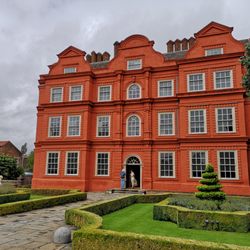
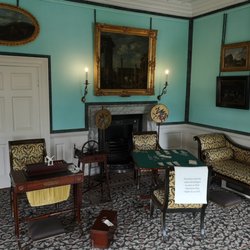
Kew Palace (on the grounds of Kew Gardens) was once a much larger complex, but most parts were…read moredemolished by various English kings as time went by - the only part left now is "Dutch House" with its striking red facade. It is open to the public, but only accessible if you buy a ticket for whole Kew Gardens, and that ain't cheap: almost €20. But since the gardens are spectacular and will occupy you for hours on end, it's totally worth it. Dutch House is smaller than it looks from the outside, most rooms are quite tiny. Some are fully decorated with vintage furniture, but compared to other, bigger palaces around the country, this one comes off as quite modest (see pictures). Dutch House is more like a "summer hideout". A visit should take you no longer than 30-40 minutes. A charming volunteer (well, it was on my visit) will greet you at the entrance and provide basic instructions on how to explore the house. When it's raining, umbrellas must be left at the entrance or be put into your bag. As you work your way from room to room, floor to floor, you will get a good impression of how employers and servants lived and worked in the 17th and 18th century. It is informative without being spectacular. But Dutch House is surely one of the major sights within Kew Gardens (along with the larger greenhouses and the pagoda), so don't miss it during your visit.

A small palace built in the grounds of Kew gardens by a well known family (can't remember who it…read morewas!). It's an extra fiver to enter on top of the enterance fee to enter the gardens. The palace is small buts it's a fine example of a country house. Do look out for the attic bedrooms where the plasterwork has been removed to expose the skeleton of the building. There are also samples of fine artwork and furnishings. To save money consider purchasing a season ticket via the Www.hrp.org.uk which gives you unlimited access to Kew palace, kensington palace, the tower of London, Hampton court and banqueting hall for just £39 for single membership. A good deal considering the tower of London alone costs around £17 to enter.

Photos
Kew Palace
Kew Palace
Kew Palace

See all

Chiswick House & Gardens - Chiswick House & Gardens interior

Chiswick House & Gardens

4.2(18 reviews)
2.1 mi•Chiswick

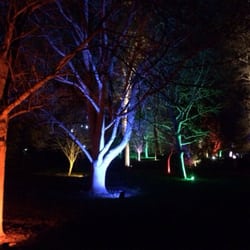
The Chiswick House & Gardens is a beautiful little garden in west London that many people don't…read moreknow about. I have been here during the fall when it is completely quiet, and during their magical lantern festival at night when it is packed with crowds. The grounds are well kept, and the lanterns are most amazing. The lanterns along the little lake are especially stunning thanks to the water reflection, but it's also extremely cold thanks to the water. There are three "rest stops": the cafe upon entrance, the marshmallow roasting station in the middle of the tour (but no warming huts which is desperately needed as it's humid and bone chilling in London), and a small fair ground at the end of the tour with hot food, hot drink, and a ferries wheels. The only problem is that it is so freezing cold, and their inadequate toilets especially for women created a huge problem: long queues, chilling cold temperature inside the loos, and generally uncomfortable dirty conditions. It is to be expected with any festivals but still the organizers could have done a better job at regular cleaning and providing directions.

We just headed here this weekend for the Magical Lantern Festival. Hence my rating and review is of…read morethe festival. However, we did see some gorgeous marble statues and the gardens (what we could see of them in the dark) and Historic House, looked like this place definitely merits another visit. The Magical Lanterns are stunning. After the London Lumiere festival, I was a bit skeptical of what would be on offer. But I was blown away by the displays. Budget 2 hours for the walk itself, especially if you are visiting on a night with crowds. We picked up hot coffees and churros at the entry. Feasted on hot chocolate and hot toddy from Beltane and Pop and roasted marshmallows on the firepit at the midway stop. And there was a good selection of meals at the exit point with a covered marquee to enjoy it in. We however decided that we wanted a proper sit down restaurant that was well warmed for dinner and hence walked across to Chiswick high street for a meal. Do note, that these are all pop ups and food trucks - I assume they are only here during the festival. They do have a permanent coffee shop on the premises that was open. But the number of wailing children on this occasion, kept us away.

Photos
Chiswick House & Gardens - Chiswick House & Gardens interior

Chiswick House & Gardens interior

Chiswick House & Gardens - Chiswick House & Gardens interior

Chiswick House & Gardens interior

Chiswick House & Gardens - Chiswick House & Gardens

See all

Chiswick House & Gardens

Sir Richard Burtons Bedouin Tomb - Burtons Tomb

Sir Richard Burtons Bedouin Tomb

4.0(1 review)
0.9 mi•Richmond Upon Thames

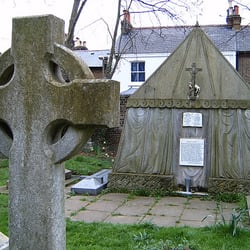
St Mary Magdalen's RC Church, 61 Worple Way, Mortlake…read more When eccentric explorer Sir Richard Burton died in 1890, Isabel (his wife) built this splendid Bedouin-style mausoleum and paid for the stained glass Memorial Window in the church. Richard Burton lived from 1821-1890, at a time in history when exploration and scientific knowledge were advancing rapidly. Explorer, writer, soldier, hypnotist, ethnologist who spoke 30 different languages and travelled round the world. Burton possessed a passionate curiosity about life in the little known Arab world and he persuaded the Royal Geographical Society in London to fund a series of adventures. He was a brilliant linguist, utterly fearless and a master of disguise, and so was able to penetrate the cities of Medina and Mecca. He secretly drew plans of the Great Mosque and its sacred inner shrine, the Kaaba, at Mecca. I own a, rather distressed, 3 volume translation, of The Arabian Nights, of his. Inspired by his part as an Arab pilgrim he then went to Harar, which was totally forbidden to non-Moslems, and made notes about the East African slave trade. His notebooks were crammed with information, geographical, commercial and anthropological. His travel books were a literary success in London and the Royal Geographical Society agreed to fund the next expedition - to find the source of the White Nile. He set of with John Hanning Speke but the two explorers fell out at Lake Tanganyika. Being the British Consul in Fernando Po, West Africa, Santos, Brazil, Damascus and Trieste gave him time to explore and write. He married his Catholic wife, Isabel Arundell, in 1861. She was completely devoted to him, and tried to keep up with his rackety life, obeying his instructions to pay, pack and follow, as he moved around the world. The Burtons were happy in Damascus, where they mixed easily with Arabs and Christians, but were eventually expelled for their over-enthusiastic involvement in local politics. His last Consulate was at Trieste, where he spent his last years quietly with Isabel. It was at this time that he privately published his translations from Arabic of the Karma Sutra and The Arabian Nights. He published 27 books in his lifetime. There is a ladder at the rear of the tomb which ascends so you can see the coffins inside and a collection of urns and Middle-Eastern lamps. The Thames Valley Times described in its edition of 17th June: It is a reproduction in stone of the semblance of an Arab tent. It stands on a bed of concrete, and above that a square of rough-hewn York-stone some 12ft. by 11ft. The tent itself, sloping inwards a few degrees on all sides, is composed of Forest of Dean stone. Throughout, the slabs are carved to represent the natural irregularities of surface of a tent, and the joinings are made neatly at the places where ropes are represented as binding the whole to the ground. The design would not allow tent-pegs being introduced, but otherwise the appearance of a tent is well maintained. The door, also a solid slab of stone, is carved to represent a drop-curtain, and moves on flanges of gun-metal. From the top of the elevation other slabs of stone form a roof which meets at an apex above which is a gilt Star of Bethlehem. Below, but at the top of the front elevation, is a well-executed crucifix, in white marble with I.N.R.I. at the head, and the crown of thorns at the foot. From the foot of the cross extend on each of the sides a row of gilt crescents. As originally designed the crescents would have been above cross and below the star, but the Catholic hierarchy placed a veto upon a Christian emblem occupying a sub-ordinate relation to the most important of the Moslem insignia. It must be added also that from the standpoint of artistic effort the crescents look striking here as they could be made to do elsewhere. On the upper part of the stone door is a carved marble Book of Life giving Burtons details. The mausoleum is lighted from the back by a small, wire-protected, stained glass window, with the single figure of a dove descending with outspread wings. Within, the Oriental style of the fabric is maintained by a number of beautiful lamps, brought over by Lady Burton from Trieste, suspended from the ceiling and shed a dim religious light through jewel-shaped facets of coloured glass each no bigger than the Koh-i-Noor diamond. Two Eastern lamps were also on the marble altar at the end, opposite the entrance door, the pillars being finely-moulded bronze serpents. and the shape, together with the suspended lamps. That of one side of a pair of small beam scales. Huge candles of graduated heights, in massive silver sticks, were also here for the occasion. On a three-cornered marble shelf at the right-had side was a curiously wrought vessel, with iron frame, to contain the holy water. The floor is of white Carrara marble, beautifully veined, and on each side are marble bearers about 6 inches high, for the coffins of

Photos
Sir Richard Burtons Bedouin Tomb
Sir Richard Burtons Bedouin Tomb - Great and eccentric explorer Sir Richard Burton

See all

Great and eccentric explorer Sir Richard Burton

Queen Charlotte's Cottage - landmarks - Updated May 2026

Loading...
Loading...
Loading...