Well, I'm bound to give my Alma mater a five star rating, as I had such a great time here (so much…read moreso, I ended up doing two degrees).
But, on a more serious note, it is one of the UK's leading academic institutions - one of the original 'red brick' Universities, it has been ranked 5th overall for research excellence in the UK. It has around 18,000 undergraduate and 11,000 postgraduate students, and one of the UK's most impressive University campuses, being one of the earliest to adopt this model of urban design.
Its history can be traced back to 1825 with the founding of Birmingham Medical College, and the establishment of the Mason Science College in the City Centre 1875. But it was not until 1900 that, with the driving force of Joseph Chamberlain, the University was awarded its charter - arguably the first of the so-called 'red brick' Universities to be formally recognised as such.
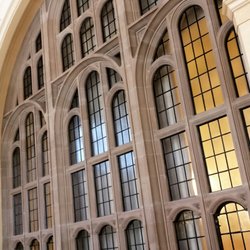
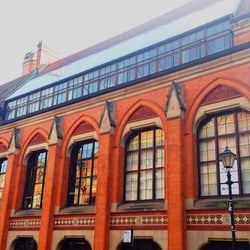
For the new University, a new site was chosen in the suburb of Selly Oak, three miles south of the city centre, to build a campus on the American model, of buildings built in a parkland environment. The original buildings at its heart really are made of blood-red brick: they include the main Aston Webb building, with its impressive main hall and domed entrance hall in the neo-Byzantine style.
But its most distinctive and well-known feature is the 100m (330ft) tall clock tower, modelled on that of the town hall in Siena, and named 'Joe' in honour of Joseph Chamberlain. (Useless facts: Joe is the tallest free-standing clock tower in the world. The University's own website calls the tower 'Old Joe' but I never heard anyone use this in over 7 years)
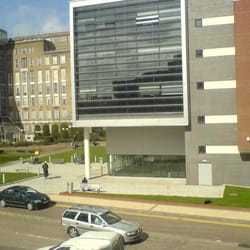
Subsequent expansion - especially in the 1960s - has brought a greater diversity of architectural styles, notably the brutalist Muirhead tower, completed in 1969. There are impressive sports facilities, and the University is regularly in the top five at Inter-varsity sporting events.
The campus itself is in two main halves, with the main halls of residence and student village on the Vale site a mile to the north. Land has been donated over the years by a number of local worthies, including Lord Calthorpe and the Cadbury family. In 1999, the various colleges of the Selly Oak campus (two miles further south) were integrated into the University, including the Westhill College of Education which was formally merged with it in 2001.
The University has a long list of achievements to its name: it was the first to accept students on an equal basis from all religious backgrounds; its school of Commerce in 1902 was the UK's first (it is now the Business School); in 1937, vitamin C was synthesised by Professor Norman Haworth, who won the Nobel Prize for Chemistry (one of several Nobel Prize laureates); and in 1940 the first microwave device was built here, heralding both the development of radar and microwave ovens! Sir Edward Elgar was professor of music in the early 1900s, and the University boasts a long list of impressive alumni. And so on
Practicalities
Access to the University is easy, thanks to it having its own station on the Cross-city railway line, between the main campus and the medical school at the Queen Elizabeth hospital. There are frequent buses on the A38 Bristol Road just to the south of the campus, and extensive car parking, although this has been restricted in recent years.
The University's motto is 'Per adua ad alta' - 'Through hard work, great things are achieved' (literally, 'through work to the heights').