Cancel

    Open app

    Search

    Grottes de Saint Antoine

    5.0 (3 reviews)

    Grottes de Saint Antoine Photos

    Grottes de Saint Antoine Reviews in Other Languages

    Verify this business for free

    Get access to customer & competitor insights.

    Verify this business

    Cathedrale saint Etienne

    Cathedrale saint Etienne

    4.8(6 reviews)
    78.7 km

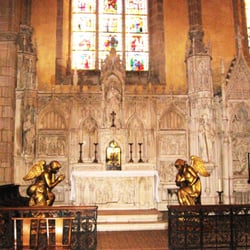
    Limoges' cathedral is an imposing edifice, dominating the top of the hill on which it sits and…read moresurrounded by the remains of the ancient cathedral town. It is a beautiful Decorated Gothic structure, the exterior a mass of flying buttresses and gargoyles. Unusually, Limoges had two old centres, one around the castle (now the main centre) and the one around the cathedral. Sacked by the Black Prince in 1370 during the 100 Years' War, the cathedral town never recovered economically, and only in the last 30 years have efforts to reinvigorate it paid off. The area now has some quirky shops and a handful of bars and restaurants. The cathedral itself, although apparently stylistically uniform, has actually been built over 600 years. Begun in 1273 on the base of its Romanesque predecessor, the oldest part of the cathedral is the choir, with its ambulatory and the north transept chapel. This was originally attached to the older Romanesque nave. Work stopped in 1327 owing to a shortage of funds, and did not restart until 1378, when part of the north transept and the chapel of St Martial were begun, and the original belltower augmented with the Gothic work that we see today. The southern transept was completed shortly after. Work stopped again for most of the 100 Years' War, after which the first two spans of the nave were built between 1458 and 1499. In the early 16th century the north transept was extended with the addition of the portal of St John, but it was not until the 19th century that the final three bays of the nave were completed and the church reconnected to its tower. The tower and the portal of St John on the north transept are the most impressive external features, the latter a wonderfully flamboyant piece of late Gothic composition. The interior is best entered via the entrance under the west tower, where you pass a series of late mediaeval memorial slabs. The impressive Renassiance rood screen has been moved to the west end, and is easy to miss as you walk through it (remember to turn around as you enter). The nave and choir then form an uninterrupted space in front of you, impressive thanks to the sheer height of the nave vault, nearly 80ft high. Alas, history has not been kind to its furnishings, which are limited to some wall paintings of angels in the radiating chapels behind the chancel, small fragments of 15th century stained glass, and two Bishops' tombs; one from the late mediaeval period, and the Renaissance tomb of Bishop Jean de Langeac. Most of the remainder of the extentive wall decoration and stained glass dates from the 19th century. Practicalities The church is open for visitors from 14:30 each day, until 18:00.

    Very beautiful cathedral dedicated to St Etienne (St Stephen)…read more Surrounded by a beautiful park and a cute medieval neighborhood. To be visited and thoroughly enjoyed!

    Photos
    Cathedrale saint Etienne
    Cathedrale saint Etienne
    Cathedrale saint Etienne

    See all

    Cité Médiévale de Sarlat

    Cité Médiévale de Sarlat

    4.9(8 reviews)
    37.5 km

    The City of Sarlat is one of the most endearing, charming, historic, and magical places I have ever…read morevisited. The amount of history surrounding this entire area of Southwest France is unparalleled to begin with, and Sarlat-la-Caneda contributes a very large portion to this magical setting. It is a medieval town that was established mainly due to the Benedictine abbey of Carolingian origin. The Sarlat Cathedral is dedicated to Saint Sacerdos, and the building itself can be seen in records as early as 1081. It was one of the very few cathedrals in the region that was never raided by the Vikings!!!! Those rascals!! Thank God, because if it were destroyed and leveled to the ground, we would not be able to visit and understand how profound this divine place actually is today and how well the efforts to preserve it have been accomplished. The Malraux Law was passed in 1962, which saw Sarlat restored, and this effort saved many buildings from demolition. The architect of this law, Andrea Malraux, was, at the time, the French Cultural Minister. This legal act greatly enhanced Sarlat's medieval center through the extensive restoration of most of its houses. My favorite (as mentioned in one of my earlier reviews) was the Manoir de Gisson, a museum that you should not miss when visiting! Some of my most favorite highlights during my visit were, of course, the food, the winding, cobblestone roads, the art galleries, and the nightlife, where visitors can enjoy an aperitif at a cozy, outdoor cafe' before venturing out to enjoy the tantalizing cuisine of this city! From foie gras, black truffles, cepes, dried sausages, cheese, walnuts, and wine, this girl was golden and I had everything that needed or could ever want! There is a great little grocery mart, tons of places to find delicious food and lot's of curiosities. There are candy shops, cafes, and desert spots galore!, And one cannot leave without visiting the farmer's markets, which are huge and packed full of the most amazing produce, delectables, and gifts. They have markets two times a week and they are a must see! I even ventured out to discover a wonderful art store and since I happen to be a painter, I could not pass up the 1.5 mile walk to scope out some French art supplies and I even got to pop into an incredibly curated antique shop as well! I could go on and on about this magical place, but I am going to leave it to you to book your ticket and see for yourself. My only hope is that my photos tell it's story and make you want to book your next trip to France!

    Sarlat is a beautiful village, and if you planned to stay here, stay in one of the Bed & Breakfast…read more(mentioned in my previous review). But stay for the Market Day on Saturday. Market Day is fabulous! You'll see stuff not sold anywhere, and you'll see various foods not cooked anywhere else (unless you're in Spain), so get ready for lunch and have some Paella! There's no warnings for pickpockets, here! They're friendly people! Go early, before it gets too hot, & too crowded, and while the dish is fresh! BTW: Our Tour Guide told us, French Costumer Service, they ignore their customers, they don't pressure you to buy, sometimes they don't even greet you. That's their style! I'm in Customer Service, but I always talk to my customers. If I was ignored, I just assumed, the seller don't care about me! But not in France.

    Photos
    Cité Médiévale de Sarlat
    Cité Médiévale de Sarlat
    Cité Médiévale de Sarlat

    See all

    Eglise Saint Michel des Lions

    Eglise Saint Michel des Lions

    4.0(3 reviews)
    79.1 km

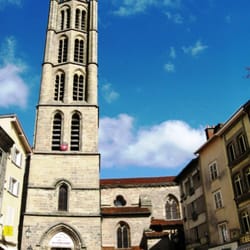
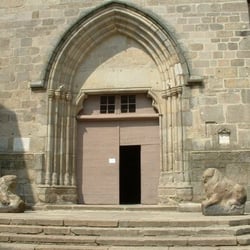
    The church of St Michel is one of Limoges' most interesting historical sights, located in the old…read morepart of the town, close to the site of the old castle (near Place Motte). The church was built largely in the 14th and 15th centuries in the Late Gothic style, and contains the relics of St Martial, who brought Christianity to the Limousin area in the 3rd century, and those of St Loup. From the outside, much of the church is obscured by adjacent buildings, and the best vantage point is Place St Michel, from where the tower and steeple - surmounted by a golden ball - can best be appreciated. The tower was begun in 1383 and is just under 200ft high. The portal onto the square is flanked by two stone lions, from which the church derives its informal name of St Michel des Lions. Inside, the space is a good example of a hall church, with a nave flanked by aisles of the same height, with chapels opening from each bay of the aisles. The slender, elegant clustered columns of the arcade lean at some alarming angles, but recent restoration work has provided additional (hidden) support to the vaults. The chancel space is simply the end of the nave and aisles, and has an impressive 19th century carved reredos, the central part of which (behind the altar) holds the brass casket (1809) containing St Martial's relics. These were brought here after the destruction of the nearby Abbey of St Martial in 1790. There are altars either side which, while technically separate chapels, actually form one continuous piece of sculpture. Of greatest interest are the two east windows to the north and south of the central window, which both contain 15th century stained glass: that above the altar of St Loup depicts the Virgin and child, surrounded by medallions of the life of the Virgin. That above the altar of St Valerie depicts St John the Baptist, again surrounded by medallions depciting his life. The rest of the church is also filled with stained glass, mostly from the 19th century and of varying quality, although there is no denying the dramatic overall effect. Other furnishings include the familiar 18th and 19th century baroque altarpieces in the chapels, some 16th and 17th century statuary and 19th and 20th century enamels.

    From the owner: Deux lions de granit montent la garde Eglise de style gothique construite du XIVème au XVIème…read moresiècle. Elle doit son nom aux deux statues de lions qui veillent à ses pieds. Le clocher est surmonté d'une boule creuse anti-foudre. A l'intérieur un autel abrite la châsse de Saint-Martial, le saint-patron de la ville.

    Photos
    Eglise Saint Michel des Lions
    Eglise Saint Michel des Lions
    Eglise Saint Michel des Lions

    See all

    Grottes de Saint Antoine - churches - Updated May 2026

    Loading...
    Loading...
    Loading...