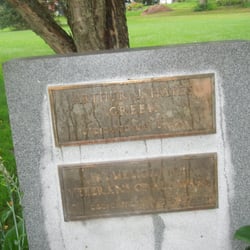
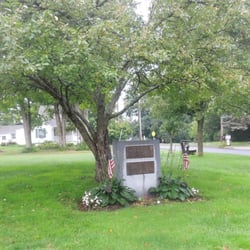
1. Granby Civil War Monument

0

Granby, CT

Cancel

Open app

Search

Granby Civil War Monument

4.0 (3 reviews)

Granby Civil War Monument Photos

More like Granby Civil War Monument

Recommended Reviews - Granby Civil War Monument

Your trust is our priority, so businesses can't pay to alter or remove their reviews. Learn more about reviews.
Yelp app icon
Browse more easily on the app
Review Feed Illustration
Photo of Bruce K.
2442
26535
79377

4 years ago

Helpful 11
Thanks 0
Love this 8
Oh no 0

13 years ago

Helpful 9
Thanks 0
Love this 8
Oh no 0
Photo of Tony M.
161
806
1713

12 years ago

Helpful 3
Thanks 0
Love this 1
Oh no 0

Verify this business for free

Get access to customer & competitor insights.

Verify this business

Granby Historical Marker

Granby Historical Marker

3.0(1 review)
0.5 mi

This is a two-sided historical marker on Route 10 North, on the property of the Salmon Brook…read moreHistorical Society. It was erected by the Town of Granby, the Salmon Brook Historical Society, and the Connecticut Historical Commission in 1980. The marker gives an overview of Granby's history in a very wide ranging narrative stretching from colonial times through the Viet Nam war. It has so much content on it, that it is engraved on both sides. It reads: "Side One Settled as the Salmon Brook section of Simsbury early in the 18th century, and established as a separate ecclesiastical society in 1736, Granby became a separate town in 1786. From the beginning, farming was the main endeavor of the populace: first subsistence farming, then raising fruits of the orchard, tobacco growing, and diary farming until agriculture waned in the 1950's. Industry, producing shoes, horse-drawn carriages, wool cards, and forest products, developed along streams where water tumbled over the rock ledges common to Granby terrain. On July 4, 1825, in Granby at the Connecticut-Massachusetts border, Connecticut's Governor Wolcott commenced construction of the Farmington Canal (1825-1849) by turning the first spadeful of earth. Settled by emigrants from Windsor, Granby, like Simsbury, was the 18th century frontier for the mother town against Indians and the French allies. Side Two One early citizen, Daniel Hayes, was kidnapped by local Indians and taken to Canada, whence he escaped to return home to live nearly a half century longer. Granby sons and daughters in the 20th century have gone on to become prominent attorneys, president of a major life insurance company, Chief Justice of the Connecticut Supreme Court and Librarian of the State of Connecticut. Ours sons have fought and some of them have died in each of the country's wars from the Indian conflicts of the 17th and 18th centuries to Vietnam. In the Civil War, volunteers from Granby included free blacks fighting for the freedom of their southern brothers. Many of Granby's young men were among those in the Connecticut 16th Militia Regiment who suffered and died in the infamous Confederate prison stockade at Andersonville, Georgia. Granby citizens participated in the westward movement of the 19th century, founding the town of Worthington, Ohio, now a suburb of Columbus. The plaque is in great condition, with crisp sharp white lettering on a blue background.

Photos
Granby Historical Marker - (Side 2)

(Side 2)

Granby Historical Marker - Side One

Side One

Granby Historical Marker

See all

Old New-Gate Prison & Copper Mine

Old New-Gate Prison & Copper Mine

5.0(13 reviews)
2.3 mi

"Light Into The Dungeon" is a unique Halloween experience that is hosted at the Old New-Gate Prison…read more& Copper Mine in East Granby, Connecticut. The historic property opened as a colonial copper mine in 1707. It is recognized as the oldest officially chartered copper mine in North America. The mine was largely unprofitable throughout its existence. It remained active until the 1750s when most colonial mining began to cease. The Colony of Connecticut purchased the property in 1773 and converted it into a prison. The prison had only one point of entry and exit: a forty-foot ladder down into the mine from the guardhouse. Prisoners were provided with musty straw to sleep on. More above-ground facilities were built in the early 1800s to keep up with the influx of new prisoners. While the prison was active, imprisoned individuals included local prisoners, counterfeiters, enslaved people, political prisoners of war, and even women. The number of inmates peaked at 127 in 1821. Old New-Gate was shut down in 1827 due to unprofitability, frequent escapes, and inhumane living conditions. Since 1968, the property has been under the ownership and direction of the State of Connecticut. From late September through Halloween, the old copper mine at Old New-Gate is illuminated by jack o'lanterns. Operating on Fridays through Sundays, visitors can descend 75 feet underground and explore a 100-yard loop that is adorned with 400 professionally carved jack o'lanterns. My family and I visited this past weekend and we had such a fun time seeing all of the cleverly carved pumpkins. We especially liked how calm it was compared to other New England jack o'lantern attractions that get to be quite crowded and expensive. We also recommend sticking around afterwards to explore the property and learn about its truly unique history. The remaining "Light Into The Dungeon" dates are sold out for the 2026 season, but we highly recommend planning a trip for a future Halloween season!

What a dark, damp, cool, and creepy place…read more In the 1700s, it started as a copper mine then transitioned to a prison; it closed in 1827. Kids 5 and under are free adults are $10 a person. This includes a 30 minute guided tour in the mine. There were ample parking; we went on a Saturday and it wasn't too busy. The grounds were interesting to walk around and look at the ruins. The mine was also intriguing. It was dark, damp, and 52 degrees. There were caverns throughout. The water was dripping on our heads and the floor was damp and some spots had puddles. I would recommend sneakers/boots not sandals since mine got a little damp. It was pretty cool seeing the green copper lines too. Overall, a historic spot worth a visit!
Photos
Old New-Gate Prison & Copper Mine

See all

East Granby Historical Marker - East Granby Historical Marker

East Granby Historical Marker

3.0(2 reviews)
3.1 mi

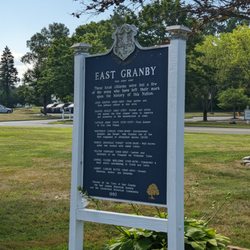
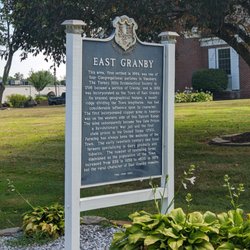
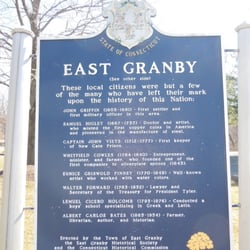
This two sided marker has quite a lot of information on it about the town of East Granby which is…read morein north Connecticut against the Massachusetts border. The town is named for John Manners, the Marquess of Granby (1721-1770). East Granby was initially settled by Europeans in 16644 and includes the first incorporated copper mine in America which later became the Old Newgate Prison. On the front, "This area, first settled in 1664, was one of four Congregational parishes in Simsbury. The Turkey Hills Ecclesiastical Society in 1786 became a section of Granby, and in 1858 was incorporated as the Town of East Granby. An unusual geographical feature, a basalt ridge dividing the Town lengthwise, has had considerable influence upon its character. The first incorporated copper mine in America was on the western side of this Talcott Range. The mine subsequently became New Gate Prison, a Revolutionary War jail and the first prison in the United States (1790). Farming has always been the mainstay of the Town. The early twentieth century saw local farmers specializing in dairy products and tobacco. The number of operating farms diminished as the population of the Town increased from 838 in 1858 to 4600 in 1979 but the rural character of East Granby remains." And on the reverse... These local citizens were but a few of the many who have left their mark upon the history of this Nation: John Griffin (1605-1681) - First settler and first military officer in this area. Samuel Higley (1687-1737) - Doctor and artist, who minted the first copper coins in America and pioneered in the manufacture of steel. Captain John Viets (1712 1777) - First keeper of New Gate Prison. Whitfield Cowles (1764-1840) - Entrepreneur, minister, and farmer, who founded one of the first companies to silverplate spoons (1843). Eunice Griswold Pinney (1770 1849) - Well-known artist who worked with water colors. Walter Forward (1783-1852) - Lawyer and Secretary of the Treasury for President Tyler. Lemuel Cicero Holcomb (1795 1876) - Conducted a boys' school specializing in Greek and Latin. Albert Carlos Bates (1865-1954) - Farmer, librarian, author, and historian. The marker was erected by the Town of East Granby, the East Granby Historical Society and the Connecticut Historical Commission in 1980. [Review 18411 overall - 77 in Connecticut - 1933 of 2022.]

It's the home of one of the country's oldest copper mines and oldest state prisons. The guy who…read moreminted America's very first copper coins is from here. Such are some of the claims to fame of this very old town -East Granby, CT. This is a two-sided marker from the CT Historical Commission in the familiar white lettering on a blue background. It has different inscriptions on both sides. It's located on a grassy area near the East Granby Town Hall. The sign was dedicated in 1980 and remains in good condition. It has a brief history of the town on the front side, and some biographical sketches of some of it's famous citizens on the other side. Side One This area, first settled in 1664, was one of four Congregational parishes in Simsbury. The Turkey Hills Ecclesiastical Society in 1786 became a section of Granby, and in 1858 was incorporated as the Town of East Granby. An unusual geographical feature, a basalt ridge dividing the Town lengthwise, has had considerable influence upon its character. The first incorporated copper mine in America was on the western side of this Talcott Range. The mine subsequently became New Gate Prison, a Revolutionary War jail and the first state prison in the United States (1790). Farming has always been the mainstay of the Town. The early twentieth century saw local farmers specializing in dairy products and tobacco. The number of operating farms diminished as the population of the Town increased from 838 in 1858 to 4600 in 1979 but the rural character of East Granby remains. Side Two These local citizens were but a few of the many who have left their mark upon the history on this Nation: JOHN GRIFFIN (1605 - 1681) - First settler and first military officer in this area. SAMUEL HIGLEY (1687 - 1737) - Doctor and artist, who minted the first copper coins in America and pioneered in the manufacture of steel. CAPTAIN JOHN VIETS (1712 - 1777) - First keeper of New Gate Prison WHITFIELD COWLES (1764 - 1840) - Entrepreneur, minister, and farmer, who founded one of the first companies to silver-plate spoons (1843). EUNICE GRISWOLD PINNEY (1770 - 1849) - Well known artist who worked with water colors. WALTER FORWARD (1783 - 1852) - Lawyer and Secretary of the Treasury for President Tyler. LEMUEL CICERO HOLCOMB (1795 - 1876) - Conducted a boys school specializing in Greek and Latin. ALBERT CARLOS BATES (1865 - 1954) - Farmer, librarian, author, and historian. Erected by the Town of East Granby the East Granby Historical Society and the Connecticut Historical Commission 1980

Photos
East Granby Historical Marker - East Granby Historical Marker

East Granby Historical Marker

East Granby Historical Marker

See all

Granby Civil War Monument - landmarks - Updated October 2026

Loading...
Loading...
Loading...