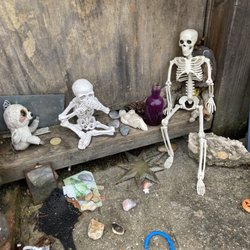
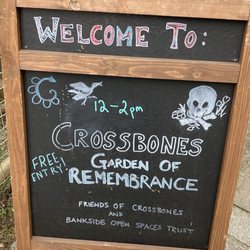
Another Halloween visit? This one holds a celebration here…read more
Cross Bones Graveyard was a mediaeval burial ground, situated in St Saviours parish, now Redcross Way SE1. There is a long established tradition that it was a final resting place for Winchester Geese, ie prostitutes, from the legalised brothels or 'stews' of Bankside. This dates back to the days when the Bishop of Winchester ran Bankside and licensed
the Geese.
Recent archaeological digs for the Jubilee Line extension have uncovered evidence of a highly overcrowded graveyard where bodies are piled up on top of each other and tests have shown that many of the bodies are women and children with diseases ranging from smallpox, TB and pagets disease to osteoarthritis and vitamin D deficiency.
This is Cross Bones, an unconsecrated graveyard going back to medieval times. The Tudor historian John Stow refers to it as a burial ground for 'single women' - a euphemism for the prostitutes who worked in Bankside's legalised brothels or 'stews'. In his 1603 Survey of London, Stow writes:
'I have heard of ancient men, of good credit, report that these single women were forbidden the rites of the church, so long as they continued that sinful life, and were excluded from Christian burial, if they were not reconciled before their death. And therefore there was a plot of ground called the Single Woman's churchyard, appointed for them far from the
parish church.'
The burial registers of St Saviour's parish don't distinguish between burials in Cross Bones and those in the churchyard adjoining what is now Southwark Cathedral. However, the long-established local tradition - that Cross Bones was a prostitutes' graveyard - is restated in the Annals of St Mary Overy (1833):
'There is an unconsecrated burial ground known as the Cross Bones at the corner of Redcross Street, formerly called the Single Woman's burial ground, which is said to have been used for this purpose' Such women were condemned to be buried in unhallowed ground. Yet many were actually licensed by the church. For some 500 years, the Bishop of
Winchester exercised sole authority within Bankside's 'Liberty of The Clink', including the right to licence prostitutes under a Royal Ordinance dating back to 1161. These women became known as 'Winchester Geese'.
Cromwell and the Puritans shut down the Bankside pleasure quarter, with its bear-pits, theatres, taverns and stews. By Victorian times, the area around Cross Bones was known as The Mint - an overcrowded, cholera-infested slum, and a notorious thieves quarter. When William Booth was conducting his survey of poverty, his researcher George Duckworth described it as:
' a set of courts and small streets which for number, viciousness, poverty and crowding, is unrivalled in anything I have hitherto seen in London.'
Duckworth walked around The Mint with a policeman who told him: 'Police don't go down here unless they have to, and never singly.' Around this time, Cross Bones witnessed many a pauper's burial. It was also the haunt of body-snatchers, seeking specimens for the anatomy classes at nearby Guy's Hospital.
The graveyard was finally closed in 1853, on the grounds that it was 'completely overcharged with dead' and that 'further burials' would be 'inconsistent with a due regard for the public health and public decency'.
In 1883, it was sold as a building site, prompting Lord Brabazon to write to The Times:
' with a view to save this ground from such desecration, and to retain it as an open space for the use and enjoyment of the people.' (10th November 1883)
The following year the sale was declared null and void, under the Disused Burial Grounds Act (1884). Subsequent attempts to develop the site were fiercely resisted by local people. The land was briefly used as a fair-ground until an action was taken against the showmen for abatement of the nuisance caused by steam organs and noisy music.
Apart from these minor intrusions, the graveyard slept peacefully and unmolested for the best part of a century. Then, in the 1990s, London Underground built an electricity sub-station to supply power for the Jubilee Line Extension. Prior to the work, Museum of London archaeologists
conducted a partial excavation of the site, removing some 148 skeletons. By their own estimate, these represented: 'less than 1% of the total number of burials that were made at this site.' Some were exhibited at the
Museum's 1998 London Bodies exhibition, including:
' a young woman's syphilitic skull with multiple erosive lesions, from Red Cross Way, Southwark, 18th century'.'
'For tonight in Hell, they are tolling the bell
For the Whore that lay at The Tabard
And well we know how the carrion crow
Doth feast in our Cross Bones Graveyard.'
They have since conducted many rituals and community events at the graveyard. The rituals are simple, inclusive and non-dogmatic, emphasising respect for 'the Ancestors', and honouring the spirit of