Cancel

Open app

Search

Goeswell Pole Dancing

1.0 (1 review)

Goeswell Pole Dancing Photos

Recommended Reviews - Goeswell Pole Dancing

Your trust is our priority, so businesses can't pay to alter or remove their reviews. Learn more about reviews.
Yelp app icon
Browse more easily on the app
Review Feed Illustration

7 years ago

Helpful 0
Thanks 0
Love this 0
Oh no 0

Verify this business for free

Get access to customer & competitor insights.

Verify this business

Festival Theatre

Festival Theatre

(37 reviews)

Newington

Although the original building wasn't designed for it, the Festival Theatre is now the largest…read morestage in Scotland and is the de facto home for opera, ballet and large scale touring musical productions. Seating just a shade under 2,000 people, it also serves as the main showcase venue during the Edinburgh Festival (as you might expect from the name). This location has held a theatre since 1830, and is Edinburgh's oldest theatre site. Resurrected from the old Empire Palace theatre, the restoration involved preservation of the auditorium and not much else. The front of house was replaced by a light, airy glass-fronted façade which, while not exactly sympathetic to the surrounding buildings, is at least an exciting addition to the area. Inside there are spacious foyers, bars, cloakrooms and a cafe area, with a central staircase providing access to all levels. There are plenty of toilets and some function rooms that you can hire for conferences or events.The contrast between this modern structure and the traditional auditorium is quite startling. The backstage area was completely rebuilt from scratch, and the actual stage is enormous - the largest in Scotland - with a side stage and rear scene dock of similar size, enabling it to stage some of the larger European operas that come to the Edinburgh Festival. In 2013 they added a Studio theatre in a new building on Potterrow, providing extra rehearsal space or a smaller performance venue for dance and small companies - a welcome addition and much needed in Edinburgh. Now, a little bit of history for you: The Moss Empires were a chain of theatres around the country, known for their large-capacity wide auditoriums, and many of them still exist, such as the Liverpool and Hackney Empires, and of course there was the infamous (and now sadly vanished) Glasgow Empire. In style they are all quite similar and can seem quite plain architecturally, favouring function over form, compared with some of the smaller more intimate theatres. This particular theatre was originally designed by the renowned (and prolific) theatre architect Frank Matcham; but you would be hard-pressed to recognise any of the characteristic Matcham features, as the building burned to the ground in a disastrous fire in 1911 during a performance by the famous illusionist, The Great Lafayette. Although the safety curtain was lowered, a piece of set prevented it from coming in fully, causing a draught which fanned the fire into an inferno killing Lafayette, ten members of his company, the lion involved in the illusion he was performing, his horse and some stage crew who were unable to escape the stage as Lafayette had ordered all the doors to the stage locked to prevent unwanted interlopers discovering his secrets. His body was soon found in the wreckage and sent to Glasgow for cremation. Two days later however, workers clearing the debris found an identical body, identified as Lafayette by the fancy rings he wore - the original body found was his secret body double, his means of performing many of his illusions. Or was it? Some say that the first body was the correct one, and that his shade haunts the theatre to this day because of the mix-up... His funeral procession through the streets of Edinburgh attracted an estimated crowd of 250,000 people, and he was laid to rest in Piershill cemetery. Because of this tragic accident, legislation was passed requiring all theatres to drop and/or lift the safety curtain at each performance in sight of the audience, just to prove that it is functioning correctly. So the next time you are at the theatre and see the safety curtain being lowered, spare a thought for The Great Lafayette, a real-life tragedy more dramatic than any play.


A great program of both mainstream theatre and more unusual performances such as circus, ballet and…read moreopera. I'm aiming to see at least one new piece of theatre each month this year so I've been here quite a bit because the programme is so good. The building itself is impressive with a glass front so you can people watch from all levels, my favourite is the first floor bar area. Being a relatively modern building there are a good number of ladies toilets so you don't end up spending the whole interval in the queue and still have time to get ice cream. The seats in the theatre are not that comfortable but are OK for most length performances. If you are planning on going to more than two or three shows a year it's worth while becoming a 'friend' of the festival and kings theatre for £39. You get 2 for 1 tickets on most opening nights plus 20% off other performances and discounts in various nearby restaurants. Plus you can book in advance so with some careful planning you can book 18 months of theatre with one year's membership.

Theatre Royal - Beautiful stage

Theatre Royal

(24 reviews)

City Centre

Theatre Royal is the oldest surviving theatre in Glasgow, the original building dating from 1867…read morewhen it opened as Bayliss' Coliseum before being renamed as Theatre Royal in 1869. Perhaps uniquely, it has been rebuilt twice by architect C J Phipps following major fires in 1880 and 1895. Although not as prolific a theatre architect as Frank Matcham, Phipps' style is splendidly represented in this building, regarded as the largest and best surviving example of his work. But don't judge the building from its bland exterior; you have to see the wonderfully ornate auditorium to really appreciate Phipps' work. The building was home to STV's studios for many years, before being sold to Scottish Opera in 1975, and it has been their home stage ever since, and is also the main home to Scottish Ballet's productions as well as being a main-scale house on the UK touring circuit. The stage is not huge by today's standards, but it's still larger than many London theatres and is the largest Glasgow can offer at the moment. The theatre is currently run and programmed by ATG (as is the Kings), so Glasgow is well served by the big touring shows. Currently the building is having a new foyer added at the corner of Hope Street and Cowcaddens in the form of a round tower, which has been a major feat of engineering to fit in with the existing architecture. As part of this refurbishment parts of the auditorium have been altered to something closer to the original design, with old entrance arches and the seating layout restored to improve audience flow and sightlines. Like any theatre, this one has a few ghosts, and like the Edinburgh Festival Theatre, there was a fire-related incident here that resulted in new legislation coming into force. In 1969, when STV moved out of the building into their new premises next door and the theatre was being restored, there was a major fire in the sub-stage area. The fire department tackled this with the then relatively new technique of pumping suppressant foam into the fire. One of the fire officers Archie McLay, working in the darkness of the stage area, fell through the stage floor into the sub-basement of the building - this extends about 20m underneath the stage floor and is carved out of solid bedrock (it was a former quarry), so it was full of foam. He was not reported as missing until the fire was under control, by which time it was too late. Resulting from this dreadful accident, the fire department introduced a 'deadman switch' device to be worn by all officers, which would radio an alarm signal if the officer was stationary for more than a few minutes. This incident is now marked by a stone plaque in the pavement of Hope Street. There have been a few reported sightings of Archie in the sub-basement, and most staff who have occasion to be down there late at night when the building is quiet will report a spooky atmosphere and a feeling like they are being watched by ghostly eyes...

I'm fairly certain I've seen things here prior to the refurb, but for the life of me I just can't…read moreremember. However, since the refurb I've been several times: some plays and operas. And i like it. Vanilla Black's has moved from Sauchiehall St, and is now the resident café for the theatre - and it's turned out to be a handy place for me to pop in for a quick work lunch. The foyer itself is open, spacious, and very welcoming - the spiral staircase is awesome, and is becoming an iconic feature of the theatre. Beyond that, it's functional and does what you expect, and you'll tend to find quite a lot of less populist productions here. The only downside is the extreme pricing at the bar. Seriously, £11 for 2 bottles of cheap lager is disgustingly extortionist.

Scottish Ballet - from http://www.scottishballet.co.uk/

Scottish Ballet

(3 reviews)

South Side

Once upon a time there was a provincial ballet company, with an aging audience and a reputation for…read moremaking rather twee pieces. They were capable of pulling out a good classical ballet, but were beginning to look old fashioned and tired. When Ashley Page arrived as artistic director, he rapidly turned this around. Getting in contemporary choreographers, and adjusting the company so that it has become as much a contemporary as classical dance troupe, he introduced a revolution that is getting Scottish Ballet noticed. Admittedly, their classical ballets are not that strong, but the brave decision to give names like Ian Spink and Richard Allston a crack at narrative ballets suggests a positive, get ahead attitude. Their recent relocation to Tramway is an expression of a dynamic approach. For the casual theatre fan, their Christmas show makes a nice break from pantomime: Page has made his own "trilogy" of seasonal favourites, which he rotates each year. The Spring and Autumn seasons are the business, though: contemporary, exciting and forceful. They often add another set of performances for the Edinburgh Festival too, meaning that the company stage up to twelve works in a year. Certainly one for the balletomanes, but increasingly, Scottish Ballet are becoming a national force. Worth catching at any cost.

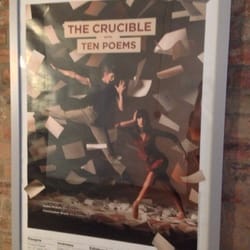
Having now been to two Scottish Ballet productions, I really was blown away on both occasions. The…read morecompany are re-inventing ballet; telling classic tales in the most modern and thrilling ways. - The stories come to life with the dancer's movement and expression. Previously, I had attended a performance of their dazzling Hansel and Gretel. Last night, Scottish Ballet told Arthur Miller's story of The Crucible along with Ten Poems, a visual-audio representation of Dylan Thomas' most well-loved poems. And so it began; starting with Ten Poems. I'll admit that it was strange at first. I'd never seen anything like it. - The poems read by Richard Burton, the rhythmic dancing along to the bouncing poetic words. I liked the expressiveness of the dancers in portraying the characters, and the emotive, stirring nature of Ten Poems. Next came the main event...Having studied the Crucible in Higher Drama, I was excited for what was to come. It was always going to be a dark affair but SB's addition of music from Alfred Hitchcock films was perfect for the thrilling, chilling nature of the Crucible. - Think Psycho and Vertigo. With this the tension heightened. And so, on edge, we perched on the ends of our seats. It was all incredible! From the dancing to the acting to the lighting to the music. One thing is clear; Scottish Ballet work their socks off.

Goeswell Pole Dancing - opera - Updated May 2026

Loading...
Loading...
Loading...