Gallipolis Historical Marker Photos

More like Gallipolis Historical Marker
Recommended Reviews - Gallipolis Historical Marker
Start your review...



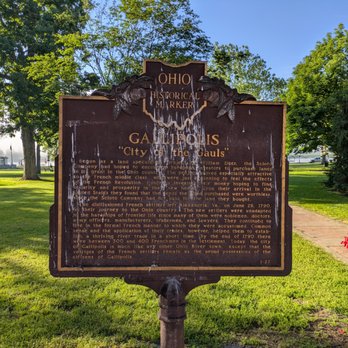
A visitor approaching this marker along the edge of Gallipolis City Park will notice that time and the local bird population have left their mark on its front face. The text is still readable, but the weathering and those chalky streaks give it the weary look of a sign that has stood watch for many seasons. Walk around to the rear, though, and the story comes through cleanly, framed by the quiet sweep of the Ohio River just beyond the curb. Its placement on the street makes it easy to pause, take in the view, and let the riverfront setting fill in the history the marker is trying to tell. The front reads, "Begun as a land speculation project of William Duer, the Scioto Company had hoped to encourage European investors to purchase lands in its grant in the Ohio country. The project proved especially attractive to the French middle class, who were just beginning to feel the effects of the French Revolution. Hundreds invested their money hoping to find security and prosperity in their new homes. Upon their arrival in the United States they found that the deeds they had purchased were worthless, since the Scioto Company had not paid for the land they bought. "The disillusioned French settlers left Alexandria, Va., on June 29. 1790, on their journey to the Ohio country. The new settlers were unadapted to the hardships of frontier life since many of them were noblemen, doctors, army officers, manufacturers, tradesmen, and lawyers. They continued to live in the formal French manner to which they were accustomed. Common sense and the application of their trades, however, helped them to establish, a thriving river trade in a short time. By the end of 1790 there were between 300 and 400 Frenchmen in the settlement. Today, the city of Gallipolis is much like any other Ohio River town, except that the vestiges of the French settlers remain as the proud possessions of the citizens of Gallipolis." And the reverse reads, "Its location and the tides of war established Gallipolis, then a town of some 3,000, as a point of strategic military importance to the Union upon the outbreak of the conflict in 1861. It was destined during the next four years to play a role without counterpart in Ohio." It then continues, listing these five points: " Here through this troop concentration area passed thousands of soldiers to the great campaigns. " Here the traditional peacetime activity of the town, long a depot of supplies for the Kanawha Valley, was turned to military purposes for maintaining armies in the field. " Here riverside warehouses held vast military stores to be transported by steamboat. " Here newly-mustered troops set up Camp Carrington in a wheat field on the upper side of town. " Here the women of Gallipolis helped minister to thousands of wounded and sick in an army hospital." It is marker number Q-27 and it was erected by the Ohio Historical Markers Committee and the Ohio Civil War Centennial Commission. There is street parking nearby. [Review 62 of 2026 - 304 in Ohio - 25252 overall] read more