Cancel

Open app

Search

Fort Basinger Photos

Recommended Reviews - Fort Basinger

Your trust is our priority, so businesses can't pay to alter or remove their reviews. Learn more about reviews.
Yelp app icon
Browse more easily on the app
Review Feed Illustration
Photo of Ariel W.
4395
5900
103637

6 years ago

Helpful 65
Thanks 1
Love this 66
Oh no 0

11 years ago

Helpful 5
Thanks 0
Love this 5
Oh no 0

Verify this business for free

Get access to customer & competitor insights.

Verify this business

Bethel Creek House of Refuge

Bethel Creek House of Refuge

(1 review)

Five stars for the history! The Houses of Refuge were federally operated life saving stations that…read morewere built on the beach so that the keeper could rescue ship wreck victims during a time period when the main form of travel and hauling goods was by ship. The houses were spread approximately 20 miles apart along Florida's coast and were often very isolated. They were all built exactly alike with a main house, a cistern, and boat house. The house that was nearest to where I live, the Orange Grove House of Refuge was the last place barefoot mailman Ed Hamilton spent the night before he disappeared forever into the Hillsboro inlet. What exactly happened to him is a mystery that has never been solved. The houses of refuge are long gone except for the House of Refuge Museum at Gilbert's Bar in Stuart which you can still visit today. I have visited that house as well as discovered several of these historical house of refuge markers along the east coast of Florida as far south as Miami. In 1915 the Life Saving Service became the US Coast Guard. The Bethel Creek House of Refuge is also no longer here. It was the first house of refuge constructed on the east coast of Florida and was active from 1876-1936. It once stood in what is now the Jaycee Beach Park and there is a historical marker in the park dedicated to it erected in 2013 by Florida Society Colonial Dames XVII Century Ann Waggaman, President. Surrounding the marker are blocks from the foundation of the Bethel Creek House of Refuge. The first keeper of this house was John Houston. In 1917 the Bethel Creek House of Refuge was destroyed by a fire and replaced by a building that was removed in 1936. During WWII the station was reopened with a 40 foot watch tower to look for German U-Boats off the coast. In 1950 the Federal Government gave these 8 acres of land the the city of Vero beach who developed it in to the Jaycee Park in 1956.

Murphy - Burroughs House

Murphy - Burroughs House

(6 reviews)

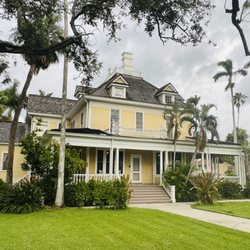
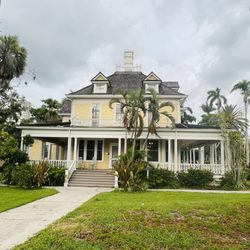
I love old houses and this yellow beauty is an architectural gem. The Murphy-Burroughs House is a…read moreGeorgian Revival style mansion built in 1901 for John T. Murphy, a cattle rancher from Montana. It is located in the River District of Fort Myers on two acres of land on the Caloosahatchee River. The house was built on First Avenue, the first house on what would become known as Millionaires Row. Materials to build the house were brought in by train and then carried the rest of the way to Fort Myers by barge. After construction was completed it drew other wealthy people to build their homes on the street. It is the only one of Millionaire Row's mansion that is still standing in its original position. Murphy was very involved in local civic and business affairs during his time in Fort Myers. He was a major shareholder of a bank and helped built a seawall that protected the downtown area. He passed away in 1914 and the house was sold to a businessman from New Jersey. In 1919 Nelson Burroughs purchased the house so his family could escape the frigid Chicago winters. Nelson made his fortune in land investments and banking. While in the home the family hosted lavish parties attended by famous winter Fort Myers residents Thomas Edison, Henry Ford, and Harvey Firestone. In 1922 Burroughs transferred ownership of the house to his daughters, Mona & Jettie. Mona bequeathed the property to The City of Fort Myers prior to her death in 1978. After her husband died in 1983 it was no longer used as a residence. On August 1, 1984, the house was added to the U.S. National Register of Historic Places. Today you can tour the home that has been lovingly restored with a grand staircase, beautiful fireplaces, and antique furnishings. Features of the house include a veranda wrapping around three sides, a large dancing porch on the east side, bay and stained glass windows, a widow's walk on the roof, and decorative woodwork. The house is a popular wedding venue. Every December, the Fort Myers Community Women's Club decorates the historic mansion for the holidays. The Uncommon Friends Foundation manages the house as well as the Burroughs family records.

What a beautiful place to throw a party, host an event or have a wedding…read more The sunset here is absolutely magnificent and there are trees and flowers everywhere.

Captain Francis A. Hendry House

Captain Francis A. Hendry House

(1 review)

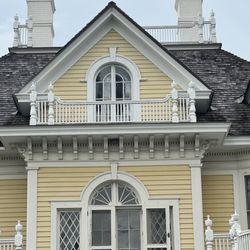
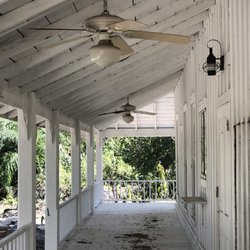
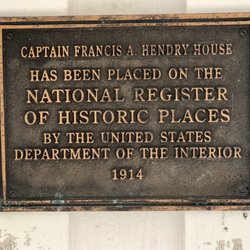
As a fan of historic architecture I was excited to find this structure on a recent trip to Labelle…read more The house is located at 512 Fraser Ave. next to the LaBelle Nature Park. This historic vernacular one and one and a half story home was built in 1914 for Captain Hendry who fought in the Confederate Army in the Civil War. After the war Hendry became a cattle rancher. Hendry hired self taught builder Benjamin F. Magill to supervise the construction of his home in the town of LaBelle which he founded on the western end of his vast ranch holdings in Monroe County. Hendry moved into the home at the age of 81 with his wife. Due to his poor health, Hendry was only able to live in the house for a few months before moving to Fort Myers for better access to medical care. He passed away in 1923 and his final resting place is a private family cemetery in Fort Myers. When Hendry County was formed in 1923 it was named after Captain Hendry. This is is the only surviving structure left associated with him. After Hendry's death, the house had numerous owners through the years. On February 5, 1998, it was added to the U.S. National Register of Historic Places. The house is not open for visitors. It looks like construction is being done on the stairs and porch. It was still fun to peek in the windows and around the outside. I love the huge wraparound porch. It looks like there are a few period furnishings inside and historic photos on the wall. I saw online that LaBelle uses the grounds for outdoor events and weddings.

Fort Denaud

Fort Denaud

(1 review)

As white settlers flooded into Florida the government became determined to relocate all Native…read moreAmericans west of the Mississippi. This forced removal policy sparked the Second Seminole War in 1835. The Seminoles fled south into Florida to evade capture and being sent out west and they moved into the Everglades in order to hide. In response the army set up forts south of Tampa to the east coast along rivers as they chased after the Seminoles who were much more skilled at surviving in the terrain than the soldiers. Fort Denaud was established by Captain B. L. E. Bonneville and troops of the 7th Infantry in 1838 on the the south side of the Caloosahatchee River. The fort was named in honor of Pierre Denaud, A French-Canadian trapper who had traded with the Seminoles and who owned land in the area in the 1830's. The fort consisted of a blockhouse with tents around it and it served as a supply depot for troops in Lake Okeechobee. The stockade at the fort guarded a bridge over the river on a military highway between Fort Myers and Fort Meade. The Fort Denaud historical marker marks the site of the blockhouse at Fort Denaud. Fort Denaud was closed after the end of the Second Seminole War and reopened at the beginning of the Third Seminole War in 1855 under Brevent Major William Hays. Soldiers added a hospital, guardhouse, jail, Sutler's store, and stables. A fire ravaged the fort in 1856 and it was rebuilt two miles downstream on the north side of the river. The fort was abandoned in May of 1858. After the war settlers moved into the town of Fort Denaud that sprang up and began farming sugar cane and citrus but most of them left after the fort was abandoned. Although there is no trace of the fort a few historic structures still remain. Today the area is mainly citrus groves and a new housing development.

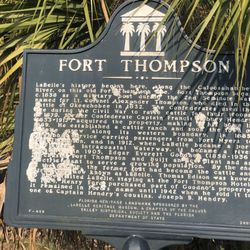
Fort Thompson

Fort Thompson

(1 review)

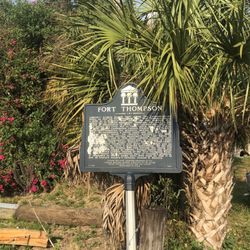
In the 1800's white settlers flooded into Florida and the government became determined to relocate…read moreall Native Americans west of the Mississippi. This forced removal policy sparked the Second Seminole War 1835-1842. As the Seminoles fled south into Florida to evade capture and being sent out west, they moved into the Everglades in order to hide. In response the army set up forts south of Tampa to the east coast along rivers as they chased after the Seminoles who were much more skilled at surviving in the terrain than the soldiers. Fort Thompson was one of these forts and it was established in 1838 as a military post to store supplies for the Seminole Wars. The fort was named Lt. Colonel Alexander Thompson, who died in the battle of Okeechobee in 1837. I was able to watch a recreation of the Battle of Okeechobee earlier this year and I learned a lot more about the battle. All that remains of the fort is the marker that signifies where it was built. The marker was placed by the LaBelle Heritage Museum. The last remnants of the fort were washed away with the dredging of the Caloosahatchee River. The Confederate army used this land during the Civil War to raise cattle. After the Civil War a community named Thompson built up around the old fort because it was the best place to cross the Caloosahatchee River for miles around. Confederate Captain Francis Asbury Hendry purchased the property in 1879 which he used it for his home and a cattle ranch. Hendry founded the town of LaBelle in the late 1880's along the western edge of the property, named for his daughters Laura Jane and Carrie Belle. Hendry County is named in honor of Captain Hendry. In 1885 steamboat service began between Fort Myers and LaBelle. Fort Thompson was purchased in 1905 by Edgar Everett Goodno who built an ice and electric plant. Goodno built the Fort Thompson Park Hotel on the site which brought many people to the area including Thomas Edison and Henry Ford. Ford purchased part of Goodno´s property in 1924 and it renmained in his name until 1942 when he sold it to one of Captain Hendry´s cousins, Joseph B. Hendry. The old Fort Thompson Park Hotel was torn down in the early 1940's. The historical marker erected on this site is a bit difficult to see and is faded. It is next to the gate of a private home located on SR80 just east of the City of LaBelle, FL. Five stars for the history of this place.

Fort Basinger - landmarks - Updated May 2026

Loading...
Loading...
Loading...