Faris Ferris Station Photos


More like Faris Ferris Station
Recommended Reviews - Faris Ferris Station
Start your review...



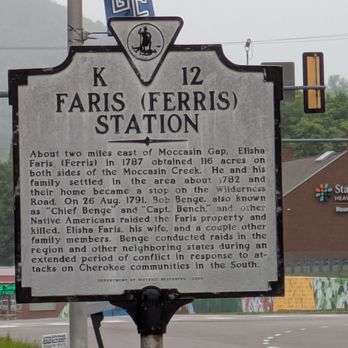
A short drive from downtown Gate City, this marker stands at the edge of a fast‑food parking lot, an unassuming spot for a story rooted in the era when this corner of Virginia was still the edge of the frontier. The traffic hums past, but if you pause for a moment, the marker pulls you back to a time when the Wilderness Road cut through dense forest and families like the Farises were carving out new lives in a landscape that was anything but settled. The placement may be modern, but the history it recounts is anything but. The marker has the same text on both sides. It reads, "About two miles east of Moccasin Gap, Elisha Faris (Ferris) in 1787 obtained 116 acres on both sides of the Moccasin Creek. He and his family settled in the area about 1782 and their home became a stop on the Wilderness Road. On 26 Aug. 1791, Bob Benge, also known as "Chief Benge" and "Capt. Bench," and other Native Americans raided the Faris property and killed Elisha Faris, his wife, and a couple other family members. Benge conducted raids in the region and other neighboring states during an extended period of conflict in response to attacks on Cherokee communities in the South." It is marker number K-12 and it was erected in 2004 by the Virginia Department of Historic Resources. The setting may be ordinary, but there is room to pull over, step out, and take in a reminder that the quiet hills around Gate City once stood at the fault line of competing homelands and hard choices. [Review 82 of 2026 - 1528 in Virginia - 25272 overall] read more