Cancel

    Open app

    Search

    Fanagan's Photos

    Recommended Reviews - Fanagan's

    Your trust is our priority, so businesses can't pay to alter or remove their reviews. Learn more about reviews.
    Yelp app icon
    Browse more easily on the app
    Review Feed Illustration

    4 years ago

    Helpful 2
    Thanks 0
    Love this 3
    Oh no 0

    Verify this business for free

    Get access to customer & competitor insights.

    Verify this business

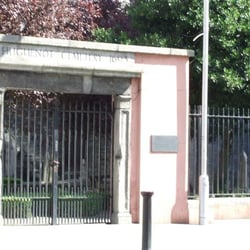
    Huguenot Cemetery

    Huguenot Cemetery

    (2 reviews)

    South Inner City

    There was a gaggle of French tourists that just appeared out of nowhere when they saw my…read morephotographing this place. Us humans are indeed descended from sheep. It was fitting that they were French tourists as their country men are buried behind the gates, about 200 plus of them. The Huguenots fled religious persecution from around the 17th century. They came to Ireland to escape death. They brought their skills of textiles, watchmaking and finance which added to the Dublin community. You cannot enter the cemetery but you can easily see the headstones through the railings, it's unique to have a graveyard near Anglo Irish Bank but quite apt at the same time.

    I like to walk while I think. Often while working out some issue or trying to come up with an idea…read morein work I will take to the streets and my feet often lead me here. Although I would love to sit inside among the trees there is something calming about this serene and largely untouched spot. Peering through the gates of this perpetually locked graveyard you will see a stone plaque with the names of all the families buried here. So who were the Huguenots ?? The short answer is they were French Protestants who came to Ireland as refugees. In 1685 King Louis of France expelled all of the Protestant clergy and told all Protestants that they could either convert to Catholicism or leave France. A large number of them left and traveled to all parts of the world. As they were generally speaking well education and professionals they were welcomed in most places they went especially Ireland where about 5,000 settled. They had a big impact in Ireland and many became very successful like the La Touch family who set up bank of Ireland and the ancestors of Samuel Beckett. There are a number of these little graveyards around the country and all look quite similar to this little one which dates from 1693. I love that the city has developed up around it and it seems to have stayed untouched.

    Glasnevin Cemetery

    Glasnevin Cemetery

    (50 reviews)

    Glasnevin

    Opened to the public in 1832, Glasnevin is the largest cemetery in Ireland and is the main cemetery…read morefor the city of Dublin. It is the final resting place well more than 800,000 people most of whom were in mass graves as a result of the Great Famine and a cholera epidemic in the 1840s. The cemetery contains the final resting place of many notable Irish figures including one of the more famous, Michael Collins who was the nationalist leader killed in the Irish Civil War of 1922. Others that I was able to find include.. Brendan Behan (1923-1964), author and activist who was jailed at an early age for participating in a bombing. Éamon de Valera (1882-1975), president of Sinn Fein and later third president of Ireland. Father Francis Browne (1880-1960), Jesuit priest who is known for the pictures he took of the RMS Titanic (it was built in Belfast). Charles Stewart Parnell (1846-1891), Irish nationalist politician There is a large section of military memorials and throughout the cemetery are monuments to those who fought for Irish independence. There is free parking and the cemetery offers guided tours on a regular basis. You can also purchase tickets to climb the large bell tower which apparently has great views of Dublin. There is a small cafe and there is a gift shop. While there is no driving in the cemetery, the lanes throughout are smooth and easily walkable. Update from my friend Klaus-Dieter: "Éamon de Valera, called Dev, has taken part in in the Easter Rising. He wasn't executed by the Brits, because he also had the American citizenship. He left Sinn Fein and became founder of a new party named Fianna Faíl." [Review 1819 of 2024 - 79 in Republic of Ireland - 22841 overall]

    Plenty of history here, over 1.5 million buried at this cemetery. It has plenty of parking, to find…read moreand the people are extremely polite.

    Mount Jerome Cemetery

    Mount Jerome Cemetery

    (2 reviews)

    Harold's Cross

    Review of MOUNT JEROME: Dublin's Victorian Cemetery. By Maurice Curtis…read more 30 March 2026 Reviewed by Ben O'Reilly, Film and Book Critic Maurice Curtis, the well-known Historian and writer, has turned his meticulously researched attention to uncover the vast secrets and stories surrounding those buried in Mount Jerome Cemetery, Harold's Cross, Dublin. This particular offering is a veritable "who's who" of the famous and not-so-famous, that are buried in Mount Jerome. Many of the names are familiar as they relate to the names of thoroughfares in the local area and in Dublin generally. The book, adorned with photographs of the many Victorian memorials, tombs, vaults and crypts, is a veritable treasure-trove of information on the history and lives of those within, complete with many anecdotal tales. For example; at the tomb of the Gresham family vault is a space for a bell - which is no longer there - which Mrs Gresham insisted on, in case she woke up! The cable from the bell is still there leading into the chamber area. Just some of the names which piqued my interest, included: Members of Michael Collins' "The Squad" (AKA The Twelve Apostles), Thomas Davis (founding editor of The Nation), Sheridan Le Fanu (writer of gothic, horror and mystery stories), Bram Stoker's mother and brother. Leo Burdock (of the famous chipper family), the Guinness family, James Pearse (father of Patrick Pearse), Lady Jane Wilde (mother of Oscar - who wrote under Esperanza. J. M. Synge, J. B. Yeats George Russel (AE). Audrey Hepburn's father is also buried there as is Maeve Binchy, The Pollock family may be unknown to many - including me - but they hold the distinction of having the very first burial held in Mount Jerome in 1836, as their new-born twins were interred within. Some of the tombs stand out from others, and one in particular is the Cusack family vault, which resembles a miniature Greek temple. The book - which lists all those famous and infamous - has an alphabetical index, for anyone seeking out information on a particular individual. I will be allowing plenty of time during my next visit to Mount Jerome, as I take a stroll along its many by-ways with a renewed interest in those entombed within. The book is available in ALAN HANNA'S BOOKSHOP in Rathmines and the Village Bookshop in Terenure or from AMAZON. It retails at 24.95 Euro and is in hardback. Ben OReilly

    Hmmm, how do you review a cemetery and crematorium. OK, here goes…read more As a cemetery, the older part of the graveyard is fascinating with the old and weathered headstones. There are some truly beautiful tombs and headstones. It's worth a wander through if this interests you. I've been here for two services in the crematorium. To be honest my first visit was a shock to the system when all I had been used to was the usual Irish church funeral. But cremation is becoming more and more popular (erm, is that even the right word for it?), so I imagine I will need to go back some time in the future. The interior is church like, but less showy in terms of decor (if memory serves). The curtain was the most striking part of it all, when it closed as the chosen music was played. The cafe was pleasant when I had to wait some time the second service to begin. Basic, but provided a nice cup of tea and biscuits which can be purchased from the pleasant staff. Basic but clean facilities here also, should nature call.

    James Connolly Memorial Statue - The James Connolly Statue is still here in 2024

    James Connolly Memorial Statue

    (3 reviews)

    Gardiner Street

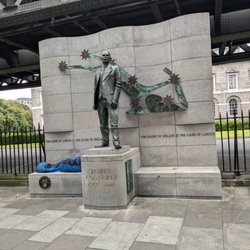
    James Connolly was an Irish republican and socialist leader, becoming one of the Marxist theorists…read moreof the day. Very deeply involved in socialism and nationalist causes throughout his adult life, Connolly was the founding editor of The Socialist newspaper and was among the founders of the Socialist Labour Party which split from the Social Democratic Federation in 1903. During the Easter Uprising, he was badly injured and was told that he had one or two days to live. Despite this, the British continued with the execution order. As he was unable to stand before the firing squad, he was carried to the courtyard on a stretcher, tied to a chair and then shot. This was a turning point of the revolution, as the news of the executions was not well received. Even in Britain. The prime minister ordered that no more executions were to take place and it brought much sympathy to the Irish Nationalism cause. The statue today, Connolly standing before a plow with stars, is outside Liberty Hall, the offices of the Services, Industrial, Professional and Technical Union building.

    The bronze James Connolly statue stands under the bridge at Beresford Place with the plough and the…read morestars and his own quote behind him - "The cause of Labour is the cause of Ireland - the cause of Ireland is the cause of Labour". Connolly was a committed socialist and heavily involved in the incipient Irish trade union movement but it was the manner of his death that brought many people around to the need for Irish independence. After taking part in the 1916 Rising, he was shot and seriously injured. Despite this, he was still tied to a chair in Kilmainham Gaol and executed by firing squad. Today, his statue (by artist Eamonn O'Doherty) looks onto the considerable oncoming traffic, no doubt hoping that most of the drivers are carpooling.

    Fanagan's - funeralservices - Updated May 2026

    Loading...
    Loading...
    Loading...