Cancel

    Open app

    Search

    Epoch Photos

    Recommended Reviews - Epoch
    Your trust is our priority, so businesses can't pay to alter or remove their reviews. Learn more about reviews.
    Yelp app icon
    Browse more easily on the app
    Review Feed Illustration
    Photo of Ariel W.
    4395
    5890
    103453

    7 years ago

    Helpful 74
    Thanks 0
    Love this 62
    Oh no 0

    Verify this business for free

    People searched for Landmarks & Historical Buildings 236 times last month within 5 miles of this business.

    Verify this business

    The Delray Wreck - The Delray Wreck Historical Marker

    The Delray Wreck

    (3 reviews)

    This must be the local dive spot of the Delray Wreck because there is a sign stating it. I assume…read morethe wreck is out in the ocean because it was definitely not on land.

    This marker along Delray Beach has seen better days since it was installed. The paint is faded and…read moreworn, which is understandable since it is literally right next to the beach and so it gets scrubbed by sand and salt day in and day out. But it still stands, pointing out a bit of history and drama that is now over a century old. There is parking nearby and don't forget to feed the meter. The marker reads, "The old shipwreck know as the Delray Wreck rests at the bottom of the ocean in 25 feet of water about 150 yards offshore the south end of Delray's municipal beach. The wreck is broken and scattered into five sections and has long been one of the most popular diving spots in South Florida. "The S.S. INCHULVA was grounded and wrecked by a fierce hurricane on September 11, 1903. Under the command of Captain G.W. Davis, the 386 foot steel hulled British steamship was bound for Newport News, Virginia from Galveston, Texas carrying wheat, cotton, lumber and a crew of 28 men. "The storm struck about 5 p.m., tossing the ship and causing the cargo to shift. Steering became impossible, so Captain Davis put out both anchors, but to no avail. The anchors parted and the INCHULVA grounded and was ripped apart. Nine crew members were lost. "Dawn revealed to the battered crew that land and a town were just a short distance away. By noon, all the men except Captain Davis and two mates had landed on shore in a small hastily-built raft. They found hot food and coffee at the Chapman House, a local hotel, where many of Delray's residents had taken shelter during the storm. "The nine seamen who lost their lives were buried on the ridge overlooking the ocean where the ship had gone down. The surviving crew members were treated, paid and sent to New York. "Before leaving for their homes, each crew member signed the guest register of the Chapman House. Under their names they wrote, "Shipwrecked in the S.S. INCHULVA, September 11, 1903, landed on a raft September 12th and received every kindness and attention at the hands of Mrs. Chapman." "Captain Davis, his Chief Officer, a 2nd Officer and a seaman from the ship were brought before the Naval Court held at the British Vice Consulate at Jacksonville on September 19th. The Court exonerated the Captain and the crew from all blame." This is marker number F-327 and it was erected in 1980 by the Historic Palm Beach County Preservation Board in cooperation with the Florida Department of State. [Review 976 of 2024 - 1852 in Florida - 22004 overall]

    Marina Historic District

    Marina Historic District

    (1 review)

    Marina Historic District sits on the intracoastal waterway. The boundary streets of the…read moreneighborhood are East Atlantic Blvd, Marine Way, SE 4th Ave, and SE 7th Ave. Marina was listed as a city historic district in 1988 and it was added to the National Register of Historic Places on June 2, 2014. It is the only historic neighborhood in Delray Beach on the list. In order to qualify for the prestigious list a district must have homes older than 50 years and the area must be of historical significance. Being on the list can improve property values. Marina was the first planned neighborhood in Delray Beach. Homes are from 1924 to 1949. Most of the homes served as winter residences for people from the north and mid west during Florida's land boom years in the 1920's. People who moved to the neighborhood in the 1930's and 1940's made it their year round home. A signature of Marina are the shady streets that are within walking distance of the Delray City Marina. Architectural styles in the neighborhood include Mediterranean and Mission Revival, Monterey, Minimal Traditional, Frame Vernacular and Art Moderne. There are cottages cottages from the 1930s that were built by cartoonist Fontaine Fox. Gustav Maass, Henry Pope, and Samuel Ogren, Sr. who was the first resident architect in Delray Beach and who designed more 250 buildings and homes in town were some of the well known architects who had a hand in designing the neighborhood. The Spady museum in the historic West Settlers district offers a $35 Ride and Remember Bus Tour once a month that travels to all five of Delray Beach's historical districts, including Marina. The tour tells the story of the origins and development of Delray Beach and is a great resource for anyone who is looking to learn more about the area.

    The Wenger Home

    The Wenger Home

    (1 review)

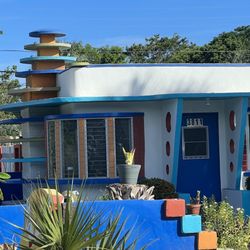
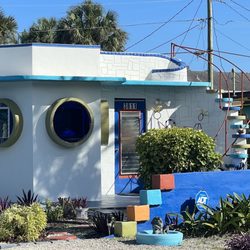
    If you love unusual architecture as I do, then you will enjoy checking out the colorful, historic…read moreWenger Home, a Nautical Moderne private residence. The house was built in 1948 by Ruth and Ray Wenger on Wall Street, an unincorporated area of Palm Beach County between Delray Beach and Boynton Beach. The home is known for its signature flat and curved walls, circular windows, and rectangular framing. The Art Deco eyebrows, flat shelves over the windows that look like a wedding cake are one of the most striking features on the house. The Wenger's built the home room by room with interesting architectural design elements scavenged from salvage yards. The kitchen was built first and the 1,400-square-foot home also has two bathrooms, two bedrooms, a family room, a living room, a Florida room and a converted den. A 400-square-foot garage was Ray Wenger's machine shop while Ruth used a portion of the home for her hair salon. An outdoor circular staircase in the front of the house takes you up to the flat roof where the Wenger's used to hang out to stay cool before they had air conditioning, A low, concrete blue wall with heart cutouts surrounding the house was a Valentine from Ray to his beloved wife Ruth. This was the first private residence ever to be placed on Palm Beach County's Register of Historic Places. Houses have to be older than 50 years to qualify for the list. The Wenger House is a treasure because of the way it combines the architectural styles of Art Deco, Tropical Deco and modernist design. In 2000, Boynton Beach artist Rick Beaulieu helped the current owners compose a rose, apple, yellow and blue color scheme making it even more spectacular. The Wenger Home was features on cable HGTV's What's With That House?, a show about homes that aren't typical to a neighborhood. This house has everything, an endearing love story and compelling architecture. Although off the beaten path, I enjoyed seeing the house in person.

    Orange Grove House of Refuge No. 3

    Orange Grove House of Refuge No. 3

    (1 review)

    This is a historic site on the ocean in Delray Beach. At this site once stood a house of refuge…read morebuilt by the federal government to provide aid to victims of shipwrecks. The house that resided here was number 3 of 5 built along the south east coast of Florida. Ten years later five more were built north to St. Augustine. Orange Grove was the only refuge house built in Palm Beach. It began operating in 1876 and was named for the sour orange grove where it was built. It was a two story wood frame house built of pine with a wrap around porch. The first floor was four rooms for the keeper of the house and the second floor contained enough supplies to last twenty guests ten days. Supplies included food, bedding, clothes, and medicine. A separate building on the property held two lifeboats so people could be rescued from the ocean. Keepers had to note the weather, look for people in need after storms, and collect marine life specimens for the Smithsonian, The pay wasn't very good so the keepers usually had a second job. Most keepers had families with them to keep them company in what could be a lonely place. Local Seminoles would stop by to bring meat and trade with the keepers. At Orange Grove the first keeper Hannibal Pierce's wife, Margretta Moore Pierce gave birth to the first white girl to be born between Delray Beach and Biscayne Bay. The babies name was Lillie Elder. Margretta found the refuge house too lonely and returned to her home at Hypoluxo Island. Hannibal followed her after the second and last keeper Steve Andrews replaced him. Steve was from England and lived at the refuge house with his wife Annie who ran the first post office in the area at the house. In 1894 Congressman William Seelye Linton stayed at the house with a group from Michigan when they were looking for land to buy. Linton plotted the Town of Linton which became the city of Delray Beach. The house ceased operation in 1896. After that it housed pioneers and settlers in the area. It was the last place barefoot mailman Ed Hamilton slept before he disappeared forever the next day while delivering the mail. In 1927 the house burned down. Now all that remains is a marker giving a brief history of the home . This site was such an important part of Delray Beach history. I loved pausing for a moment to imagine what life was like here a hundred years ago. Only one refuge house remains Gilberts Bar (no. 2) in Stuart. It is a historical museum where you can learn about Florida's pioneer and seafaring history. I hope to visit one day to learn more about the refuge houses.

    Ethel Sterling Williams History Learning Center and Archives

    Ethel Sterling Williams History Learning Center and Archives

    (1 review)

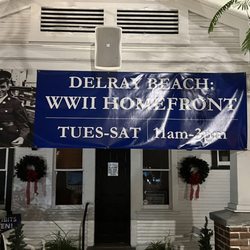
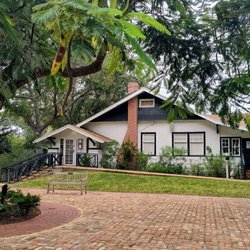
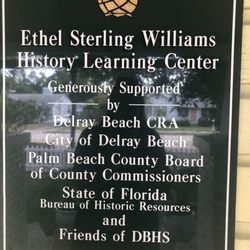
    The Ethel Sterling Williams History Learning Center and Archives was opened in 2009 and is operated…read moreby the Delray Beach Historical Society to maintain and preserve the historic archives of the city. The collection contains over 20,000 items. Photographs, documents, records, memorabilia, letters, clothing, newspapers, paintings, and original drawings are just some of the items they have preserved. They also have a book collection that has rare and out of print books and contemporary ones on topics like architecture. All of the items are stored in a temperature controlled concrete and steel archive bunker attached to the building that can withstand a catagory 5 hurricane. The historical society handles as many as 500 free research requests a year by citizens of the town, media, businesses, researchers, and anyone else who is looking to get further insight into the history of Delray Beach. They also provide a computer in the enter for research use by the public. In addition to storing archives the building is also used as a classroom and to host lectures and tours. Ethel Sterling Williams who the center is named after was a civil rights pioneer in Delray beach. She was the co founder of the Delray Beach Historical Society and served as its first president. Her mother Mary Elizabeth Sterling was the founder of the Ladies' Improvement Association which improved roads, schools, sidewalks and built the first the town hall. They also built the first beach pavilion which enticed visitors to the town and and helped it move from a reliance on agriculture to one based on tourism. Ethel's husband Dr. William C. Williams Jr. helped found Bethesda Hospital in the 1950's which was the only hospital in Palm Beach at that time that was open to all people regardless of race or ability to pay. Ethel Sterling Williams passed away in 1987 at the age of 95. The Ethel Sterling Williams History Learning Center and Archives is located in the historic Hunt House bungalow. The historical society used to house their archives in the Cornell Museum of Art & History but they lost their lease in 1991. In 2006 the opportunity arose to acquire a home from developers Madison of Delray. The building had previously been used as the office of Bridges, Marsh & Associates architectural firm and was slated for destruction. The houses roots ran much deeper than the architectural firm however. It was built by John Alm in 1907. Horace and Rae Hunt were the first occupants and lived their with their young daughter. They rented the home until they could afford a mortgage. The Hunt family lived in the house until 1915. In November 2007 the Deerfield Beach Historical Society accepted the house and had it moved next to another property they operate, the Cason Cottage. The historical society restored the house to how it looked in 1908 and now it is where all of their archives are based. The center is open to visitors Thursday through Saturday 11- 3.

    Old School Square Historic District - Old School Square Historic District marker, Delray Beach

    Old School Square Historic District

    (2 reviews)

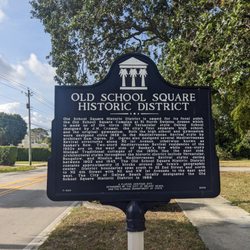
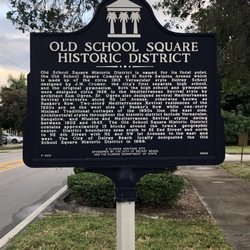
    I love this little marker buried in a residential neighborhood and standing in front of a classic…read moreold church. It points out the local history of the immediate vicinity. There was a time I lived in Delray Beach and never knew all of this, so it's nice to see all of this added. The marker has the same text on both sides, reading "Old School Square Historic District is named for its focal point, the Old School Square Complex at 51 North Swinton Avenue which is made up of the circa 1913 Vernacular style Delray School designed by J.M. Cromer, the city's first separate high school, and the original gymnasium. Both the high school and gymnasium were designed circa 1926 in the Mediterranean Revival style by architect Sam Ogren, Sr. Ogren also designed several Mediterranean Revival structures along NE 1st Avenue, otherwise known as Banker's Row. Two-story Mediterranean Revival residences of the 1920s are on the west side of Banker's Row while one-story Minimal Traditional cottages of the 1930s line the east side. Architectural styles throughout the historic district include Vernacular, Bungalow, and Mission and Mediterranean Revival styles dating between 1902 and 1945. The Old School Square Historic District contains approximately 15 blocks around the town's geographic center. District boundaries span south to SE 2nd Street and north to NE 4th Street with NE and NW 1st Avenues to the east and west. The City of Delray Beach locally designated the Old School Square Historic District in 1988." This is marker F-669 and it was erected in 2009 by The City of Delray Beach and the Florida Department of State. You can park in the church parking lot to read the marker. [Review 987 of 2024 - 1863 in Florida - 22015 overall]

    I love how the city of Delray beach embraces its history. They have several historic districts with…read moremarkers through the city so you can learn more about how the city was created out of pineapple plantations and has now transformed into a premier vacation destination. Delray Beach's largest historic district is the Old School Square Historic District. It was created from the Delray Elementary built in 1913 on the corner of Swinton and Atlantic Avenues for grades one through twelve and the 1925 Delray High School which was built just north of the elementary building. The last graduation in the high school building was held in 1949 and by the mid 1980's, the Palm Beach School District had abandoned both buildings. The Delray Beach Historical Society gathered together concerned citizens and spearheaded an effort to restore the buildings in order to help a struggling downtown. Old School Square was locally designated in 1988 by the City of Delray Beach. In 1990 the elementary school opened as the Cornell Museum of Art and the Crest Theater opened in the former high school in 1993. Other historic buildings in this district include the 1902 turn of the century frame architecture Sundy House that was home to Delray Beach's first mayor, John S. Sundy, who served for seven terms. The building is now a bed and breakfast and restaurant/event space. Two of the cities oldest churches also reside in this district, the 1904 St. Paul's Episcopal Church and the 1903 Methodist Church. The restoration of the buildings did revitalize Atlantic Avenue as was envisioned. On the street there are many restaurants, shops, and galleries. Just off Atlantic is the Pineapple Arts District and a brand new food hall. On any given weekend you can see the street full with locals and tourists dining on the street at outdoor cafes. Still some signs of struggle remain. Doc's All American, a historic hamburger and hot dog stand remains closed while the city figures out a way to bring it back or develop something new. If you visit right now there is a giant Christmas tree that you can walk through set up in Old School Square while the during the weekend, Old School Square is the site of an excellent weekly farmer's market in the winter. I love the architecture and history of this section of Delray Beach. There is always something going on. It is one of my favorite places in south Florida to visit.

    Del-Ida Park Historic District - Del-Ida Park Historic District, Delray Beach

    Del-Ida Park Historic District

    (2 reviews)

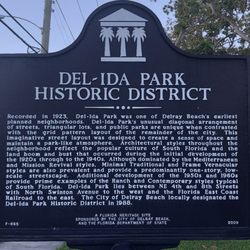
    Fabulous to see the history of this delightful residential community in Delray Beach. It was an…read moreinteresting wander, exploring this part of the city. The marker is next to a bus stop and reads, "Recorded in 1923, Del-Ida Park was one of Delray Beach's earliest planned neighborhoods. Del-Ida Park's unusual diagonal arrangement of streets, triangular lots, and public parks are unique when contrasted with the grid pattern layout of the remainder of the city. This imaginative street layout was designed to create a sense of space and maintain a park-like atmosphere. Architectural styles throughout the neighborhood reflect the popular culture of South Florida and the land boom and bust that occurred during the initial development of the 1920s through to the 1940s. Although dominated by the Mediterranean and Mission Revival styles, Minimal Traditional and Frame Vernacular styles are also prevalent and provide a predominantly one-story, low-scale streetscape. Additional development of the 1950s and 1960s provide prime examples of the Ranch and Contemporary styles typical of South Florida. Del-Ida Park lies between NE 4th and 8th Streets with North Swinton Avenue to the west and the Florida East Coast Railroad to the east. The City of Delray Beach locally designated the Del-Ida Park Historic District in 1988." It is marker number F-665 and it was erected in 2009 by The City of Delray Beach and the Florida Department of State. You can pull over onto the median to read the marker.

    The Del-Ida Park Historic District is the first subdivision created in Delray Beach. It was plated…read morein 1923 during the Florida land boom. It is 58 acres and the neighborhood boundary streets are Northeast Fourth St., Northeast Eighth St., North Swinton Ave., and Northeast Third Ave. There are 151 structures in the district. Houses in the neighborhood are from the 1920's. Architecture styles are Spanish Mission, craftsman bungalow, and the ornate Mediterranean Revival. There are also wood frame houses built in the 1930's and 1940's. An interesting feature that is unique to this neighborhood is the streets are on the diagonal creating triangular blocks. The community has three triangular shaped parks. The residents of this community are interested in preserving their historic homes. The district hopes to build off the momentum of the restoration of Old School Square and the Pineapple Grove Arts district. Committees have been created to improve landscaping and safety and to maintain the architectural details that make this historic district unique. This neighborhood was once advertised as "new blood for Delray" and residents hope to preserve the historic buildings that once made this the premier place to live in Delray Beach.

    Epoch - landmarks - Updated May 2026
    Loading...
    Loading...
    Loading...