Cancel

Open app

Search

Dorset Gardens Methodist Church

5.0 (1 review)

Dorset Gardens Methodist Church Photos

Recommended Reviews - Dorset Gardens Methodist Church

Your trust is our priority, so businesses can't pay to alter or remove their reviews. Learn more about reviews.
Yelp app icon
Browse more easily on the app
Review Feed Illustration
Helpful 0
Thanks 0
Love this 0
Oh no 0

Verify this business for free

Get access to customer & competitor insights.

Verify this business

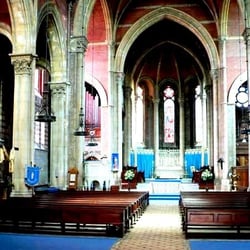
Church of St Mary the Virgin, Kemptown - St Mary Brighton - nave from baptistery

Church of St Mary the Virgin, Kemptown

5.0(1 review)
0.2 mi

Never can such an unprepossessing exterior have hidden such a gem. From the outside, St Mary's…read morelooks like you average, run-of-the-mill neo-gothic Victorian church. It doesn't even look that large, and has the added humiliation of a public lavatory attached on one side. But once inside, you turn and find yourself in a cathedral-like space: a huge nave, an even larger crossing and a spectacular chancel and sanctuary. This is architecture as drama, writ large. St Mary's has had an interesting history: opened in 1827 to cater for the burgeoning suburbs of east Brighton, the original church was a rather handsome neo-classical building, modelled on the temple of Nemesis in Athens. Alas, like many Regency buildings, it was badly built, and partially collapsed during building work in 1876. The architect commissioned to design its replacement was William Emerson, known mostly for his work in India. St Mary's is his only church in the UK, and he chose the decorated gothic style for his new creation, albeit one with other elements: the aisle arches are round-headed and groups of Early-English lancets proliferate - all in red brick, with Bath stone detailing. The arcades rise to Corinthian capitals, both in the nave and in the apse of the sanctuary. Cleverly, Emerson made full use of the changes in levels, first down from the entrance and baptistery into the nave, and then back up again into the sanctuary, to emphasise the height. (The nave is 40ft across and 60ft high.) The only element not completed was the tower, which was abandoned for lack of funds, although early drawings show what was intended. The church has a wide array of Victorian stained glass, including an example by Kempe, although other workshops predominate. (The web-site has excellent pictures of all the glass). The furnishings are also of high quality, including a carved pulpit of Caen stone, and a marble font, which stands on a plinth of granite from the Schreckhorn mountain in the Bernese Oberland in Switzerland. This commemorates the second Vicar, Julius Elliott: an accomplished rock climber, he was the second to ascend the North Face of the Matterhorn, but died in 1869 after an apparently successful ascent of the Schreckhorn, at the age of 28. The other notable feature is its organ, which is known for its tonal quality, enhanced by the excellent acoustics of the church. The only downside to all this grandeur is that to-day's rather smaller congregation struggles to resource the scale of maintenance required of such a huge building. It needs generous visitors.

Photos
Church of St Mary the Virgin, Kemptown - St Mary Brighton - original design with the tower (never built)

St Mary Brighton - original design with the tower (never built)

Church of St Mary the Virgin, Kemptown - St Mary Brighton High Altar Reredos (1893)

St Mary Brighton High Altar Reredos (1893)

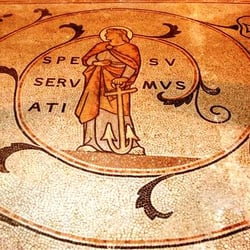
Church of St Mary the Virgin, Kemptown - St Mary Brighton Mosaic 01

See all

St Mary Brighton Mosaic 01

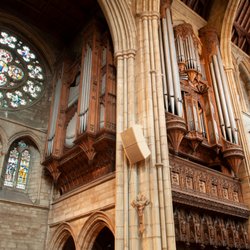
All Saints Hove - Double-fronted organ case, design by the church architect's son

All Saints Hove

5.0(1 review)
1.6 mi

The church's website describes All Saints as 'one of the finest churches of the nineteenth century…read moreGothic Revival'. Possessed of an extraordinary interior, it was much admired by the eminent architectural historians Pesvner and Sir John Summerson, and is well worth seeking out. The church was the vision of Thomas Peacey, the first Vicar of Hove when it was made a parish in its own right in 1879. He rebuilt the old church (St Andrew's) and erected another (St Barnabas), before turning his attention to providing a new and spacious Parish church. The architect chosen was John Loughborough Pearson, viewed by many as the greatest architect of the Victorian Gothic revival. Amonst other things, he was responsible for the new cathedrals of Truro and Brisbane, as well as many churches in London. All Saints was to become the largest and costliest of his parish churches. Work began in 1889 and was largely completed by 1901, although the base of the tower was not finished until 1922 (and the remainder of the tower has, unfortunately, never been completed). Pearson chose a French C13th Early Decorated Gothic style for the new church, which is built of Sussex sandstone, and roofed with Sussex oak. The outside is attractive enough, with strong pinnacles around the south transept and chancel, although the tower base looks forlorn with its humble pyramidal cap. But the interior is breathtaking. For a start, the scale and proportions are those of a cathedral: the nave is 40ft wide, and flanked by generous aisles. And the walls are entirely faced with ashlar stone - clear evidence of no expense having been spared. The plan is conventional, with an aisled nave, short transepts, south chapel and chancel. The nave is particularly impressive: five bays of clustered piers rise through large clerestoreys towards transverse roof arches. These provide a repetitive pattern against the dark wooden roof, emphasising the height and leading the eye towards the chancel. Only the south chapel and sanctuary have stone vaults. The windows are equally impressive, and the church carries an almost complete scheme of stained glass by the famous company of Clayton and Bell. The north transept has three twin-light windows with a rose window above, whereas the south transept has a magnificent five-light window. The furnishings are equally impressive and lavish: pride of place goes to a stunning high-Victorian stone reredos, of Pearson's design and carved by Nathanial Hitch. There is elaborate wooden carving everywhere, most notably the screens of the South Chapel, the choir stalls and the amazing organ case, the latter designed by Pearson's son, Frank Pearson. The marble font is a later addition, dating from 1928, and carries a large ornate wooden cover. Although the pews have been removed, the replacement chairs are reasonably sympathetic, and the interior is very well maintained. The church takes advantage of the splendid setting to stage a wonderful Sung Eucharist, every Sunday at 10h. During the summer, they also host classical music concerts every Thursday, May to September (free to enter but donations requested), and lay on tea, coffee and biscuits. The church also has an active programme of children's groups, as well as other outreach and support groups. Details of other services and events can be found on the website.

From the owner: All Saints Hove is an inclusive catholic parish in the Church of England. We believe that there is…read morea place for everyone to receive the unconditional welcome of God, and we are a member of the Inclusive Church network. We seek to give to give a voice to those on the margins in our society and use our facilities to support the homeless and vulnerable and champion the outcast and poor. Whether you are looking for a grand period event space or a casual, cost-effective location to run classes or meetings, we make various spaces available for hire, for the purpose of offering community services and strengthening community spirit and bringing residents together.

Photos
All Saints Hove - The chancel façade of the William Hill & Sons pipe organ

The chancel façade of the William Hill & Sons pipe organ

All Saints Hove - Nave, looking east

Nave, looking east

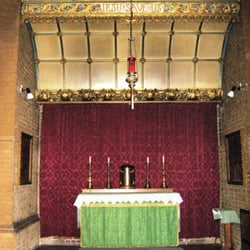
All Saints Hove - High altar, viewed from the choir stalls

See all

High altar, viewed from the choir stalls

St Nicholas' Church

St Nicholas' Church

4.5(2 reviews)
1.3 mi

Brighton's ancient parish church is easily overlooked on a visit to the town. The church sits in a…read morelovely churchyard, with lawns, mature trees and brick pavements, just yards from the busy modern shopping area of Churchill Square, and yet feels as if it would be equally at home in a Sussex village. Superseded as the parish church by St Peter's in the 19th century, it still claims itself as the 'Mother Church' of Brighton, and indeed St Nicholas was the patron Saint of fishermen, doubtless a natural choice for the original little fishing village of Brighthelmstone. Its history dates back to Saxon times: the Domesday book (1085) states that there was a church here in the time of King Edward (the Confessor, presumably), although nothing survives from this foundation. It is clear that it was rebuilt in the Norman period, and there is a small amount of Norman work in the tower. Otherwise, the church is substantially a late 14th century creation, from around 1380: the nave (five bays on octagonal piers), chancel and tower arches date from this time, and the outside of the tower is probably original too. The church was heavily restored around 1853, and a clerestory added in 1892. The church is notable, however, for its furnishings. Pride of place must go to its font: the great architectural historian Pevsner regarded it as the 'best piece of Norman carving in Sussex'. The font is drum shaped, and probably dates from around 1170. The surface is completely carved, with scenes representing the Last Supper; St Nicholas and the ship; the Baptism of Christ; and another presumed story of St Nicholas. The base has a decorative frieze below the scenes, featuring scallops, scrolls and half rosettes. It is a stunning survivor. Other fittings are mostly Victorian. Close to the font is the Duke of Wellington memorial (1853): the young Wellington attended church here, and the huge octagonal sculpture, in the shape of a font cover but inspired by the Eleanor crosses, is elaborately carved in best Decorated Gothic style. There are walls painting on the east and west nave walls by Kempe, as well as some attractive stained glass, also by Kempe. An iron plaque commemorates another regular worshipper, Samuel Johnson, and a medallion celebrates another, the actress Dame Flora Robson. Outside, two headstones are worth a look: the first, commemorates Phoebe Hessel, who dressed as a man and served - and fought - as a foot soldier and died aged 108 in 1821; and the second, to Martha Gunn (d. 1815): 'Peculiarly Distinguished as a bather in this town 70 years'. It clearly did her good, as she lived to be 88.

On Wednesday's there are concerts starting at 1230hrs, put on by various Musicians or Singers, for…read moreabout three quarters of an hour. These are free, but a donation is appreciated. Prior to the concert tea and biscuit are availble for 50 P.

Photos
St Nicholas' Church
St Nicholas' Church
St Nicholas' Church

See all

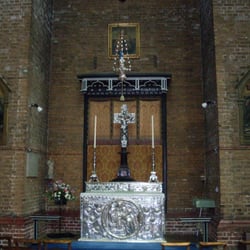
St Bartholomew's Church - Lady Altar - also known as the 'Silver Altar', for obvious reasons...

St Bartholomew's Church

4.2(11 reviews)
0.6 mi

Pevsner's 'The Buildings of England' describes St Bartholomew's as 'an unforgettable experience',…read moreand it's hard to better that description. This Victorian gothic edifice, just outside the centre of Brighton, is one of the most dramatic parish churches in the UK, with one of the highest naves in Europe. At 135ft (41m), it is just 7 feet lower than that of Cologne Cathedral. For many years, it dominated the view to the east as you arrived by train into Brighton station. (Alas, a sight no longer available thanks to the erection of some appallingly dull blocks of offices and flats). The building was the brainchild of Father Arthur Douglas Wagner, (1824-1902) himself son of the Vicar of Brighton, and a colourful local character: a wealthy young man, he was ordained in 1849, and became priest of St Paul's, Brighton (see separate Qype entry), which his father had essentially built for him. A leading Catholic Revivalist, and determined to develop a ministry to the poor, A D Wagner was to build several churches in Brighton, all out of his own pocket. Of these, St Bartholomew's is the best known. Built in 1872-74 to designs by a local architect, Edmund Scott, St Bartholomew's is in a plain Gothic style, and of brick throughout. The church is aligned north-south, with the main (ritual West) entrance on Ann Street. Standing in front of this gives a good foretaste of what is to come: a towering brick facade, containing a truly huge Rose Window, it completely dominates its surroundings. Once inside, the eye is immediately drawn upwards and forwards: the wooden wagon roof simply disappears in darkness, and nine bays of huge pointed arches lead the eye to a sanctuary containing an enormous baldachino, 45ft (15m) high, covered entirely in marble. The arches each contain a shallow chapel with a single lancet, with another lancet in the clerestory above. Polychromatic bricks are all that relieve the scale, for there is virtually no other ornament in the architecture. The accumulated grime on the walls gives the interior a dark and mysterious feel. The intended chancel was never built, and instead a sanctuary was created at the east end of the nave. This accommodates the baldachino and a huge pulpit also of marble both by the noted arts and crafts designer, Henry Wilson (1864-1924). He also designed the Lady Altar also known as the silver altar with a repoussé frontal of silver plate on copper and the pair of pillar-sized candlesticks either side of the altar. The whole effect is breathtakingly dramatic, and perfectly suited to the high Anglo-Catholic ritual and superb liturgical music, for which the church is renowned. The church has an active and busy parish life, and a weekly mass for the attached junior school. A constant stream of visitors from around the world walks through its doors daily, to see this astonishing building for themselves.

I walk past this sky scraper like church on my way to Sainsbury's, recently I ventured in to have a…read morepeak. I'm not religious, and I don't think that helps really. I found all the bronze and silver statues of Jesus and various friends dying to be a bit glum, and also a bit anthithetical given that the church asks for donations. In terms of the building though, it's unbelievably tall. From what I read, it's the tallest church in Europe, for that along, definitely visit if you're nearby. I found it massively interesting, the architecture is unlike much else, as is the slightly scared feeling you get walking around inside.

Photos
St Bartholomew's Church - St Bartholomew's totally dominates its surroundings...although the view from the railway is, now, alas destroyed.

St Bartholomew's totally dominates its surroundings...although the view from the railway is, now, alas destroyed.

St Bartholomew's Church - Altar with tabernacle for the Reserved Sacrement

Altar with tabernacle for the Reserved Sacrement

St Bartholomew's Church

See all

St Peter's Church - From website

St Peter's Church

3.0(5 reviews)
0.5 mi

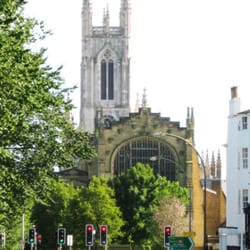
St Peter's Church is one of Brighton's most distinctive landmarks. Slightly out of the city centre…read moreon the main A23 to and from London, it sits in the middle of the gardens which run down to the sea, in splendid isolation. For many, it is the first memorable sight on entering the city. It is a grade II* listed building. The church was built originally as a 'Chapel of Ease' of the then parish church of St Nicholas, to accommodate the growing population of the city in the first quarter of the 19th century. A competition was held to design it, won by the young Charles Barry, later to find fame as the architect of the Houses of Parliament. The church was begun in 1824 and consecrated in 1828. Orientated north-south, the church had large aisle galleries and a simple hexagonal apse, making the interior typical of the 'preaching boxes' of the time. The exterior, however, with its confident Perpendicular Gothic forms - rows of buttresses and pinnacles and an innovative tower design - was a major departure for the time; the classical style was still in vogue for church building, alongside the more stylised 'Gothick' used in many country houses: many regard St Peter's as the most important neo-Gothic church of the pre-Victorian period. The church was substantially altered between 1898 and 1907 when the east end was replaced with a more traditional chancel, to designs by Somers Clarke and Micklethwaite. Built in deep yellow local sandstone, and itself an impressive work of late Perpendicular Gothic, this has, however, always contrasted somewhat uncomfortably with the earlier work in colour (Barry built in and style. The interior galleries were removed at the same time. Whilst this undoubtedly opened up the nave, it also drained some of the character from what is otherwise an impressive space. The church has a number of impressive windows by Kempe, perhaps most notably the jaw-droppingly vast east window, and the east and south-east windows in the south chapel. Increasing maintenance costs (not aided by elements of the original design, not least the unsuitably of Barry's stonework to resists the effects of salt-laden seaside air) were becoming beyond the means of its congregation, and led to the decision to declare the church redundant. It was closed in July 2009 and is now being run as a 'church plant' by Holy Trinity, Brompton, founders of the Alpha Course.

I find it pretty hard rating a church out of five, what with all the balancing my own quite open…read morebut non believing tendencies, with respect for those who do believe, I find I'm in a bit of a conundrum. But...I'll go for 3 stars. It's big and imposing, but it's also quite worn and tattered from the outside. 19th Century churches always make me think of Dicken's and Oliver, and general scary Victorian strictness, so I don't warm to this church all that much. However some of the glass windows and the art work in the ceiling is magnificent, and I'm sure with a full on choir in here, it can become pretty special.

Photos
St Peter's Church - Sunday morning at St Peter's.

Sunday morning at St Peter's.

St Peter's Church - From website

From website

St Peter's Church

See all

Church Of The Good Shepherd

Church Of The Good Shepherd

4.0(1 review)
1.7 mi

The Church of the Good Shepherd is a familiar landmark to those entering Brighton from the A27…read morealong Dyke Road, with its 60ft brick tower and clean, modern gothic lines. The church was the vision of Prebendary Gerald Henry Moor, vicar of Preton, who foresaw the need for a church in the suburbs growing along the artery of Dyke Road before the First World War. He died in 1916, but a temporary 'tin church' was established on the site, and the work to complete a new brick church was carried forward (and largely paid for) by his wife, Alice Mary Moor. The new church was consecrated in 1922, although the East end and tower were not completed until 1927. The architect was E P Warren, who designed a number of churches, but is most noted for his work on various Oxford Colleges and for designing the British military cemetery at Basra. The church is adjoined by church offices, the Vicarage and a church hall, linked together with stone paths and neat gardens. The exterior is neat and attractive, with mixed bricks and a West Window of five simple Early English lancets, with the south-west tower providing a clear focal point. The entrance is through a generous narthex under the tower, but nothing can prepare you for the interior, which is something of a surprise: here, very narrow, low aisles are separated from a very broad nave by plain gothic arches with square piers, and a huge, low, wagon roof. This sweeps uninterrupted, except for a rood screen, to the chancel, giving the appearance of a tunnel. Indeed, one friend compares it with the grand stations on the Moscow Underground, and the description is rather apt. The effect is rather intensified by the sea of modern chairs in the nave, upholstered in bright blue. The ceiling has attractively decorated transverse and longitudinal ribs, and an organ case and other furnishings by the Guildford architect William Henry Randoll Blacking (1889-1958). The church has a busy parish life, with a large and active congregation, a strong choral tradition and an active team of bellringers. Worship is in a modern (and moderate) Catholic tradition and, according to its website, aims to 'meet the worship and spiritual needs of people from a wide range of traditions'. Full details are set out on its web-site.

Photos
Church Of The Good Shepherd

See all

Brighton Buddhist Centre

Brighton Buddhist Centre

4.8(6 reviews)
0.4 mi

I was completely in awe on my first visit here on 6th June…read more I am completely new to Buddhism and was so happy to be so welcomed, so accepted, and so happy to be around people that I can relate to and learn from. I arrived at 12:30 when free meditation was open and had a look around the reception area. I was very happy to be offered a cup of tea and be so pleasantly chatted to. The lady kindly took me on a tour of the building, showing me the beautiful two large shrine rooms and the small personal shrine room. She not only told me a bit of the history of the charity and the founder, but also showed me how to meditate, and did some guided meditation for me. I'll have to save up to get the train back to Brighton just to visit here again. I'm so glad these people exist.

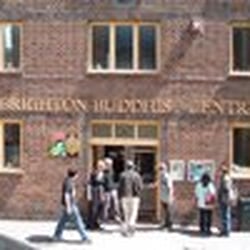
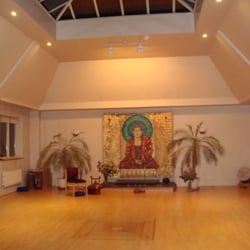
Brighton Buddhist Centre is the hub of Buddhist study and practise in Brighton- they have been…read moreteaching and practising Buddhism, meditation and yoga for over thirty years. The organisation aims to make spiritual practise accessible to all sorts of people with all levels of knowledge and experience. The centre is staffed by friendly volunteers who will welcome anyone who wishes to drop in for a chat about what's on offer. Amongst the many classes and courses available, they run led drop in meditation for those who aren't yet ready to commit to a full course. Similarly you can drop in to an impressive range of yoga classes- choose from: Hatha, Iyengar, Astanga and Vajrasati. There are lunchtime and evening classes to suit all schedules. The building itself has a calm, peaceful atmosphere (as one might expect!). A small shrine room is available for individual meditation and a beautiful large room with a glass roof is used for group meditation practise. The centre is a really great resource, not only for supporting Brighton's Buddhist community but for educating people as to what Buddhism is really all about! That said, you don't need to be interested in spiritual study to attend the meditation or yoga classes...they're open to all.

Photos
Brighton Buddhist Centre - Picture courtesy of Brighton Buddhist Centre

Picture courtesy of Brighton Buddhist Centre

Brighton Buddhist Centre

See all

St. Pauls Church - Narthex, with the entrance to the Nave on the right.

St. Pauls Church

4.0(2 reviews)
0.5 mi

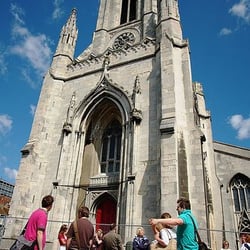
Despite being at the very centre of Brighton, next to the conference centre and between the railway…read morestation and the sea, St Paul's is often overlooked by locals. In spite of its size, and its distinctive tower, it almost hides itself among the adjacent office blocks and the Churchill Square shopping centre. At night, and especially at week-ends, the area is packed with people visiting the numerous bars in the area, who probably don't give a second thought to the church in their midst. But they are missing a gem - a beautiful church with a colourful history, and a haven of peace and tranquility in the heart of the City Centre. St Paul's was essentially the vision of one man, Rev. Henry Michell Wagner, vicar of Brighton for forty-six years from 1824 - 1870. He was a wealthy man, and saw the need to build a church to minister to the poor living in the fishing quarter to the west of the church (where the Churchill Centre now stands). He was also a proponent of the Tractarian movement, which advocated a return to more traditional liturgy and ceremonial in the Catholic style. The church has remained a beacon of Anglo-Catholicism ever since. Completed in 1848, the church was one of the first designed in the Gothic Revival style, by the architect Richard Cromwell Carpenter. Saint Paul's was built with newly researched gothic proportions, structures and symbolism, and won immediate acclaim, with its inspiring furnishings and fine stained glass. The glass in particular, is a notable feature, designed by Augustus Pugin (1812-1852), who designed much of the interior of the Houses of Parliament. The windows represent the most complete cycle of Pugin glass in any Anglican church, and are quite exceptional in their colour and detail. It was Wagner's son, Arthur Douglas Wagner, who became the Vicar when he was ordained in 1850, and he remained here until his death in 1902. The traditional style of service, with its pre-reformation elements, attracted both a large congregation and considerable controversy. The ceremonial was mocked as 'the Sunday Opera at St. Paul's', and Wagner's uncompromising teaching on the sacraments evoked anti-papist politics, which eventually broke out into open violence. In 1865, Wagner had refused to give evidence from the confessional at the trial of a woman who had murdered her half-brother. This led to outrage and questions in Parliament about the nature of the confessional at St Paul's. The scandal deepened when it emerged she had offered him £1,000, even though he had not accepted it. Wagner himself was assaulted, and worshippers pelted with stones. Things are, thankfully, much quieter to-day. The church itself is accessed either via the long (and slightly dingy) cloister from West Street, or the old main entrance in Russell Place. It is a grade II* listed building. The exterior has walls of Sussex flint with Caen stone dressings. The tower, originally rather shorter, was extended upwards with a large wooden octagon in 1873. This amazing structure, restored by english heritage, gives the church a slightly foreign appearance, more akin perhaps to the imaginary towers of some Transylvanian castle than a Sussex church. Once inside, the church has a generous Narthex, or entrance space, adjacent to which is the Fishermen's Vestry. This fine Baronial-style Hall, now used for meetings, was once used by the fishermen as a place to mend their nets - hence the name. Turning right from the Narthex, you are hit by the full theatre of the main worship space: a large and beautifully proportioned nave in the decorated gothic style, with generous aisles, leads to an elaborately decorated chancel. The rood screen in front was designed by Carpenter himself, though the cross and figures above were designed by G F Bodley, another great neo-gothicist. As well as the glass and chancel, the church has rich furnishings, in particular its font, pulpit and elborate four-pillared lecturn, designed specifically for the church. All this comes alive during special services, when the church is lit largely by candle-light: whatever your feelings about this style worship, it's a magical experience. To-day, the church has a busy life, with regular week-day services, as well as being a home for music recitals (including during the Brighton Festival) and art exhibitions in the Narthex.


Parish church for the centre of Brighton. Small but ornately decorated. Has life-like Stations Of…read moreThe Cross - one of the best that I've seen. It is a High Church of England & has Mass @ 12.30 on Tues & a sung Mass @11AM on Suns. Strong choir in the parish. It has retained the original altar rails that I knew as a child. The altar screen was erected in 1911 & has a richly decorated pulpit. It has a vibrant parish community, with weddings & baptisms being celebrated there which is good for the future of the church. The only problem for visitors is that it is not easily seen from the road. You could walk by it in the blink of an eye, which is a shame.

Photos
St. Pauls Church - St Paul's church from the south-west, West Street, Brighton

St Paul's church from the south-west, West Street, Brighton

St. Pauls Church - Nave, looking East

Nave, looking East

St. Pauls Church - Chancel and Rood Screen

See all

Chancel and Rood Screen

Dorset Gardens Methodist Church - religiousorgs - Updated May 2026

Loading...
Loading...
Loading...