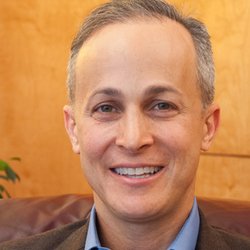
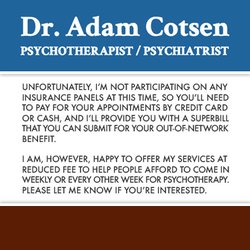
David is a psychopharmacology guru. I've been his patient for almost 20 years (he's a doctor, not a therapist for short term issues, so that's a GOOD thing). He's quite literally changed my life, and in one instance he probably saved it. So I'm kind of a fan. Here's why.
I saw David for 10 years prior to having to move away for a job in another state. I recently returned to the Bay Area, and initially went to Stanford for reasons that were unrelated to him. The first doctor at Stanford was wonderful, but she moved away. The second practitioner wasn't even a doctor (see my review of that), but a nurse practitioner with the authority to prescribe meds. She was a disaster, and Stanford was unsympathetic. See my review of Stanford for more on that.
So back back to David I went.
First, he always considers context when changing meds or starting new ones. He is highly knowledgeable about potential side effects of the drugs he is prescribing, and great at helping me to understand their significance and factor them into my treatment plan.
As a former scientist and now patent lawyer who works in the Pharma field, I appreciate that he will talk science to me on a level that makes me especially confident in what he does.
I am on a number of drugs for a number of things, and our sessions always begin with, "has anything changed?" Then if they have, he assesses whether any known drug-drug interactions exist that would be cause for concern or necessitate changes to prevent my other meds from either not working or working too much and causing deleterious effects - like dying. He also does this when considering changes to my treatment plans.
David keeps up with the literature in a way I have never seen any other doctor of any type do. That's important in this field, one where the illnesses are still poorly understood, so diagnosis and treatment are still mostly empirical, and based primarily on patients' reports of their inner experiences and observations about their affect and their behavior, both self-reported and observed.
Because he keeps up, he can offer treatment options (if there are any), so if one thing doesn't work, he has lots of other things to try. He's also aware of the most recent developments, and tells me if they are still in the experimental stages and still unavailable (but are likely to be), or currently in the market, and if so, whether they are viable options or if they are something to try as a last resort.
He is one of the few docs who has his patients obtain genomic testing for markers that can in some cases help determine what you are likely to respond to and whether you're likely to have side effects. This in some cases can allow him to do a better job of identifying your best options without a lot of messing around. (As a patent lawyer formerly involved in the genomics field at a very early stage, it's utterly amazing to see one of genomic science's potential benefits becoming reality in such a short period of time).
David involves me in treatment decisions so I feel like I am working with him, and am not just being told what to do. He is incredibly easy to talk to - so much that he's had to remind me he's not a therapist - and gets a good handle on where you're at in your life before he decides whether and how to tinker with my treatment plan.
I have seen several psychopharmacologists, and David stands out because he is so engaging and personable and well, just downright likable. He will be firm when necessary, but always in a respectful and constructive way. His concern and regard and respect for me is sincere and never in question. Consequently I never feel like I need to hold anything back - and this is vital to getting the best possible treatment.
Finally, seeing him is quite convenient - my appointments are conducted via FaceTime (he uses other platforms too) so there is no driving time required. That saves a huge amount of time. He is extremely tech savvy so things get done literally immediately.
So, if you need a paychopharmacologist, he's literally the best one around, from a scientific, patient service and quality of care perspective. He's made a huge difference in my life, and allowed me to function and enjoy my life to the greatest possible extent I can. read more