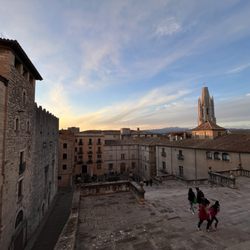
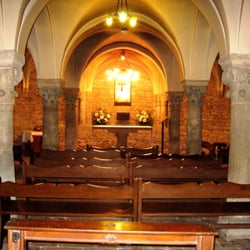
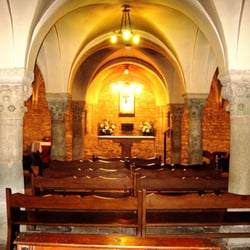
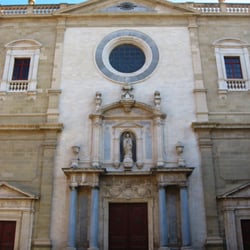
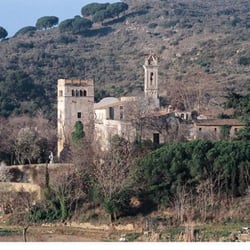
Set at the confluence of two rivers, this stunning collection of ecclesiastical buildings (actually…read morethe three churches of Sant Pere, Sant Miquel and Santa Maria) comprises one of Spain's best preserved monuments from the Visigothic period (6th to 8th Centuries). With their reddish-gold stone walls and tiled roofs, they also make an exceptionally attractive group of buildings, even to those not wowed by their age, history or churches in general.
History
The history of such a site is, as you might expect, rather complicated, but essentially, there is some evidence that it was settled before the Roman period, with finds of Iberian pottery. It may have been the site of the Roman town of Municipium Flavium, but the evidence is pretty convincing that it was the site of the later Roman town of Ègara.
Here, a Christian settlement developed towards the end of the Roman Empire, and continued through the Visigothic period. In the early 5th century, a baptistery and basilica was built on the site, where the church of Santa Maria now stands, alongside other Roman buildings. This was adapted and extended in the later 5th Century to become a cathedral of the Visigothic Bishopric of Ègara. This flourished until the 8th century, when the Visigothic kingdom declined when invaded by the Moors.
Alongside the cathedral, some time between the 6th and 8th Centuries, a small square-plan church (now Sant Miquel) was built, using Roman columns in its construction. This was linked to the cathedral and may have been a mausoleum or funerary church. Slightly further to the west, another church was built between the 6th and 8th centuries, now the site of St Peter. This had a graveyard adjacent, and was probably also linked to the cathedral by a covered passageway.
The sanctuaries of both Sant Pere and Santa Maria were rebuilt some time around the 6th to 8th centuries, and their naves rebuilt in the late 11th and early 12th centuries in the Romanesque style: Santa Maria was consecrated in 1112. Thereafter, Santa Maria became a priory and Sant Pere the parish church, until it was moved to Sant Esperit church in the centre of Terrassa in the 16th century.
Sant Pere
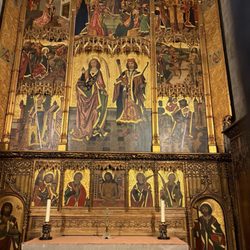
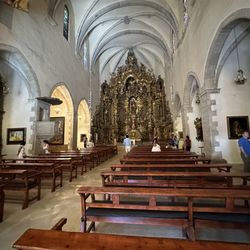
The largest of the three churches, Sant Pere's sanctuary dates from some time before the 8th century, with the nave dating from the 12th. On entering, the church appears spacious but dark: opposite on the north wall are rather pale wall paintings from the 14th century, showing scenes of Christ's Passion and the lives of the Apostles and various saints. On the south wall towards the west end is a fine 15th century altarpiece by Jaume Huguet, depicting the Saints Abdo and Senen, saints of Persian origin venerated locally in Catalonia, and the physician saints Damian and Cosme.
The most impressive part is the Sanctuary, which has a mosaic floor from the 10th century, as well as an impressive reredos consisting of two rows of blind arcading, with fresco decoration in the Byzantine style, showing angels, the four evangelists and other persons with haloes.
In the north chapel is a well preserved 17th century baroque altarpiece, and in the south transept are modern paintings and mosaics dedicated to the Virgin of Montserrat. At the west end is an impressive 18th century balcony with an impressive organ.
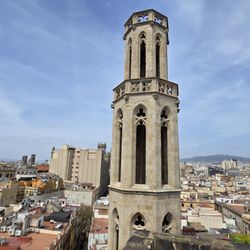
Outside, the church is rather plain, with belfries at both ends.
Sant Miquel
In many ways the most attractive of the three churches, it is the oldest complete building on the site, dating from some time between the 6th to the 8th centuries.
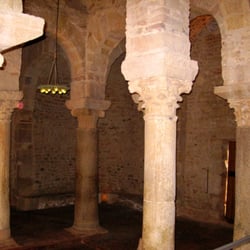
The exterior clearly indicates its internal plan, of a Greek cross imposed on a square, with a polygonal apse. Inside, there is a central cupola supported on narrow arches, in turn supported on eight columns with reused Roman or Visigothic capitals, above a large central baptismal pool. There are also signs of Roman tiles having being used in the building of the walls.
The apse is decorated with the remains of wall paintings in a primitive Byzantine style, depicting the Theophany, with the twelve apostles and the prophet Ezekiel. Below the apse is a small three-chambered chapel, dedicated to Sant Celoni. The windows throughout are made of thin plates of quartz stone, one attractively decorated to resemble two rows of Romanesque arches.
Santa Maria
This is the most complex of the churches, and the most rebuilt. Before entering, look outside the west door on the ground to see the well-preserved remains of the mosaic floor from the 5th century basilica.
The exterior is remarkable: the west end has symmetrical stepped blind arcades of narrow arches in the Lombardic style, but the eye is drawn to the extraordinary crossing. This consists of a tower with round-arched openings beneath a pyramidal cap almost a campanile - sitting on top of (and slightly off-centre from) an octagonal crossing tower, which supports the dome beneath. Elsewhere are the small, round arched widows typical of Romanesque