The world's first nuclear explosion occurred on July 16, 1945, on what was then called the White…read moreSands Proving Ground, a base established for a specific use by the Army following the attacks on Pearl Harbor, when a plutonium implosion device was tested at a site located 210 miles south of Los Alamos, New Mexico, on the plains of the Alamogordo Bombing Range, known then as the Jornada del Muerto. The code name for the test was "Trinity."
Hoisted atop a 100-foot tower, a plutonium device, called "Gadget," detonated at precisely 5:30 am over the New Mexico desert, releasing 18.6 kilotons of power, instantly vaporizing the tower and turning the surrounding asphalt and sand into a green glass, called "trinitite." Seconds after the explosion, an enormous blast wave sent searing heat across the desert, knocking observers to the ground.
Reports from witnesses came from as far as 200 miles away. A forest ranger 150 miles west of the blast said he saw a flash of fire, an explosion and black smoke. An individual 150 miles north said the explosion "lighted up the sky like the sun."
A U.S. Navy pilot flying at 10,000 feet near Albuquerque, New Mexico, said it lit up the cockpit of his plane and was like the sun rising in the south. When he radioed Albuquerque Air Traffic Control for an explanation, he was simply told, "Don't fly south." After the test, the Alamogordo Air Base issued a press release that stated simply, "A remotely located ammunition magazine containing a considerable amount of high explosives and pyrotechnics exploded, but there was no loss of life or limb to anyone." The actual cause of the blast was not disclosed until after the U.S. bombing of Hiroshima, Japan, on Aug. 6.
The success of the Trinity test meant an atomic bomb could be used by the U.S. military and it marked the start of the Atomic Age.
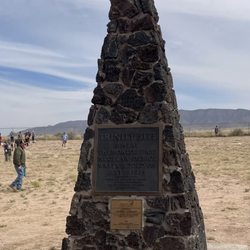
The Trinity Site is now part of the White Sands Missile Range and is owned by the Department of Defense. Ground zero is marked by an obelisk made of black lava rock, with an attached commemorative sign. A slightly depressed area several hundred yards across surrounds the monument, indicating where the blast scoured the ground.
Most of the northern Tularosa Basin is still used for missile research. WSMR is home to the DoD's largest, fully-instrumented, open air range, missile defense system, which provides America's Armed Forces, allies, partners, and defense technology innovators with the world's premiere research, development, test, evaluation (RDT&E), experimentation, and training facilities to ensure our nation's defense readiness. But inside this basin are also enclosed numerous areas that are not military land (like the NPS's White Sands National Park which I could not fit in.
Unlike a typical desert that is composed of quartz, the White Sands area here is named...well...for its white, which is made of gypsum and calcium sulfate. This allows the desert sand to look like snow and feel cold to touch, and is protected by the state of New Mexico as a National Monument!
Everyone should experience these hollowed grounds that changed history.