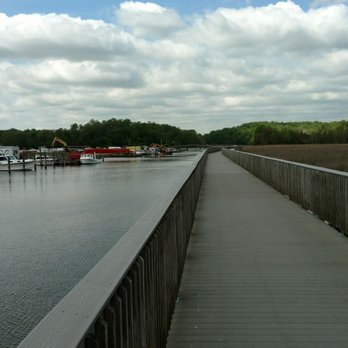
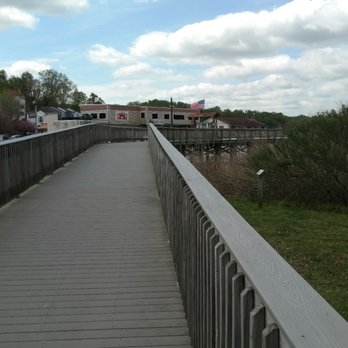
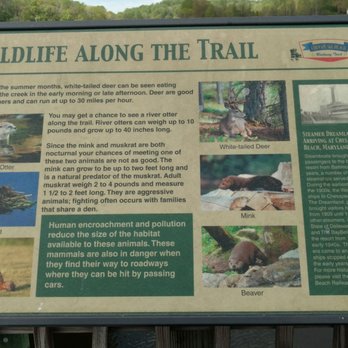
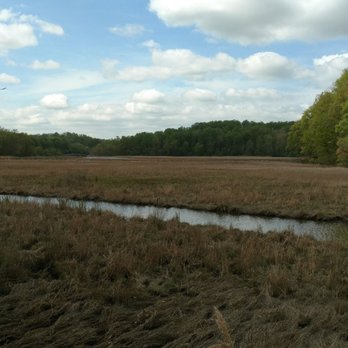
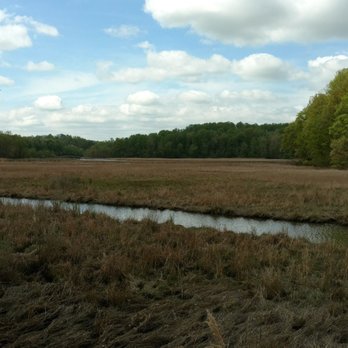
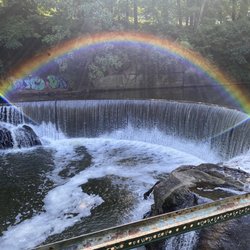
SUMMATION: Beautiful, well-managed wildlife area. They are accomplishing good environmental…read morepreservation and education.
NAME: Parkers Creek Preserve
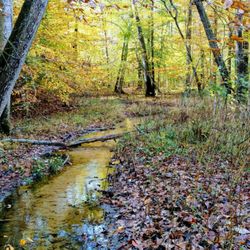
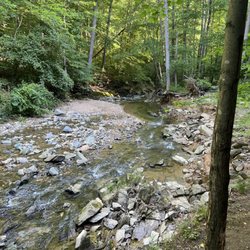
DESCRIPTION: Parkers Creek Natural Area has the largest contiguous tracts of forest in Calvert County. It progresses from dry, sandy upland woods to cool, moist ravines and forested wetlands. The ancient shell deposits from the Miocene Epoch, which deposit fossils on the beaches of Calvert County, create fertile soils in the inland ravines that support remarkable spring wildflower displays. Flowers such as American Golden Saxifrage [A] and Two-leaf Miterwort [B], uncommon on the typically poor soils of the Coastal Plain, thrive in the rich, moist soils of these steeply sloped valleys. Eastern Fence Lizards [C] and other reptiles make their home in the dry, sandy uplands, as do some unusual plants. The creek meanders near the coast.
MY RATING: Excellent (4.9/5)
SIZE: ~2000 acres with Creek 2.5 miles long and 15 miles of hiking trails.
TITLE: "Great Conservation" [Yelp, Parguera Pirate review #450 [1], 10 November 2015, updated 30 November]
CHESAPEAKE BAY TRIP REVIEW NUMBER: 19
TELEPHONE: (410) 414-3400, FAX: 410-414-3402
WEB PAGE:
MANAGEMENT: American Chestnut Land Trust
LOCALITY: South trail: Scientists Cliffs Road, Port Republic, Maryland 20676; North trail: Double Oak Road, Prince Frederick, Maryland 20678 [see maps on web page]
MAILING ADDRESS: PO Box 2363, Prince Frederick, Maryland 20678
DIFFICULTY LOCATING: easy
DIRECTIONS: see their web page
HOURS OF OPERATION: Daily dawn to dusk. Double Oak Farm is closed during deer firearms season for safety.
FEES: none, but memberships available
AMINITIES: Fifteen miles of self-guided serene public hiking trails in two locations. Guided hikes are available from spring through fall. Guided canoe trips are offered from spring through fall on beautiful Parkers Creek. Check the online calendar of events for annual family events.
ANIMALS: pets welcome
HEALTH:
(I) Swarms of mosquitoes near the wetlands and biting Black Flies [D] in the forest.
(II) Limited access for wheelchairs and must be arranged prior to visit.
AWARDS: Important Bird Area (2014, National Audubon Society)
HISTORY: When Annie Gravatt died in 1986, Peter R. (Richard) Vogt (76) and Ralph H. Dwan (1932-2011) collected $400,000 from more than 90 families in Scientists' Cliffs to purchase 450 acres of nearby, undeveloped land from her estate to save it from commercial development. Vogt contributed $7500 to start the preservation project called the American Chestnut Land Trust (named for the trees once common in the area). The trust now manages more than 4000 natural acres, acquired by the State and the Nature Conservancy. The trust includes Parkers Creek and offers hiking and canoeing.
FOOTNOTES:
[1] Plus thousands of unnumbered article and book reviews for hundreds of journals.
SPECIES:
[A] American Golden Saxifrage, Chrysosplenium americanum. We also saw a lot at the base of the cliffs at Scientists' Cliffs.
[B] Two-leaf Miterwort, Mitella diphylla.
[C] Eastern Fence Lizard, Sceloporus undulatus.
[D] Black Fly, Simulium spp., are small insects. Adult females feed on blood. Swarms can be quite aggravating. One got the Pirate, but did not escape unsquashed. They carry human diseases in the tropics.