I am leaving this review because I believe prospective clients, should know about my experience and…read moreshould be able to examine the correspondence for themselves. I was referred to Maria Scheuring through the Suffolk County Bar Association Lawyer Referral and Information Service. I paid $25 for the 30-minute consultation I was referred for and repeatedly attempted to obtain that consultation.
Instead of simply scheduling the consultation, I was repeatedly asked to explain and re-explain what I was seeking. My request was reframed, narrowed, redirected, and ultimately sent elsewhere. At one point, I was told, "They help people like you in situations like this," and I was provided with the direct contact information for Feride Castillo, ECLI-VIBES's co-founder and Program Development & Education Director. I was not asking for free representation. I was not asking Ms. Scheuring to represent me without a retainer. I had already paid for the consultation that I was referred to her for. I also never received a retainer quote, was never asked what I could afford, and never represented that I could not afford legal services. Yet the interaction increasingly became about whether I belonged somewhere else rather than about providing the consultation I had already purchased. I asked a very simple question:
"Are you going to provide the 30 minute consultation I paid for or not? Yes or No?"
I did not receive a yes-or-no answer. That is significant to me because a straightforward professional response could have ended the matter immediately. If the consultation was not going to be provided, I could simply have been told that, and I could have returned to the Bar Association regarding the referral and payment. Instead, I received additional explanations about why my request was confusing, why legal advice could not supposedly be provided without a retainer, and why I should contact another organization.
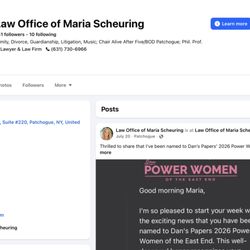
I was also struck by the contrast between being told that legal advice could not be provided without a retainer because of liability concerns and the public-facing presentation of professional service, community involvement, pro bono work, and service to people experiencing difficult circumstances. I am not criticizing anyone for having professional boundaries or for deciding what services they will provide. I am asking for consistency and transparency about those boundaries and then there is the phrase:
"They help people like you in situations like this."
People like me in what way? What information did the attorney have about me that caused her to determine what category of people I belonged to, what services I could afford, or where I should be redirected instead of providing the consultation I had already paid for? I will not assign a meaning to the phrase "people like you" that Ms. Scheuring did not put into writing. I do not need to. I am providing the correspondence so that readers can see exactly what was said, consider the surrounding circumstances, and draw their own conclusions. Based on the entirety of the interaction, I strongly believe that racial and class bias influenced the way I was treated. That is my inference from the interaction. I am not asking readers to accept that inference simply because I have stated it. I am asking them to read the correspondence. Discrimination does not always announce itself through an explicit statement. It can operate through assumptions, categorization, misinformation, withholding, obstruction, narrowing, differential access, and redirection. Sometimes the individual interaction looks small enough to explain away. The pattern becomes visible when you examine what happened as a whole.
For those who can read these emails and still cannot see what is happening here, I invite you to read my framework on the Architecture of Harm, where I examine how harm can be produced not only through overt acts, but through withholding, redirection, delay, obstruction, misinformation, and differential access.
Maria, I invite you to read it as well. You may find it useful to examine your own interaction with me through the same framework you would presumably apply when evaluating systems and institutions that claim to serve people in vulnerable circumstances. People from marginalized communities are not props through which professionals establish reputations for service, advocacy, empowerment, or social justice. Those connections and commitments should be used for actual good that elevates people rather than dehumanizes them.
I am not writing this review to shame anyone or to manufacture a conclusion for the reader. I am bringing a professional interaction into the light and allowing the correspondence to speak for itself. The best way to avoid a contradiction between who you present yourself to be and how you actually treat people is simply to be who you present yourself to be. People like me are people. We deserve dignity, equal access, straightforward answers. Alles Gute.