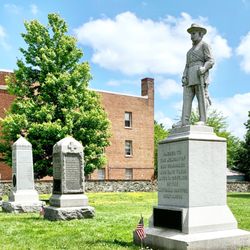
Bethesda is situated along a major thoroughfare that was originally the route of an ancient Native American trail. Between 1805 and 1821, it was developed into a toll road called the Washington and Rockville Turnpike, which carried tobacco and other products between Georgetown and Rockville, and north to Frederick. A small settlement grew around a store and toll house along the turnpike. By 1862, the community was known as "Darcy's Store" after the owner of a local establishment, William E. Darcy. The settlement was renamed in 1871 by the new postmaster, Robert Franck, after the Bethesda Meeting House, a Presbyterian church built in 1820 on the present site of the Cemetery of the Bethesda Meeting House. The church burnt in 1849 and was rebuilt the same year about 100 yards south at its present site.
Throughout most of the 19th century, Bethesda was a small crossroads village, consisting of a post office, a blacksmith shop, a church and school, and a few houses and stores. It was not until the installation of a streetcar line in 1890 and the beginnings of suburbanization in the early 1900s that Bethesda began to grow in population. Subdivisions began to appear on old farmland, becoming the neighborhoods of Drummond, Woodmont, Edgemoor, and Battery Park. Further north, several wealthy men made Rockville Pike famous for its mansions. These included Brainard W. Parker ("Cedarcroft", 1892), James Oyster ("Strathmore", 1899), George E. Hamilton ("Hamilton House", 1904; now the Stone Ridge School), Luke I. Wilson ("Tree Tops", 1926), Gilbert Grosvenor ("Wild Acres", 1928-29), and George Freeland Peter ("Stone House", 1930). In 1930, Dr Armistead Peter's pioneering manor house "Winona" (1873) became the clubhouse of the original Woodmont Country Club (on land that is now part of the National Institutes of Health (NIH) campus). Merle Thorpe's mansion, "Pook's Hill" (1927, razed 1948) -- on the site of the current neighborhood of the same name -- became the home-in-exile of the Norwegian Royal Family during World War II.
That war, and the expansion of government that it created, further fed the rapid expansion of Bethesda. Both the National Naval Medical Center (1940-42) and the NIH complex (1948) were built just to the north of the developing downtown. This, in turn, drew further government contractors, medical professionals, and other businesses to the area. In recent years, under its visionary regional planner and longtime Mayor, Walter Whitman (1946-1962), Bethesda consolidated as the major urban core and employment center of southwestern Montgomery County. This recent growth has been significantly vigorous following the expansion of Metrorail with a station in Bethesda in 1984. Alan Kay built the Bethesda Metro Center over the Red line metro rail which opened up further commercial and residential development around the surrounding vicinity.
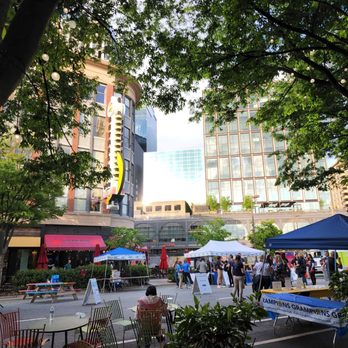
The area commonly known as "Downtown Bethesda" is centered at the intersection of Wisconsin Avenue, Old Georgetown Road and East-West Highway. Other focal points of downtown Bethesda include the Woodmont Triangle, bordered by Old Georgetown Road (Maryland Route 187), Woodmont and Rugby Avenues, and the Bethesda Row, centered at the intersection of Woodmont Avenue and Bethesda Avenue. Much of the dense construction in that area followed the opening of the Bethesda station on the Red Line of the Washington Metro rapid transit system, also located at this intersection and the centerpiece of the Bethesda Metro Center development. The Medical Center Metro stop lies about 0.7 miles north of the Bethesda stop, Medical Center, which serves the NIH Campus, the Walter Reed National Military Medical Center, and the Uniformed Services University of the Health Sciences. read more