Cancel

    Open app

    Search

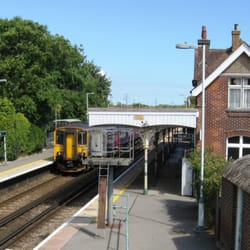
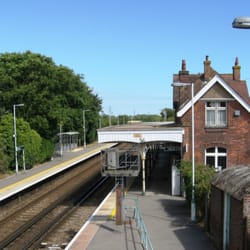
    Barnham Train Station

    4.0 (1 review)

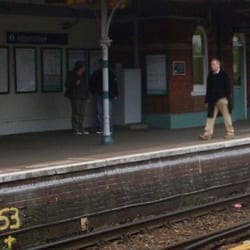
    Barnham Train Station Photos

    Recommended Reviews - Barnham Train Station

    Your trust is our priority, so businesses can't pay to alter or remove their reviews. Learn more about reviews.
    Yelp app icon
    Browse more easily on the app
    Review Feed Illustration

    14 years ago

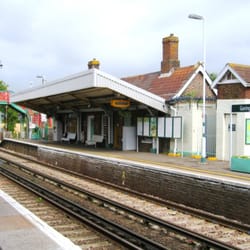
    A lol of platforms and a nice cafe with decent food. There is also a waiting room and local shops nearby

    Helpful 0
    Thanks 0
    Love this 0
    Oh no 0

    Verify this business for free

    Get access to customer & competitor insights.

    Verify this business

    Bognor Regis - Bognor Regis train station

    Bognor Regis

    4.5(2 reviews)
    3.5 mi

    Most folks walk on by and don't notice this train station, yet this is a delightful and historical…read moreEdwardian building with a hellava backstory. The station dates from 1864 and in its 158 years it has been blown down by a hurricane and burnt down because a coat had been left to warm on one of the stoves in the waiting room in October, 1899. By 1865 the Pier had been built, there were houses in West Street. A number of religious groups were opening churches at the time and new streets were being developed. Pubs were opening, and Bognor's population was about 3,000. The area in which the station was built was at the end of Dorset Gardens. It was at that time outside the town. However, it was not long before the town grew out to its new station. The Bank Holiday Act in 1871, which fixed holidays for Christmas, helped to increase rail traffic in the season. Excursion trips to the seaside became a part of the lives of millions of people. National newspapers were advertising cheap day trips to Bognor and the Daily News of May 28, 1900, announced all its arrangements for trains over the Whitsuntide holidays, including late trains for those working in London on Saturdays. In 1910 the return fare from London to Bognor was three shillings (15p) and because of this, high numbers continued to come into the town. In 1913 it was reported that on Wednesday, July 9, there were 4,350 day visitors in the town. The world's first travel agent Thomas Cook reported that in 1918 there had been more than 35,000 visitors to the town 'hard to believe, especially when the population was only 8,500.' So it's population had trebled in 53 years and 93 years later, by 2011, it was just over 24,000. The four platform station (and the town) was re named Bognor Regis in 1930 as it was the place of the King's (George V) recuperation from serious illness. Regis 'of the King'. The king who was 70 when he died had suffered for years from chronic bronchitis (heavy smoking didn't help) and in 1928 suffered septicaemia from which he never recovered. Bognor is one of the oldest recorded Anglo - Saxon place names in Sussex. In a document of AD 680, it is referred to as Bucgan ora meaning Bucge's (an Anglo-Saxon name) shore, or landing place. It has survived two world wars, the swinging 60's, the strike-bound 70's, all the polarisation of the Thatcher years, the rise and fall of New Labour. On its 154th birthday (2018) it got a £2.5 million refurbishment and improvements including a new business creative digital hub with an ultra-fast internet connection for leasing to start-up businesses and freelancers but when I was there in July 2022 it was dodo dead. A hive of inactivity. Maybe a victim of wu flu. Not just any old train station then?

    Great place to travel from..staff helpful and there's a kiosk to hand while you wait to start your…read morejourney. There are toilets and a bus stop on both sides of the station.

    Photos
    Bognor Regis - No comment

    No comment

    Bognor Regis

    See all

    Angmering

    Angmering

    4.0(2 reviews)
    6.7 mi

    I hope my review of Angmering isn't Angering you…read more This is not too far from Brighton, about 15 miles away in the countryside, and it's right next to a secondary school so Aletta (not Aletta but I'm in love with Aletta so)... a lot of... students use it to get to their little country houses and whatnot. How nice it must be to be middle class or rich in the suburbs of Sussex. Looking at you, Keane. It's a cute little station in the middle of nowhere with a nice dark brown house with a couple of chimneys on top of it. There's a level crossing right at the station which adds to the beauty for a nice element.

    Angmering is a small station situated on the outskirts of Littlehampton, serving the suburb of East…read morePreston and the pretty village of Angmering to the north. It is on the 'West Coastway' line between Brighton and Chichester. The station was opened on 16 March 1846 when the London, Brighton & South Coast railway line was extended from Worthing to Ford Junction, before its extension onwards to Chichester. The present building was built in the 1860s. The station has a traditional but rather plain brick-built building with a generous awning on the eastbound platform (to Brighton/London). Facilities include a staffed ticket office, ticket machine, and a privately-run food outlet selling sandwiches, snacks, confectionery and hot and cold drinks. (NB No toilets). There's a decent sized car-park with two disabled parking bays, and cycle racks behind the building and also on the westbound platform. There's a privately run taxi-office just behind the main station building as well. There is level access to both platforms, via the road level crossing at the west end of the station. Off-peak, it's served by the half-hourly London-Littlehampton service, as well as the hourly Brighton-Portsmouth and Brighton-Southampton services. In the evenings there are also some local Littlehampton to Brighton all-stations services.

    Photos
    Angmering

    See all

    Ford Train station

    Ford Train station

    2.0(2 reviews)
    2.7 mi

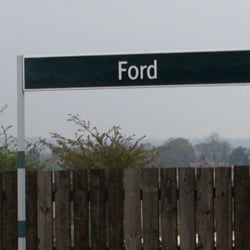
    Well, I think Ford is a rather quaint country station! It serves the small community of Ford…read morenearby, as well as the nearby Open Prison, and the village of Climping. It's situated on the Brighton-Southampton 'West Coastway' line, and is also just west of the junction for the direct line to London via Arundel. The station was opened in 1846 on the line from Brighton to Chichester, and became a junction when the line to London via Arundel opened in 1863. However, Barnham, 4 minutes to the west, functions as the real junction, as not all trains stop at Ford. It has a direct train to London once an hour on the service to/from Bognor, as well as the local stopping services on the West Coastway line from Littlehampton and Brighton to / from Portsmouth, giving five departures an hour, off-peak on weekdays. The station is generally staffed until lunchtimes only, after which you have to buy a 'permit to travel' from a machine and pay the guard on the train. Both platforms have brick buildings with old-fashioned canopies. There's no buffet, but there's a pub five minutes' walk down the road towards Climping. Both platforms have step-free access via the end gates adjacent to the level crossing. There is a small cycle rack, too. It's pleasant enough on a warm day in summer, when it feels delightfully rural, but windswept, dark winter evenings may be another matter

    This is not a nice place! Unless you are escaping from Ford open prison. Its not a stop to use…read moreunless one has too. I had to change here for Southampton. Barnham is the next stop up or Littlehampton from the other direction. It is bleak and nothing there to entertain oneself with.

    Photos
    Ford Train station
    Ford Train station
    Ford Train station

    See all

    Goring-by-Sea

    Goring-by-Sea

    3.5(2 reviews)
    9.0 mi

    Not to be confused with Hermann Goring By Sea, which is a town full of fascists, I suppose. Might…read morebe at home in America then? This is one of five stations in Worthing, and it's one of the tiny ones, with a the tiny little brown building on the platform with a blue overhang. It's cute and doesn't have too many people manning it day or night, and it's just a cute little place with a cute little bridge over it, and not much going on.

    A small station serving the seaside town of Goring-by-Sea, between Worthing and Littlehampton on…read morethe West Coastway line. It is used by just under 0.5m passengers a year. The station was opened on 16 March 1846 when the London, Brighton & South Coast railway line was extended from Worthing to Ford Junction, before its extension onwards to Chichester and Littlehampton. The main station building looks original, although the canopy has been renewed. Facilities include a part-time ticket office, cycle storage (part sheltered), a small car park and a platform shelter on platform 2 (westbound). There are neither toilets nor a taxi rank. There is level access to both platforms, via the road level crossing at the west end of the station. Train services are operated mostly by Southern (http://www.southernrailway.com) . Off-peak, it's served by the half-hourly London-Littlehampton service, as well as the hourly services to Southampton (daytime) or Portsmouth (late afternoon/evening) and Brighton. In the evenings there are also some local Littlehampton to Brighton all-stations services.

    Photos
    Goring-by-Sea
    Goring-by-Sea
    Goring-by-Sea

    See all

    Arundel Railway Station

    Arundel Railway Station

    4.0(2 reviews)
    4.2 mi

    I've been Arund and about this area many times, or in Spanish, "Arund el area", and this is the key…read morerail station in this proverbial neck of the proverbial woods. Much like a lot of the stations in Sussex, this has a brown brick building that looks like a pub or a large stately country house with two huge chimneys on it. Arundel is actually an important transport hub for this little region, with Littlehampton and other important towns being served from here. So it's definitely a nice station and has been around for a long time, first opening in 1863. It has white platforms and the old building really complements the region. It's definitely one of the better stations in the region in my opinion.

    Arundel's railway station is situated about half a mile south east of the historic town, just off…read morethe busy A27. The station is staffed only part time, but has retained the traditional station buildings and attractive awnings on the London-bound (up) platform, and two substantial awnings on the down platform. There is also a splendid historic goods shed at the southern end of the London platform. The route now known as the Arun Valley Line was built in phases, with services reaching Horsham from Three Bridges in 1848. The line came as far south as Pulborough in 1859, as part of a line via Midhurst to Petworth, before the section through Arundel to the Brighton-Chichester coast line was finally completed in 1863. Services on the line are basically half-hourly in the weekday off-peak, with Arundel being served by the Bognor portion of trains otherwise going to Southampton or Portsmouth Harbour. Passengers for Brighton and other destinations can change at Ford or Barnham. The station has a taxi office and rank and a very large car-park, although other facilities (including the waiting room and access to toilets) are only available when staffed. There is a half hourly bus service from the end of the station approach to Arundel town, Brighton and Worthing operated by Stagecoach buses, although Arundel is only a 10 minute walk away. There is level access to the London bound platform only.

    Photos
    Arundel Railway Station
    Arundel Railway Station
    Arundel Railway Station

    See all

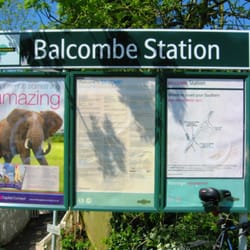
    Balcombe Railway Station - The main station noticeboard at London Road

    Balcombe Railway Station

    4.0(1 review)
    26.8 mi

    It's a surprise to find a station serving as a small village as Balcombe, especially on a main…read moreline. However, the lack of good roads to and from the village, and its proximity to London, ensures a healthy flow of commuter traffic, with Balcombe acting as a rail-head for several villages around - it is used by just over 100,000 passengers a year. It's an attractive small station, the east side nestling in a cutting, and surrounded on all sides by mature trees and shrubs, and is very popular at week-ends with walkers exploring the surrounding woodlands. The station opened on 12 July 1841 as an intermediate station on the then London and Brighton Railway, later amalgamated into the London, Brighton and South Coast Railway. The 1841 census shows that there were 550 railway labourers living in the village at the time - which must have been challenging for the locals! The station has been rationalised over the years, but retains a small building on the down (Brighton) platform, complete with Victorian canopy, ticket office and toilet. The office is only open at peak times (the toilet is also closed when the office is shut). If this is the case, you need to buy a 'permit to travel' from the machine and buy a ticket on board. The up platform (for London) has a small waiting shelter with step-free access from the car park, and there are car parking spaces and a cycle rack on this side of the station. A footbridge provides access between the platforms, and also provides the exit to London Road at the top of the cutting. Note that there is no step-free access to the Brighton platform. An oddity is the extension of the Brighton platform under the small tunnel at the south of the station: this is only used to board and alight from trains, and a sign warns not to enter the tunnel when a through (ie non-stopping) train is approaching which they do, at some speed. The service is fairly sparse: off-peak, Monday to Saturday there is one train an hour in each direction, on the First Capital Connect service from Bedford to Brighton via London Bridge. On Sundays, an hourly service is provided by Southern on the Brighton to London Victoria line. Additional services stop during rush hours in both directions. To the north of the station is Balcombe tunnel, 800 yards long, and to the south the famous Ouse viaduct, the first long railway viaduct in southern Britain. At 1,475 ft (450m) long, faced with Caen stone and with four Italianate pavilions at each end, it is regarded as one of the most attractive in the UK.


    Photos
    Balcombe Railway Station - A fast through train for Brighton rushes past platform 2.

    A fast through train for Brighton rushes past platform 2.

    Balcombe Railway Station - Main station building on platform 2 (for Brighton). It contains a ticket office, sheltered seating and toilet.

    Main station building on platform 2 (for Brighton). It contains a ticket office, sheltered seating and toilet.

    Balcombe Railway Station - A Bedford-bound train leaves platform 1.

    See all

    A Bedford-bound train leaves platform 1.

    Barnham Train Station - trainstations - Updated May 2026

    Loading...
    Loading...
    Loading...