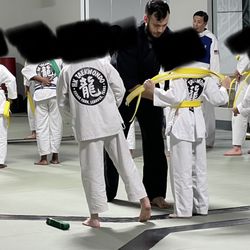
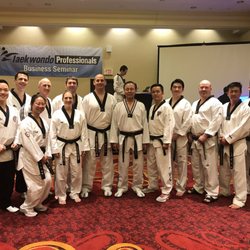
I think people need to be very careful when it comes to martial arts training. Many strip mall martial arts outfits are just there to part you from your money without providing you or your kids with anything of substance. These outfits use people's ignorance of what to expect from a martial arts gym to their advantage. This outfit appears to do exactly that. TKD Plus or whatever it is called now is not exactly a scam. It specializes in efficiently parting people from their cash while expending minimal effort to impart solid martial arts skills.
So what do you get for your money at this outfit? Not very much at all.
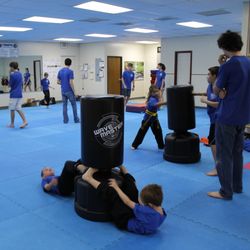
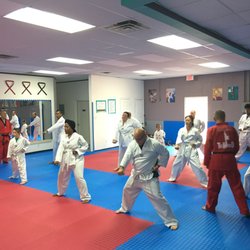
For one thing, what is taught at this school is not really Taekwondo, nor is it any identifiable martial art. To start, there are no patterns - no Koryo, Pinan, Palgwe, or Chan Hon patterns. Also, there is very little actual kicking and punching over the course of a workout. Typically you need to do hundreds of strikes (kicks and punches) per workout to get a positive training effect. Like anything else, it's in the repetition. At this school, I think on average there are perhaps several dozen kicks and strikes per class. This low frequency of execution is made worse by a near-absence of emphasis on proper form, such as the use of correct striking tools. Further, training for real self-defense is non-existent. Sparring is painful to watch. The upper belts employ no combinations; lack distance control; don't seem to understand footwork; and heavily rely on exchanges of single-shot lead leg kicks. If people can't spar well in a controlled setting, then they certainly can't fight effectively in real circumstances. So strike self-defense from the list.
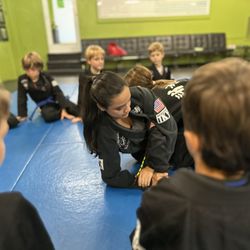
There is much signage about the availability of Brazilian Jiu-Jutsu. Yes, you can get that, but not as a normal part of your fees. It's extra.
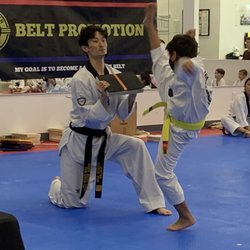
The instructors are dressed informally, sometimes in shorts. Considering the dollars paid for tuition, one could at least expect an instructor to come dressed for the part, instead of looking like a Margaritaville regular. The exception is testing day, when suddenly the instructors are decked out in all their finery. And about testing...
Most martial arts programs have 10 or so belts to black belt. Each belt progression requires a test, and a fee. Testing fees is a major source of revenue for martial arts schools. There is nothing wrong with that. However, this outfit takes paid testing frequency to a new level of cost for the student. And here is the outfit's core gimmick.
I think there are about 15-16 tests (each with fees) to get a black belt. Most tests in other schools are every 3 or 4 months. Here the testing is every two months. So you can get a black belt in just over 2.5 years. But it won't be a legitimate black belt. Since you've been poorly trained, you'll need to continue training to get your elementary kicks and punches to a reasonably proficient level. And Lo!, there is a program for that - a second degree black belt! And then a third degree black belt! But shelling out money does not make you an expert, if the training you get is sloppy from the get-go. Failure to acquire fundamentals in the beginning of any endeavor just means you'll have impaired progress later.
Note, an intensive and rigorous 2.5-year program is perfectly legitimate for a modern TKD black belt, but intensity and rigor do not apply here. Then there is extra money for a required "sparring clinic" and such. And there is an optional extra testing fee to get certified according to other standards - makes no sense, other than to further part folks from their money.
Just to make things worse, the actual number of tests to a black belt is not clearly stated. Nothing is shown on the website, nor are written progression materials outlining the path to a black belt provided. Communication is limited that way. The actual subject matter content of skills required for each test is also not written down - so students can't really work on their practice at home. Focus on testing starts to spool up about 2 weeks prior to each test, when suddenly students have to practice the 6 or so things required for the test. The rest of the time is spent doing unspecified other stuff.
It is interesting that the first three tests move the student from white to yellow to green belts, giving a sense of momentum. Then, once the students are committed, the testing breaks down into three tests per color belt. Three tests for blue, three tests for red, three or four tests for brown, etc. Very interesting.
In sum, I have to conclude: Buyer Beware! read more