Cancel

Open app

Search

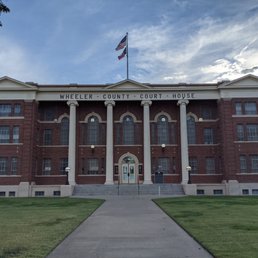
Wheeler County Courthouse

3.0 (1 review)

Wheeler County Courthouse Photos

Recommended Reviews - Wheeler County Courthouse
Your trust is our priority, so businesses can't pay to alter or remove their reviews. Learn more about reviews.
Yelp app icon
Browse more easily on the app
Review Feed Illustration

5 years ago

Helpful 10
Thanks 0
Love this 9
Oh no 0

Verify this business for free

Get access to customer & competitor insights.

Verify this business

Blarney Stone - Blarney Stone Plaza

Blarney Stone

3.5(2 reviews)
15.9 mi

An alleged fragment of the Blarney castle that was brought to Texas in 1959 stands here in a…read moretheft-proof crash-proof cylinder, painted solid green. True? False? Someone did actually make the trip to Ireland and earn the gift of gab? I have no idea. As for "Kissing the Blarney Stone," I did not make physical contact. I did blow it a kiss because in 2021, we don't do such things. There is an official State Historical Marker here. It reads, "Early area settler George Nickel and his wife, Dora (Haggard), raised their family in a dugout home in Wheeler County. For his Irish Heritage and for its symbolism of luck and courage, George suggested "Shamrock" for a post office approved for their home in 1890. The name was retained when the town of Shamrock was platted along the Rock Island Railroad built through the county in 1902. Shamrock bandmaster Glenn A. Truax envisioned the town capitalizing on its Irish name by producing a one-day celebration to draw thousands of visitors to the "Irish city." With the help of the Shamrock Boosters Club, the first St. Patrick's Day festival was celebrated in 1938, linking the local celebration with the feast day of the patron saint of Ireland. The first observance featured such free attractions as a parade, street dance, matinees at the Liberty and Texas theaters, a massed band concert of five hundred pieces from twelve cities, and historical and dramatic presentations, attracting about 12,000 people to a town of less than 4,000. The following year attendance topped 30,000, with parade spectators positioned along streets and the roofs of downtown buildings. The annual event continued until it was suspended during World War II and again during the Korean War. The Chamber of Commerce took over sponsorship in 1952. Shamrock's St. Patrick's Day celebration has welcomed many state and national figures in politics, sports, music and entertainment. It has evolved to a multiple-day affair, retaining many original activities and adding several others that have become annual tradition and an important part of the economy. In 2013, the Texas Legislature adopted House Concurrent Resolution 83, proclaiming Shamrock's celebration the official St. Patrick's Day celebration for the state of Texas." Blarney Stone Plaza has the stone and some Irish and Saint Patrick themed items. Sláinte! [Review 16206 overall - 380 in Texas - 1712 of 2021.]

You can kiss a Blarney Stone without booking a flight to Ireland! My grandparents live in Shamrock…read moreand my Memaw took us on a little midnight tour of the town and this is one of the tourist "attractions" we stopped at. Fun, quick attraction along Route 66. If you're into unique and interesting stops on your road trip, I would suggest a short stop in Shamrock, TX. Not recommended for the germaphobe.

Photos
Blarney Stone - St. Patrick's Day Celebration marker

St. Patrick's Day Celebration marker

Blarney Stone - Blarney Stone Plaza, Shamrock

Blarney Stone Plaza, Shamrock

Blarney Stone

See all

Cast Away Intersection - Cast Away Intersection

Cast Away Intersection

5.0(1 review)
16.4 mi

Round number reviews should be something special. My round number 16000 was the Grand Saline Salt…read morePalace and 16100 was the Kimbell Art Museum in Fort Worth. So here we are at 16200 and it's... an intersection. What? Well, my friend. This is a special intersection. At the end of the Tom Hanks movie Cast Away, we see the protagonist at a literal and a philosophical intersection. Having been rescued from the island and finding out that his fiancée has moved on, he is stopped here and trying to work out what's next in his life. A pretty redhead pulls up and tells him, "Well, that's 83 South. And this road here will hook you up with I-40 East. Um... if you turn right, that'll take you to Amarillo, Flagstaff, California. And if you head back that direction, you'll find a whole lot of nothin' all the way to Canada." Watch it here: https://youtu.be/afiuJ2tsoVA. What do you think the character does after the credits roll? But back to here. I agree that there's not much between here and Canada and maybe she was referring to the next town north, Canadian. Regardless, it's desolate. I was here for 15 minutes, parking the car in the same spot that Tom Hanks did and setting out my tripod so that I could get my selfie properly. Not a single vehicle passed by from any direction in those 15 minutes. Very little has changed since then. The stop signs are the same. The fences are the same. I had arrived from the north, the same as Tom Hanks did. That road is now gravel and not packed dirt. Dozens of wind turbines are erected and spinning. Otherwise? It's a postcard for a literal crossroads that is near absolutely nothing and 35 miles from the I-40 that the young lady mentions. Sadly, the actress Lori White passed away in 2018. This detour was worth it for me. I doubt very much that I'll ever be back in this part of the world so this was a once-in-a-lifetime stop. What's next in my life? Oklahoma City, Tulsa, Nashville, and home in 1300 miles. [Review 16200 overall - 376 in Texas - 1706 of 2021.]

Photos
Cast Away Intersection - Cast Away Intersection

Cast Away Intersection

Cast Away Intersection - Cast Away Intersection

See all

Cast Away Intersection

Buffalo Wallow Battle Ground

Buffalo Wallow Battle Ground

5.0(1 review)
9.7 mi

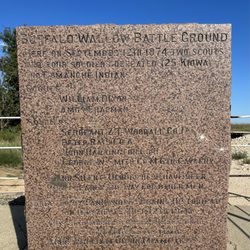
Today, September 12, 2024 is the 150th Anniversary of the Battle of Buffalo Wallow…read more At this remote location way up in the Texas Panhandle, early on the morning of September 12, 1874, two US Army Scouts and four Enlisted Men were spotted and attacked by a group of about 125 Kiowa and Comanche Warriors. Caught out in the open, outnumbered 125 to 6, things looked grim for the Soldiers. In the first minutes of the battle all of the soldiers and both scouts had been wounded. The exchange of gunfire stampeded their horses. The loss of their horses left the men with no water and only the ammunition they had on their person. The lead Scout, Billy Dixon, spotted a buffalo wallow, a depression in the ground created by buffalos trying to cool themselves off by rolling around in the dirt. With the Warriors circling and shooting at them, Dixon eventually got all the badly wounded Soldiers to the wallow. With no water and running out of cartridges for their guns, the situation seemed hopeless for the soldiers. But late in the day the weather turned cold and it began to rain. The rain came down in torrents. It mixed with the Soldier's blood, gathering in pools in the wallow. It was enough to keep the Soldiers alive. The weather change prompted the Kiowa and Comanche Warriors to break off the attack and eventually withdraw. One of the soldiers, shot through the lungs, died during the night. The next day Billy Dixon decided to leave the others, setting out on foot to try to find help. Miraculously he spotted a Calvary column and signaled them. Ok, so at this point in the story you're thinking, here comes the Calvary to the rescue, right? But no. As it turned out, the Calvary officer in charge was a kind of a Dick. He sent a detail with his Surgeon to evaluate the situation. They concluded the men were too badly injured to ride horseback. They needed an ambulance, something the Calvary column didn't have. The Calvary left the wounded men some raw buffalo meat and resumed their original journey. The wounded men suffered, exposed to the elements until finally being rescued on September 18. For their bravery in battle the survivors were awarded the Congressional Medal of Honor, the highest honor our country bestows on military personnel. A couple years after Billy Dixon died, Congress decided to revoke his Medal of Honor because Dixon wasn't actually in the military; he was just a Scout. Fortunately Dixon's widow told the Congress to go pound sand. She refused to give the Medal back. Today Billy Dixon's Medal of Honor is on display at the Panhandle Plains Museum in Canyon, Texas. To their credit, the US Congress eventually saw the stupidity of taking away Dixon's Medal and officially restored it to him in the 1960's. Last year I visited the Buffalo Wallow Battle site for the first time. I'm visiting again this Fall. This site is extremely remote. Way off the beaten track. Not at all easy to visit. Mikey C says: I don't care. I've got to be there. To me this place is hugely significant.

Photos
Buffalo Wallow Battle Ground

See all

Custer on the Sweetwater Historical Marker

Custer on the Sweetwater Historical Marker

3.0(1 review)
1.0 mi

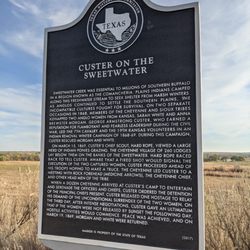
About three miles north of Wheeler, you'll find this marker that recalls the travels of one of…read moreAmerica's most infamous generals. There is a small pull out here so that you're off the roadway. It is on the west side of the road. The marker reads, "Custer on the Sweetwater. Sweetwater Creek was essential to millions of southern buffalo In a region known as the Comancheria. Plains Indians camped along this freshwater stream to seek shelter from harsh winters. As Anglos continued to settle the southern plains, the incompatible cultures fought for survival. On two separate occasions in 1868, members of the Cheyenne and Sioux tribes kidnapped two Anglo women from Kansas, Sarah White and Anna Brewster Morgan. George Armstrong Custer, who earned a reputation for flamboyant and fearless leadership during the Civil War, led the 7th Cavalry and the 19th Kansas Volunteers in an Indian removal winter campaign of 1868-69. During this campaign, Custer rescued Morgan and White. On March 15, 1869, Custer's chief scout, Hard Rope, viewed a large herd of Indian ponies grazing. The Cheyenne village of 260 lodges lay below them on the banks of the Sweetwater. Hard Rope raced back to tell Custer. Aware that a fired shot would signal the execution of the two captured women, Custer proceeded ahead of his troops hoping to make a truce. The Cheyenne led Custer to a meeting with Rock Forehead (Medicine Arrows), the Cheyenne chief, and other head men of the tribe. When a dozen Cheyenne arrived at Custer's camp to entertain and serenade the officers and chiefs, Custer ordered the detention of the principal chiefs present. Custer released one hostage to relay his demand of the unconditional surrender of the two women. On the third day, after intense negotiations, Custer gave an ultimatum that if the women were not released by sunset the following day, hostile activities would commence. Peace was achieved, and on March 19, 1869, Morgan and White were returned." General Custer was killed on June 25, 1876 at the Battle of Little Bighorn in Montana Territory (which is about 1000 miles north-northwest of this spot). He was initially buried on the battlefield but was later reinterred in West Point Cemetery. [Review 16203 overall - 377 in Texas - 1709 of 2021.]

Photos
Custer on the Sweetwater Historical Marker
Custer on the Sweetwater Historical Marker - Custer on the Sweetwater Historical Marker, Wheeler TX

Custer on the Sweetwater Historical Marker, Wheeler TX

Custer on the Sweetwater Historical Marker - Custer on the Sweetwater Historical Marker, Wheeler TX

See all

Custer on the Sweetwater Historical Marker, Wheeler TX

Wheeler County Courthouse - landmarks - Updated May 2026

Loading...
Loading...
Loading...