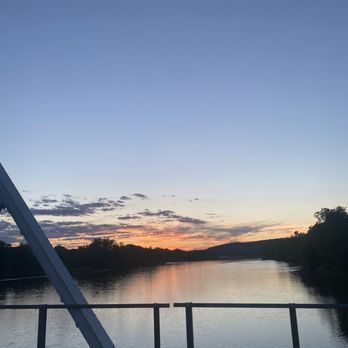
Those of us seeking a beautiful alternative to crossing the Delaware River on the Rt. 95 Scudders Falls Bridge, or going all the way to New Hope, Pa. or Lambertville, NJ, know that the Washington Crossing Bridge spans the waters and casts its shadow where General George Washington marshaled his revolutionaries to cross the frozen flow on Christmas Eve, 1776; surprising the Hessians in Trenton and then marching toward Princeton for another critical victory where the grand oak stood until recently along Princeton Pike south of the Prince's Town.
This truss bridge, originally commissioned to be constructed in 1831 is best known for the number of floods that have swept it away (1841 and 1903), until it was reconstructed with steel rather than wood, and barely survived the storms of 1955, 2004 and 2006.
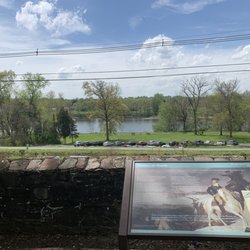
I admit to a nervous excitement every time I approach it as a driver. The narrow lanes originally designed for horse powered vehicles challenge my visual acuity and steady hand. I always hope not to confront a vehicle coming from the other side causing me to play a game of chicken in my head. When unchallenged, the moment I can look upstream at the sparkling Delaware, rolling hills and deep blue sky, give me Van Gogh inspiration I yearn to commit to canvas or digital imagery.
For this is the other deep meaning of Washington Crossings' dual realities on both sides of the river. While we will never forget that our country was in large part born right here due to the guile and courage of Washington and his first Americans, we are doubly blessed by the natural beauty of this place. It may never transcend its human history, but its timeless ebb and flow, be they vicious torrent or drought plagued emptiness, allow us memories we carry with us always. read more