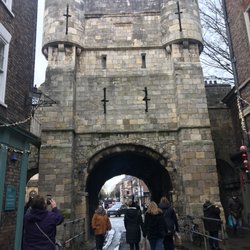
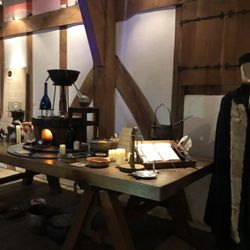
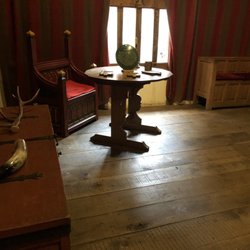
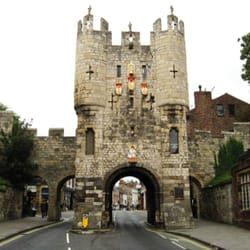
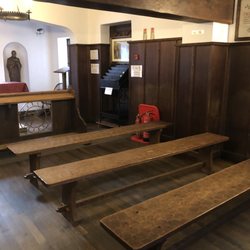
We visited this small shrine in the Shambles devoted to St Margaret Clitherow an English saint and…read moremartyr of the Roman Catholic Church, known as "the Pearl of York".
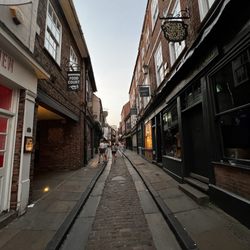
It was quiet within. We were the only people there as the outside street which I'm told was claimed (and refuted) as the inspiration for Diagon Alley was crammed with visitors.
If you are close by indulging in the fantasy world of this street with potion shops and wizards take 5 minutes here for reality to sink in.
State killings were breathtakingly savage back then, on the orders of kings and courts, often in the name of religion (mind you some states in the USA inappropriately use lethal chemicals by injecting them into prisoners to kill them cruelly today).
St Margaret was one of five children of Thomas and Jane Middleton. Her father was a businessman, a wax-chandler and Sheriff of York in 1564, who died when Margaret was fourteen.
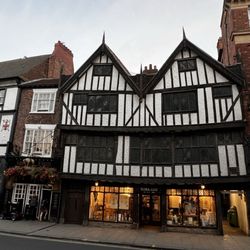
In 1571, she married John Clitherow, a wealthy butcher and a chamberlain of the city, and bore him three children; the family lived at today's 10-11 The Shambles. She was pregnant with her fourth child when murdered.
She converted to Roman Catholicism in 1574. Although her husband, John Clitherow, belonged to the Established Church, he was supportive as his brother William was a Roman Catholic priest. He paid her fines for not attending church services.
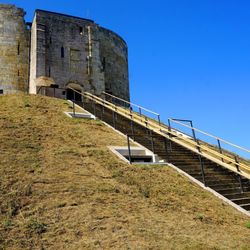
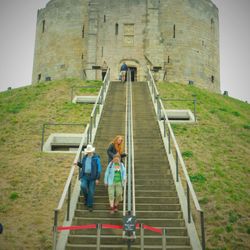
She was first imprisoned in 1577 for failing to attend church, and two more incarcerations at York Castle followed. Her third child, William, was born in prison.
Margaret risked her life by harbouring and maintaining priests, which was made a capital offence by the Jesuits, etc. Act 1584. She provided two chambers, one adjoining her house and, with her house under surveillance, she rented a house some distance away, where she kept priests hidden and Mass was celebrated through the thick of the persecution.
Her home became one of the most important hiding places for fugitive priests in the north of England. Local tradition holds that she also housed her clerical guests in The Black Swan at Peasholme Green, where the Queen's agents were lodged.
Margaret was arrested and called before the York assizes for the crime of harbouring Catholic priests. She refused to plead, thereby preventing a trial that would entail her three children being made to testify, and being subjected to torture.
She was sentenced to death and executed on Lady Day, 1586, (which also happened to be Good Friday that year) in the Toll Booth at Ouse Bridge, by being crushed to death by her own door, the standard inducement to force a plea.
The two sergeants who should have carried out the execution hired four desperate beggars to do it instead. She was stripped and had a handkerchief tied across her face then laid across a sharp rock the size of a man's fist, the door from her own house was put on top of her and loaded with an immense weight of rocks and stones so that the sharp rock would break her back. Her death occurred within fifteen minutes, but her body was left for six hours before the weight was removed.
She was canonised in 1970 by Pope Paul VI.