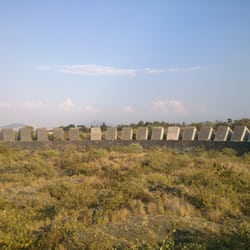
On a recent trip to Mexico City I visited the Sculptural Space at UNAM (National Autonomous…read moreUniversity of Mexico). Proposed by sculptor Federico Silva in 1979, it is one of a series of 7 public sculpture's dedicated to ecology and art, and built on campus by artists from the University. Referencing pre-Hispanic culture and the aesthetics of nearby ceremonial sites such as the pyramids at Teotihuacan, this site specific work exists in harmony with its surrounding landscape and calls to a time in history when place was honored.
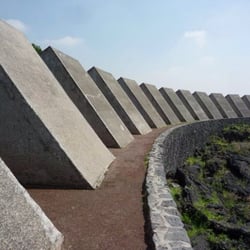
The walk to the site requires traversing a long path surrounded by a muted palette of desert flora -- fields of tall dry grass sprinkled with bundles of cacti, pink desert flowers, and jagged rocky outcrops. At one point the concrete path became a grid of symbols resembling an ancient, or even extraterrestrial, form of communication. Upon arrival at the sculpture, I was confronted with a wall of 64 massive slabs of rock in a circular formation, 120 ft in diameter. I noticed people, mostly pairs, perched on the tips of some of these structures. The grand presence of these outcrops had a dwarfing effect while simultaneously offering an invitation to slip inbetween the slabs revealing an open field of jagged, black, petrified lava on the other side. There is a circular walking path lining the inset (slightly lunar) landscape but I chose to climb down into it and head to the center. From inside, the geometric ring of rocks frame the sculptural space and act as protectors, while also producing a kind of amphitheater effect.
Unlike many public monuments which often feel indifferent to their degree of engagement with the viewer, Sculpture Space felt like a democratic and inviting public space, ripe for meditation, public interaction, and activation. It felt sacred. Like a celebration of place, history and ecological diversity that spoke to the institutions dedication to art...or so I initially thought. The view from the center offers a 360º horizon of sky and surrounding mountains with one jarring exception -- a disruptive, stark white building towering in the east and ultimately poisoning the entire experience. Upon further research it's revealed that this is a recently built faculty building for the Political and Social Sciences program at UNAM, which immediately strikes me as an institutional contradiction. The fact that a program within the institution which studies anthropology and archeology would build a structure that disrespects, and ultimately destroys, a monument that is dedicated to their cultural heritage, seems rather outrageous. And it appears as though the art and student community in Mexico City agrees.
Earlier this month a petition started circulating demanding that the top 4 floors of the building be removed in order to return the Sculpture Space to it's original state. A demostration led by hundreds of artists and representatives from the university community took place spurring a lot of media attention and resulting in the formation of a committee of architects, artists, environmentalists, and researchers dedicated to addressing the issue.
What began as a symbol of cultural heritage, celebration of place, and public engagement, has shifted to a conversation around institutional critique and politics. Here's to hoping the institution can make the changes necessary to honor it's past dedication to the integrity of the art.