Cancel

    Open app

    Search

    Tollgate County Junior School

    5.0 (1 review)

    Tollgate County Junior School Photos

    Recommended Reviews - Tollgate County Junior School

    Your trust is our priority, so businesses can't pay to alter or remove their reviews. Learn more about reviews.
    Yelp app icon
    Browse more easily on the app
    Review Feed Illustration

    17 years ago

    Helpful 0
    Thanks 0
    Love this 0
    Oh no 0

    Verify this business for free

    Get access to customer & competitor insights.

    Verify this business

    St Nicolas & St Andrew Church

    St Nicolas & St Andrew Church

    3.3(3 reviews)
    37.5 km

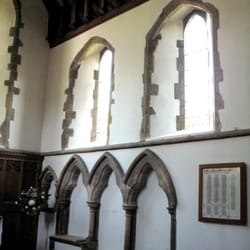
    Despite being surrounded by modern housing estates, the old village centre of Portslade still…read moreretains a villagey feel: indeed, the approach from the busy A270 Old Shoreham Road is quite a shock: a sea of modern car showrooms gives way to a village green with winding lanes, cottages, a post office and two pubs. At its centre is the parish church of St Nicholas, one of the oldest buildings in Brighton & Hove. Built in the Norman period around 1150, it was substantially enlarged with a new chancel and tower around 1250. Apart from the addition of a remarkably sensitive north aisle by the Victorians, it remains substantially a church in the Early English Gothic style. From the outside, it is entirely conventional: a short west tower, a single roof covering both nave and aisles, covered in Horsham Slate, a smaller tiled chancel, and a south porch. It really could be in any Sussex village. Inside, the oldest part of the church is the south aisle wall and the south nave arcade: of three bays, the two piers are typically Norman: heavy, round, and with square scalloped capitals, with the shallowest of pointed arches. The aisle windows were altered to lancets around 1250, when the chancel and tower were added. Until 1847 there were early mediaeval wall paintings on the south arcade of the Nave, depicting a 'Doom', with the souls of the good and the damned moving to heaven and hell, either side of Christ seated in Judgement. Unfortunately, these were whitewashed shortly afterwards. The chancel is particularly attractive: the two lancets with a sexfoil window above on the east wall are nicely balanced, and it has a fine sedilia (seats in niches for the priest and his assistants) and piscina on the south wall. The tower with rough stone walls also has an attractive high lancet window. The north aisle was added in the latter part of the 19th century but, apart from being wider, it is an almost mirror image of the south aisle, down to the scalloping on the capitals. The east wall repeats the motif from the chancel of two lancet windows, this time below a trefoil window, but the west end is given over to the Brackenbury Chapel, erected in 1874 for Miss Hannah Brackenbury (also spelt Brakenbury) and her brothers and niece. This contains heavily stained glass windows, and is separated by a large mullioned glass screen from the body of the church. The interior is well lit, as few of the windows are coloured. Furnishings are limited, but there are some handsome 18th century memorials on the aisle floor, and a pair of formidable skulls from another memorial (presumably 17th century?) in the south aisle floor. Overall, this is a lovely spot and a heaven of peace and quiet away from the anonymous sprawl of suburban Brighton and Hove. The church is part of a very active parish: detailed of services and other activities can be found on the website. To the north of the church are the scant remains of Portslade Manor House, one of the few examples of a Norman Manor surviving. Unfortunately, much of the fabric was pillaged to build a Victorian folly 'ruin' further north. The remains are nevertheless of national importance and it is a grade II* listed monument. Practicalities The old village sits north of the Old Shoreham Road, well over a mile from the railway station and shopping centre of modern Portslade, and two miles from the sea. It is on the 1/1A bus route, which provides a very frequent service. Alight at the stop for 'St Nicolas'.


    This church is suffering largely from falling church goer numbers but still continues to put on…read morecertain events over the year so that locals can benefit. The local primary schools use these facilties once a week for hyms and to pray. It is also a graveyard which does give this church an eerie feeling but I think that is part of it's charm. When I go to a church I like to be thought provoked by what is going on around me, if I don't then for me the church is no good.

    Photos
    St Nicolas & St Andrew Church
    St Nicolas & St Andrew Church
    St Nicolas & St Andrew Church

    See all

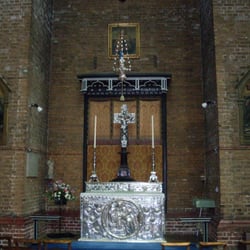
    St Bartholomew's Church - Lady Altar - also known as the 'Silver Altar', for obvious reasons...

    St Bartholomew's Church

    4.2(11 reviews)
    31.7 km

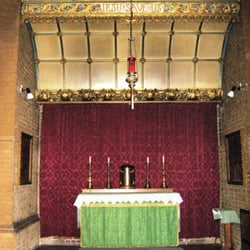
    Pevsner's 'The Buildings of England' describes St Bartholomew's as 'an unforgettable experience',…read moreand it's hard to better that description. This Victorian gothic edifice, just outside the centre of Brighton, is one of the most dramatic parish churches in the UK, with one of the highest naves in Europe. At 135ft (41m), it is just 7 feet lower than that of Cologne Cathedral. For many years, it dominated the view to the east as you arrived by train into Brighton station. (Alas, a sight no longer available thanks to the erection of some appallingly dull blocks of offices and flats). The building was the brainchild of Father Arthur Douglas Wagner, (1824-1902) himself son of the Vicar of Brighton, and a colourful local character: a wealthy young man, he was ordained in 1849, and became priest of St Paul's, Brighton (see separate Qype entry), which his father had essentially built for him. A leading Catholic Revivalist, and determined to develop a ministry to the poor, A D Wagner was to build several churches in Brighton, all out of his own pocket. Of these, St Bartholomew's is the best known. Built in 1872-74 to designs by a local architect, Edmund Scott, St Bartholomew's is in a plain Gothic style, and of brick throughout. The church is aligned north-south, with the main (ritual West) entrance on Ann Street. Standing in front of this gives a good foretaste of what is to come: a towering brick facade, containing a truly huge Rose Window, it completely dominates its surroundings. Once inside, the eye is immediately drawn upwards and forwards: the wooden wagon roof simply disappears in darkness, and nine bays of huge pointed arches lead the eye to a sanctuary containing an enormous baldachino, 45ft (15m) high, covered entirely in marble. The arches each contain a shallow chapel with a single lancet, with another lancet in the clerestory above. Polychromatic bricks are all that relieve the scale, for there is virtually no other ornament in the architecture. The accumulated grime on the walls gives the interior a dark and mysterious feel. The intended chancel was never built, and instead a sanctuary was created at the east end of the nave. This accommodates the baldachino and a huge pulpit also of marble both by the noted arts and crafts designer, Henry Wilson (1864-1924). He also designed the Lady Altar also known as the silver altar with a repoussé frontal of silver plate on copper and the pair of pillar-sized candlesticks either side of the altar. The whole effect is breathtakingly dramatic, and perfectly suited to the high Anglo-Catholic ritual and superb liturgical music, for which the church is renowned. The church has an active and busy parish life, and a weekly mass for the attached junior school. A constant stream of visitors from around the world walks through its doors daily, to see this astonishing building for themselves.

    I walk past this sky scraper like church on my way to Sainsbury's, recently I ventured in to have a…read morepeak. I'm not religious, and I don't think that helps really. I found all the bronze and silver statues of Jesus and various friends dying to be a bit glum, and also a bit anthithetical given that the church asks for donations. In terms of the building though, it's unbelievably tall. From what I read, it's the tallest church in Europe, for that along, definitely visit if you're nearby. I found it massively interesting, the architecture is unlike much else, as is the slightly scared feeling you get walking around inside.

    Photos
    St Bartholomew's Church - St Bartholomew's totally dominates its surroundings...although the view from the railway is, now, alas destroyed.

    St Bartholomew's totally dominates its surroundings...although the view from the railway is, now, alas destroyed.

    St Bartholomew's Church - Altar with tabernacle for the Reserved Sacrement

    Altar with tabernacle for the Reserved Sacrement

    St Bartholomew's Church

    See all

    Tollgate County Junior School - education - Updated May 2026

    Loading...
    Loading...
    Loading...