"Make Us Free"
I…read morelearned about the Amistad story from Steven Spielberg's 1997 movie. In 1839, a Spanish slave ship called La Amistad was carrying African slaves to Cuba. Under the leadership of Joseph Cinque (the central figure of the Amistad story), there was a prison break on the ship and two of the Spanish crew were killed. The ship ended up in New Haven, CT where a Supreme Court trial took place to decide the destiny of the slaves.
Were they Spanish property? Were they free men? Were they criminals? What exactly were they?
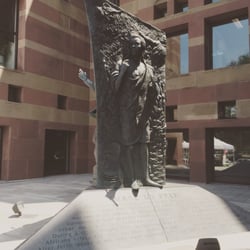
You will find this powerful memorial in front of the New Haven City Hall. It's a striking three sided sculpture with a trio of sculpted panels depicting Sengbe Pieh, also known as Joseph Cinque. Each panel shows him at different stages in his life -as a free African, as a defendant in the Supreme Court trial, and as a free man ready to return to Africa.
The gorgeous sculptures of Cinque are 9 feet tall, resting on a 2 foot granite base. The three-sided base contains a large inscription that tells the story.
The full inscription reads:
Make Us Free
This monument is a memorial to the 1839 Amistad Revolt and its leader, Sengbe Pieh, also known as Joseph Cinque. Sengbe Pieh was one of the millions of Africans kidnapped from their homes and transported in bondage to the Americas. Sold into slavery in Cuba, he and forty-eight other men, and four children were bound aboard the schooner La Amistad. During a storm, Sengbe Pieh successfully freed himself and his fellows. The Africans seized the ship, but their offers to steer La Amistad homeward were thwarted. After futile weeks at sea, they were captured off Long Island by the U.S.S. Washington.
On this site, the Amistad Africans were jailed awaiting trial for piracy and murder. To aid their struggle for freedom, the Amistad Committee formed, counting in its number ministers Simeon Jocelyn, Joshua Leavitt, and James Pennington; merchant Lewis Tappan; professor Josiah Gibbs; and lawyer Roger Baldwin. The Africans were tried twice prior to their ultimate triumph before the United States Supreme Court, where former President John Quincy Adams courageously defended them. Sengbe Pieh and his fellows were declared Free Persons.
The Africans sought to return home. To raise funds for their voyage and to further the anti-slavery cause, they engaged in a series of speaking tours. In 1841, after a sojourn that profoundly influenced the abolitionist movement, they set sail, free at last.
To commemorate the heroism of the Amistad Africans and those who shared in their quest for freedom, the 1989 Amistad Committee commissioned his sculpture by Ed Hamilton and dedicated it on September 26, 1992.
Erected 1992 by the 1989 Amistad Committee
One of the best movie courtroom scenes I have ever seen has the great Anthony Hopkins as an elderly John Quincy Adams arguing for the freedom of the slaves before the US Supreme Court. If this doesn't give you goose bumps, go check to see if you are breathing.
Check this out..
https://www.youtube.com/watch?v=EZFr4VLPW9Q