Cancel

    Open app

    Search

    Tetrahelix

    4.0 (1 review)

    Tetrahelix Photos

    Recommended Reviews - Tetrahelix
    Your trust is our priority, so businesses can't pay to alter or remove their reviews. Learn more about reviews.
    Yelp app icon
    Browse more easily on the app
    Review Feed Illustration

    3 years ago

    Helpful 3
    Thanks 0
    Love this 5
    Oh no 0

    Verify this business for free

    Get access to customer & competitor insights.

    Verify this business

    Sail Sculpture

    Sail Sculpture

    5.0(1 review)
    0.5 mi

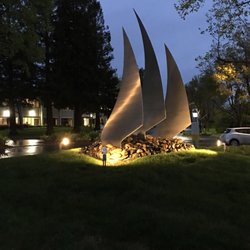
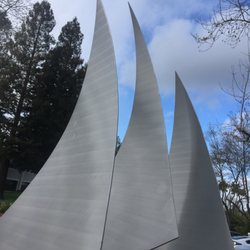
    Sail Sculpture is an outdoor art installation located in the city of Mountain View, California…read more Located on Garcia Avenue, it is the work of artist Burke Rutherford. It is located near Intuit Corporation Building 4. As a side note you never see Intuit bikes abandoned but I digress... Rutherford, who was born in Utah, and moved to California in his youth, studied art extensively in Europe. His work which is primarily seen in North America, ranges from huge outdoor installations to small tabletop designs. Its seems very hard to pin down a particular style and he seemed content to dabble in a vast multitude of them. He passed away at his home in Mexico in 2015 From the artist: 'There is noting more gratifying than to see people, young, old, and even blind, enjoy your work, touching and feeling the sculpture as it truly should be experienced" And indeed, before I did my research, I was compelled to run my hand down the face of one of the triangles. I normally do not do this but I'm happy to see this was his intent. The sculpture consists of three abstract, curved triangles position close together. The effect is very cool, and from some angles you may only see one, or all three, but you are drawn into the symmetry and differences of each piece. This kind of art significantly interfered with my bike ride as I was really reluctant to leave the sculpture. It really drew me in. If I had a lawn chair and a decent pilsner in quantity, I could spend hours just staring at it. Sail Sculpture is really off by itself. There is a variety of activities to do within a few miles, and this is better as a stop than a destination. There is a nearby installation I have already review, Ling The Lang and Buzzcock, so there is more than afew to see int he immediate vacinity. There are also several installations int he immediate area I have not gotten too, so stay tuned

    Photos
    Sail Sculpture
    Sail Sculpture
    Sail Sculpture

    See all

    Ursa Mater - Ursa Mater

    Ursa Mater

    5.0(2 reviews)
    12.7 miDowntown

    "As my artist's statement explains, my work is utterly incomprehensible and is therefore full of…read moredeep significance."―Calvin San José has a long line of, shall we say, questionable Public Art (PA) projects; everybody knows about the giant dog turd statue Quetzalcoatl―or as I like to call him Quetzacaca ( goo.gl/lvswBr )―in the Plaza de César Chávez. Let's also not forget the Fallon Statue debacle ( goo.gl/wKEv0g )―and don't get me started on the mangled shopping carts (goo.gl/vbB6NE) passing for a statue on the corner of Alma Ave and Almaden Rd. Need I go on?! So, whenever CSJ does something right I love to point it out. I first read about Ursa Mater (aka Mama Penny Bear) in the Merc from my buddy Sal Pizarro's column. Ursa Mater is a gigantic piece of coin art that was put together by Hayward-based artists Mr & Mrs Ferguson. She first made an appearance at last year's Burning Man festival and is now prominently displayed in Paseo de San Antonio―just east of Plaza de César Chávez, right by Bijan Bakery. The statue of Mama Bear and her two cubs sits at least 10-12' tall and is completely covered in 200,000 pennies ($2,000 worth) to make up the bears fur. It's pretty cool to look at from afar, and even cooler up close. I suggest getting here quickly to check her out, as she will only be on display until the end of May. And then we'll be back to staring at Quetzacaca forever. FOL...

    I like to think that these represent the bear on the California flag. The name Ursa Mater…read more Is an excellent play on words by the artist. Ursa Major is Latin for "greater she bear" So Ursa Mater translates roughly to "She bear of matter" ( I only understand a very small amount of Latin so this may or may not be the exact translation). The bear and her cub are made of pennies so it seems the artist's intention was to make a realistic mother bear out of " matter" , hence the name. Also behind the pennies is a concrete core. It's as if these bears have a real fur made out of metal. As the previous reviewer said, there are are a lot of bad San Jose art pieces, but this one is fantastic. Just an edit: it seems to be gone now. Very sad.

    Photos
    Ursa Mater - Made of 200,000 pennies!

    Made of 200,000 pennies!

    Ursa Mater - Ursa Mater

    Ursa Mater

    Ursa Mater - Baby Bears =)

    See all

    Baby Bears =)

    Computer History Museum - Software Arch in Revolution exhibition.

    Computer History Museum

    4.4(391 reviews)
    0.9 mi

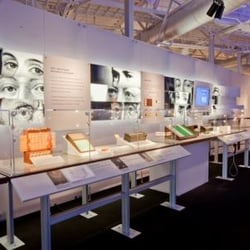
    Spent a few hours at the Computer History Museum and didn't expect it to feel as reflective as it…read moredid. The museum walks you through the evolution of computing, from early mechanical calculators to modern microprocessors, software systems, and AI. You can see machines like ENIAC (one of the first general-purpose electronic computers) along with punch-card systems, the Apple I, and other machines that once felt futuristic and now look dusty and almost fragile. Everything here is built in layers, not in isolation: ideas evolving over time, people contributing in ways that are not always visible at first, yet shaping the outcome. Still, it is striking to see how these machines have become extensions of how we think nowadays (our brains). We offload memory, rely on algorithms to anticipate what we want, and increasingly hide behind screens. We run away from the real world and avoid real human connection. In some ways, it can feel easier to trust systems than real people because systems are predictable, responsive, dopamine-inducing, and do not require human effort or vulnerability. People do. People are messy. Here where the museum unexpectedly becomes even more reflective. It makes you wonder how easily we stay self-contained, avoid the messiness of real connection, and fill the space with endless technological distraction. Roughly 1 in 2 U.S. adults report experiencing loneliness, with in-person social interaction declining over time. Technology makes it easier to stay in your own world, away from uncertainty, risk, and the effort real closeness requires. So where does this lead us? What is our future? Is it for our good? If it feels easier this way, is it actually better? Are we becoming more connected, or just more efficiently alone? P.S. I think the admission for youth should be cheaper.

    A fantastic journey through the history of computing! So…read moremuch to explore here and they even offer demonstrations. Always a great time.

    Photos
    Computer History Museum - Punched Card Gallery in Revolution exhibition.

    Punched Card Gallery in Revolution exhibition.

    Computer History Museum - Calculators Gallery in Revolution exhibition.

    Calculators Gallery in Revolution exhibition.

    Computer History Museum - Calculators Gallery in Revolution exhibition.

    See all

    Calculators Gallery in Revolution exhibition.

    Max

    Max

    5.0(1 review)
    0.9 mi

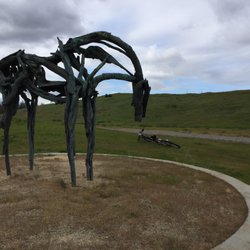
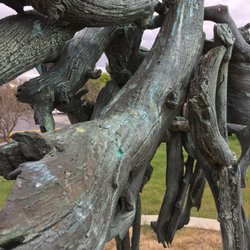
    Max is an outdoor sculpture located in Mountain View, California..... Wow this one came out of…read morenowhere and I was really shocked. I have seen other works of Deborah Butterfield at major museums, and was floored to see this art installation in the middle of nowhere (I mean its near offices etc, but not on any maps), off by itself with little fanfare. I was biking by and saw it from a distance. Curious I rode up and was very surprised Deborah Butterfield began sculpting horses back in the 1970's. She started with sticks and clay, but soon progressed to scrape metal. She later moved on to cast bronze. She selects individual pieces of wood and then creates the bronze cast. The wood/bronze is then used to create the horses. A native of San Diego, California, her art can be seen in museums around the country. From the artist: ""The lines of the branches do not simply outline the forms of horses, they create the contours through an accumulation of simple or energetic lines that seem to build up from within. This is three-dimensional gesture drawing, and the result is both skeletal and muscular." The sculpture at first glance appears to be driftwood with all of its detail, but when you touch it and feel the cold hard metal its shocking everything even though I know what to expect. There is a stark simplicity to the sculpture as a whole from a distance, but the intricate details of the casting and the complexity the small shapes form are shockingly complex. The sculpture is about 40 feet from the sidewalk and up a slight hill. There is nothing around and I have to admit I spent a good 30 minutes enjoying both the relative quiet and the sculpture from different angles. As with most of my public art reviews this is more of a stop than a destination. There is quite a bit to do in the immediate are from the various Bay Trails and Shoreline Lake etc.

    Photos
    Max
    Max
    Max

    See all

    Papua New Guinea Sculpture Garden at Stanford

    Papua New Guinea Sculpture Garden at Stanford

    4.9(14 reviews)
    4.6 mi

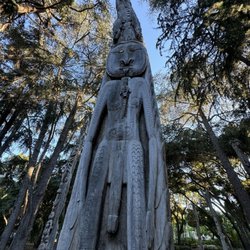
    This isn't just an art exhibit, it's a whole experience! The setting here is like a jungle, full of…read moreplantlife and fallen leaves, with different stone sculptures, wooden carvings, and totem pole artworks almost camouflaged among the tree trunks and branches, displayed underneath the shade, and benches situated randomly within the forest of art. In 1994, Anthropology grad student and researcher, Jim Mason, organized a project to have a group of artists, aged 27-74, coming from 6 different villages in the Sepik River region of Papua New Guinea, to create the beautiful sculptures at Stanford University. The landscaping and plants of the garden were organized by other entities. The artwork is based on Kwoma and Iatmul mythology and stories of creation, the center of the garden created in the likeness of "spirit homes". Two of the pieces, The Thinker and The Gates of Hell, were inspired by the Rodin sculptures on campus bearing the same names, but tell their own stories. The history and design of this sculpture garden are fascinating, and the natural environment and overall maintenance of this exhibit make it an appealing place to visit. It's even a desirable area of campus to hold school events (they had just finished such an event when I visited this past Sunday). Also, free parking is available at Stanford on the weekends.

    Its a very cool outdoor installation located on the Stanford campus. T They sculptures are spread…read moreout and all have interesting descriptions of the culture and the art. This is a perfect COVID activity as its not crowded, everything is spread out and its outdoors. Mask up and keep your distance and its all good. There are at least 12 other art installations nearby as well as the Student Union and main bookstore.

    Photos
    Papua New Guinea Sculpture Garden at Stanford - The Thinket

    The Thinket

    Papua New Guinea Sculpture Garden at Stanford - The Thinker

    The Thinker

    Papua New Guinea Sculpture Garden at Stanford - Sculptures/forest

    See all

    Sculptures/forest

    Epoch

    Epoch

    5.0(1 review)
    4.3 mi

    Epoch is a public art installation located in the City of Sunnyvale, California. Located on Java…read moreStreet and adjacent to the NetApp headquarters, it is the work of Brad J. Goldberg. Goldberg, a native of Rhode Island, specializes in large outdoor installations. His works can be massive and often incorporate element of the surrounding community into account. From the artist: "Artist Brad Goldberg sees his work as a fusion between sculpture, landscape, and the built environment. Sculptures are seen, not as isolated objects, but rather as spirit-creating components of larger spatial experiences. The desire to work with the environment as a whole allows the creation of a unique non-preconceived response to the total aspect of a place." Epoch is a fantastic instillation. Its composed of three large granite boulders that have been cut in half and arranged in a split fashion. The cut surfaces have been polished smooth and the whole face has been engraved with binary code which reflects the technological aspect of the area. I freely admit that I can still send rudimentary signals with semaphore (Thank you Boy Scouts) but binary code reading is beyond my skill so I have no idea if there is a message in teh code. However, as I was taking a picture of a snail on the surface I noticed that several words were engraved into its surface breaking up the strings of 1 and 0's. The words I found were: Change, Nature, Community, Listen, Integrity, Imagination, Evolve, Substance, See, Chaos, and Craft. The artist intent was to show "words which can be seen to align or conflict with today's technological advancements". If that was his true intent he really hit it spot on. Epoch as noted is located in a technology park and basically surrounded by office space. There is very little in the area beyond this installation and it should be treated as a stop as opposed to an outright destination. There is a light rail station right next to the street for the public tranpost inclined.

    Photos
    Epoch
    Epoch - Change

    Change

    Epoch - Chaos

    See all

    Chaos

    Wiggle Room and C'Mon

    Wiggle Room and C'Mon

    4.0(1 review)
    3.6 mi

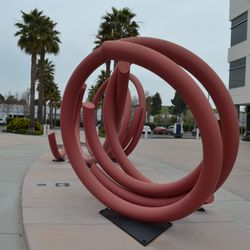
    Wiggle Room and C'Mon are two outdoor sculptures Co-located in Sunnyvale, California. Situated in…read morean office complex on Bordeaux Dr, they are the works of artist John Clement. Clement is a native of Philadelphia and is presently based out of New York. Its interesting that he is a disciple of Mark di Suvero who's work I have reviewed as well. Whereas di Suvero makes extensive use of linear forms, Clements expression seems more rooted in curvy, non linear forms. From the Artists biography: "My sculptures are three-dimensional realizations of imaginary forms," says Clement. "I rely heavily on the artistic process, allowing the work to evolve and mature, eventually become self-referential. Although many of my works are site-specific their form does not directly rely on the surrounding architecture or landscape. The clearly defined positive and negative space of the work, combined with its scale, creates a new framework in which the surroundings can be experienced through the sculpture ... I choose to work with steel and approach the material first as an artist and second as a craftsman. The success of my work does not rely upon gimmicks or trickery in the materials, but on the implied movement and strength of form of each individual piece. The bright, primary colors used to paint the work serves to bring the form of the work to the forefront, enhancing the sense of the work leaping from the ground as well as protecting the material from corrosion." As noted both sculptures are located in an office park and within 100 feet of each other. C'Mon is the smaller of the two with its interlocking curves and striking red paint. While massive in size its form projects a sense of continuity and fluidity and you can easily get lost trying to follow them. Wiggle Room is a much more massive structure. This sculpture gives the impression from some angles of a single coil being unwound. Its a bit more chaotic than its smaller sister and sometimes you get the feeling of two coils trying to interact. Regardless its a fascinating piece and what makes more interesting is that the relative closeness of these sculptures makes it easy to compare and contrast. Wiggle Room and C'Mon are sort of off by themselves and are at best a quick stop and there is really nothing to do in the immediate vicinity. That being said there are several parks in easy walking distance and the Sunnyvale Bay Trail is also located nearby.

    Photos
    Wiggle Room and C'Mon
    Wiggle Room and C'Mon
    Wiggle Room and C'Mon

    See all

    Auras

    Auras

    4.5(2 reviews)
    3.9 mi

    So beautiful at night!…read more Several of the uprights and downlight are broken on the Aurus sculpture, which makes it look not as nice as its sibling across the street. Notice in the photo there is only the southern downright working; northern downlighting was broken. Also 3 out of 4 uprights were broken.

    Auras is an outdoor art installation located in the City of Sunnyvale, California. Located on…read moreBordeaux Drive and in the middle of a large office complex, the sculpture is the work of artist Cliff Garten. Garten, who is based out of Venice, California, has not only a Masters of Fine Arts (sculpture) but also a Masters in Landscape Architecture (Harvard) which he uses to incorporate his designs into the environment in which they are placed. From the artist: " There is a latent potential in every public place and situation to become more than the specific functions it appears to perform. Public and private experiences are never distinct, but exchange places throughout the day. My search for a place where desire intersects with our everyday activity is the search for sculptural forms which engage us in the poetry of our own actions and define our personal and social histories. The necessary facts of our public infrastructure are cause for the possibility of a public expression through the conscious design and integration of art. Sculpture defines our interaction and movement by creating energy between things, generating interest in public activity, reframing our private lives and creating a sense of place within public and private realms." Working in a variety of mediums, the vast majority of his work focus on large public installations and can be seen around the world. Auras (the plural form) is appropriate because this installation features two of the sculptures. One on either side of the street. They are slight offset in relation to each other. Both are nearly identical to my eye and feature sort of a basket within a basket form. Made of stainless steel the interlocking lattice has a very cool effect on the light patterns that filter through. Apparently at nigh they are lit with multiple colors which I was unable to observe. Aside from the pleasing patterns, there was very little in the way of contemplation one would find with say an abstract sculpture. However, there was a sort of relaxing quality in their symmetry. Auras as noted is kind of in a remote location and is better off as a single stop as opposed to a destination. There are several other art installations nearby (I'm slowly getting to all of them), but little in the way of other infrastructure nearby unless you are working at one of the building in the area.

    Photos
    Auras
    Auras
    Auras

    See all

    Stone River - Andy Goldsworthy

    Stone River - Andy Goldsworthy

    4.6(5 reviews)
    4.4 mi

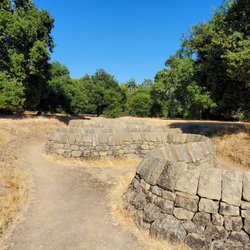
    Checked out this art piece on the Stanford University campus on Sunday, and it was reminiscent of…read morethe artist's Wood Line log sculpture in SF, which I had visited several months prior, the curves of the sandstone river wavy like the slither of a snake. It was built by 8 stone-wallers from Great Britain and consists of 6,500 stones, with the artist aiming to emphasize a connection to nature through the sculpture's materials, location, and design. The parking lot in front of the Anderson Museum (on Museum Way) is free on weekends and provides direct and easy access to this awesome Andy Goldsworthy exhibit.

    Also known as 'The Snake", Stone River is an permamant art installation on the Stanford Campus. It…read moreis the work of Andy Goldsworthy. Goldsworthy, a native of Brittan, uses natural products and strives to make a connection to the area the art is emplaced. From the artist : 0 "Movement, change, light, growth and decay are the life-blood of nature, the energies that I try to tap through my work." and "My sculpture can last for days or a few seconds - what is important to me is the experience of making. I leave all my work outside and often return to watch it decay." True to his vision, Stone River was constructed using limestone from campus buildings damaged during the 1989 Loma Prieta earthquake. The installation is massive stretching almost 320 feet and used almost 130 tons of stone. From my perspective it looks like a giant snake especially from the air. As noted Stone River is located on the Stanford Campus and is right next to the Cantor and Andersen art museums. Its a cool stop especially if you have kids as they can run amok over, around etc on it.

    Photos
    Stone River - Andy Goldsworthy
    Stone River - Andy Goldsworthy - View from parking lot

    View from parking lot

    Stone River - Andy Goldsworthy - Sculpture

    See all

    Sculpture

    Tetrahelix - publicart - Updated May 2026

    Loading...
    Loading...
    Loading...