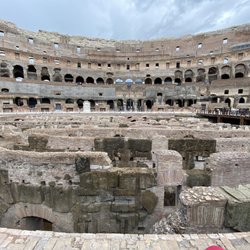
I booked a Colosseum guided tour through LivTours for my family during a long planned trip to Rome,…read moremeant to celebrate my son's graduation from Lehigh University and my daughter's high school graduation. Instead of a memory to celebrate, we left with one none of us will forget for the wrong reasons.
LivTours guides do not give guests individual paper tickets. The guide holds all admission on an electronic ticket and hands each guest a small sticker as the only proof of entry. On an extremely hot day, my sticker came loose. Our guide walked ahead with two other guests to the bookshop and, by her own account, only glanced back and saw our group heading toward the exit. She never confirmed we actually made it out and never checked that each of us still had proof of admission.
When I reached the exit checkpoint, staff asked for my ticket. I had none, because LivTours never gave me one. I was told it was illegal to be in that area without a valid ticket, pulled aside, and questioned. The police were called. I stood there while my wife and children watched and had to step in to try to help me. My wife eventually pulled up our purchase receipt on her phone, and that is the only reason I was allowed to leave.
LivTours admitted in writing that the guide saw our group heading toward the exit and left without confirming we made it out. She did not secure our exit. She did not check that everyone in the group actually cleared the checkpoint before she walked off with two other guests to the bookshop. Making sure a group actually exits a controlled site, not just watching them walk in that general direction, is a basic responsibility of a tour guide, especially one holding the only ticket that gives that group the right to be there in the first place.
As an African American man in a foreign country, being publicly stopped, questioned, and detained by police in front of my family was humiliating in a way that is hard to put into words. This was supposed to be a trip celebrating my children's accomplishments. Instead they watched their father get pulled aside like a criminal because a tour guide walked away without making sure we had what we needed to leave.
A LivTours representative called me shortly after and told me directly that a refund would be issued. Weeks later, after I put the complaint in writing, LivTours reversed course completely. They now claim the tour was "completed as planned" and that the incident was outside their control. Their own emails contradict that. They admit their guide saw us walking toward the exit and left without confirming we got out safely. They admit they do not provide physical tickets to guests. Those two facts together are exactly why this happened, and it happened because of how LivTours operates, not because of anything my family did.
I would not recommend LivTours for any tour requiring facility exit past a checkpoint. Ask directly whether you will receive an individual physical ticket before you book, and get it in writing.
Reggie