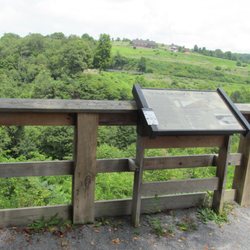
Please note that the above is NOT the address of Staple Bend Tunnel. Staple Bend Tunnel is two miles to the west of this point along the Path of the Flood Trail and this is the closest trailhead with parking to the tunnel. You may only access the tunnel via foot or bicycle, so if you want to see it you must be up for a four mile round trip bike ride or hike.
Although a part of the Allegheny Portage Railroad, Staple Bend Tunnel is open as a separate area of the APRR National Historic Site. It lies about 20 miles to the west of the visitor's center, but if possible it should be included as a part of your visit. My husband and I along with my cousin & her husband visited the APRR site last weekend. So this weekend Rick and I combined a trip to the tunnel with a bike ride down the Path of the Flood Trail.
Staple Bend Tunnel was completed in 1833 and was the first railroad tunnel in the United States. Other tunnels had existed in the U.S. however they were for other canals. Workers were paid $13.00 a month to chip and blast their way through some 900 feet of solid rock. They worked 12 hour days, six days a week, often in very inclement weather and under dangerous conditions. Sundays were reserved for church. In order to blast through the rock, 9 holes had to be drilled. Each hole was 1 inch wide and three feet long. This was an arduous task, each hole taking about three hours to drill and using a three man crew. The holes were then filled with a pound of blasting powder. The blasts were timed to coincide with mealtimes. Workers would eat while the dust settled. Each hole drilled only yielded about 18 inches in blasted tunnel. So you can imagine how long it took to complete the tunnel. Work began in November 1831 and finished in April, 1833.
Staple Bend Tunnel was used for about 20 years, until the Allegheny Portage Railroad was overtaken by the Pennsylvania Railroad. Neither New Portage Railroad nor the Pennsylvania Railroad used the tunnel. It became one of the first highway tunnels in Pennsylvania, used by carriages up until the Johnstown Flood of 1889. After that, safety and flood damage became concerns and the tunnel was closed to the public. In the 1940s, the tunnel was lined with concrete. The Manufacturer's Water Company installed water lines and a water tank. Bethlehem Steel used these lines
Eventually Staple Bend Tunnel fell out of this use and was essentially forgotten by the public. In 2001 it reopened as a separate area of the National Historic Site. The west entrance of the tunnel has been restored to its former Roman Revival grandeur. Today you can walk or bike the entire length of the tunnel. Just be aware that this tunnel is 900 feet long and is NOT lighted. Even though you can see either end of the tunnel, I recommend that you bring a flashlight or bike headlight and that you dismount and walk your bike through here. The trail surface is not well maintained through here and you will not be able to see any obstacles. Presently the trail ends just on the other side of the tunnel. read more