St. Stephan Photos


Recommended Reviews - St. Stephan
Start your review...


Reviews With Photos


Oder: die blaue Kirche. Blau deshalb, weil die von Marc Chagall in seinen späten Jahren entworfenen Kirchenfenster den Innenraum in ein bläuliches Licht tauchen. Die Kirche findet man am höchsten Punkt der Altstadt von Mainz, abgesehen von den Chagall-Fenstern ist sie vergleichsweise schlicht gestaltet. Doch die Fenster (ausgezeichnet dokumentiert, hierzu gibt es separate, kostenpflichtige Führungen) alleine lohnen schon den Besuch.


Probably one of the most uniquely inspiring churches I've ever seen, a trip to Mainz, DE not only put the Gutenberg Museum on my radar, but also St. Stephan church, starkly austere, almost poor with one stunning feature: Chagall's blue stained glass windows. Who cares? I thought I didn't. All I knew was Chagall was one of the greatest Euro artists, a modernist, but that was all I remember from college. We'll Im not an art snob but if you want to know about Chagall's significance in this church go pay it a visit or maybe read a little about him here. St. Stephan built originally in 990 (expanded in 1267-1340) is the largest church in Mainz. You can get to St. Stephan up the street (the only street that goes uphill) from the main square in Mainz, past lots of small shops, drugstores (called apothecaries, very popular) on Steffanstrasse, going up to the very top of the highest hill in Mainz. This church is a simple beautiful Gothic building, no frills, really cool ceilings, until you see Chagall's windows. Then you're in awe. What would posses one of the great artists of all time, a Russian Jew, make blue stained glass windows for a Catholic church? Turns out he made these windows as a gesture of friendship to a priest, Klaus Mayer, he knows at St. Stephan. Ironically, Jews were driven out of and persecuted in Mainz for centuries until World War II (learned this about Mainz on my trip there in December). What's pretty incredible about this church is the stained glass casts this blue light of awesome protection throughout the church. Blue light. Silent wonder. Here's a wiki about Chagall's work at St. Stephan: http://en.wikipedia.org/wiki/St._Stephen's_Church,_Mainz as of 3/17/14 "The Chagall choir windows in St. Stephan are unique in Germany. Between 1978 and his death in 1985, Russian Jewish artist Marc Chagall created nine stained-glass windows of scriptural figures in luminous blue. The figures depict scenes from the Old Testament, demonstrating the commonalities across Christian and Jewish traditions. Chagall intended his work to be a contribution to Jewish-German reconciliation, made all the more poignant by the fact that Chagall himself fled France under Nazi occupation. He chose St. Stephan due to his friendship with Monsignor Klaus Mayer, who was then the presiding priest of St. Stephan. Chagall's work has been continued since his death by his pupil Charles Marq and by others." If you appreciate old churches, Art and ironies of life, Yelp St. Stephan if you're in this part of Germany and pay St. Stephan's a visit. Look up at these cool blue magnificent windows and when you feel the radiating glow of peace, meditate and give Moishe Segal thanks. I came back twice. Tip: Meditate for world peace. Visits: 2


BEAUTIFUL STAINED GLASS WINDOWS BY MARC CHAGALL =============================================== My husband and I had a day to explore Mainz and this church was probably on the top of my list. I had previously seen stained glass windows created my Marc Chagall in Rheims, France and I wanted to see the ones at St. Stephan's too. If you are in Mainz for a day I highly recommend a visit. read more


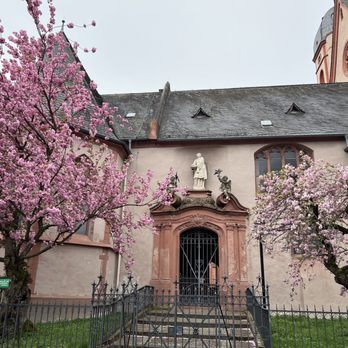
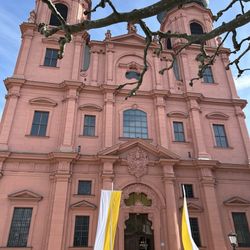
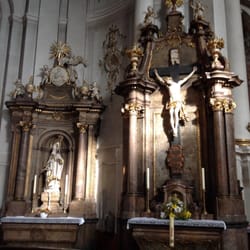
St. Stephan is a large Gothic church in Mainz that although the original structure was built in 990, the building you see today was started in 1267 and through the years additional sections were added thru the 14th century. It is the oldest Gothic hall Church in the Upper Rhine district of Germany and is known for it's stained glass windows created by Marc Chagall. The church was heavily damaged by bombing during WWII and parts of the vaulted ceiling were unable to be restored leaving sections with a flat ceiling. Nine blue stained glass windows were created by Marc Chagall between 1978 and 1985. His contribution to post-war Jewish-German reconciliation. It's really not and easy location to access by car. GPS took us through a neighborhood and then wanted us to go down a street that was blocked off by bollards. We did end up happening upon the church luckily after a couple of attempts. There is not much parking here at all so it's probably best to park elsewhere and walk in. The church itself is not ornate or filled with murals as many other European churches are. If that is what you are hoping for, you will be disappointed. This is an historical structure. Read up on the structure's history and Marc Chagall's contribution before visiting. Definitely worth a visit for it's architectural and historical significance. read more




4 years ago
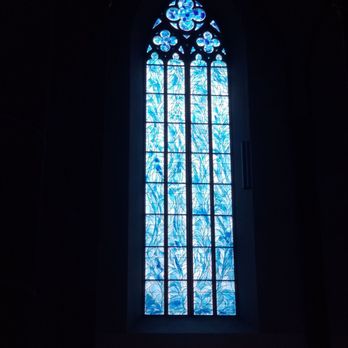
This was a wonderful visit to a special church named for st stephan. The blue stained glass is all Chagall. The new organ pipes were so perfect. read more


4 years ago
Oder: die blaue Kirche. Blau deshalb, weil die von Marc Chagall in seinen späten Jahren entworfenen Kirchenfenster den Innenraum in ein bläuliches Licht tauchen. Die Kirche findet man am höchsten Punkt der Altstadt von Mainz, abgesehen von den Chagall-Fenstern ist sie vergleichsweise schlicht gestaltet. Doch die Fenster (ausgezeichnet dokumentiert, hierzu gibt es separate, kostenpflichtige Führungen) alleine lohnen schon den Besuch. read more


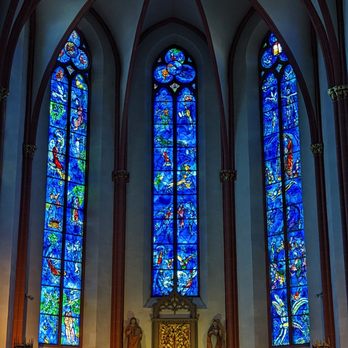


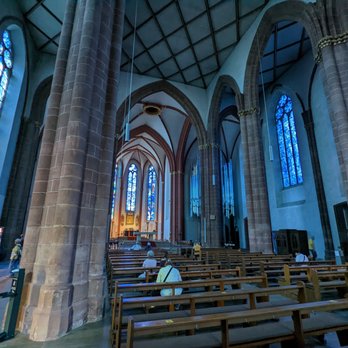


Probably one of the most uniquely inspiring churches I've ever seen, a trip to Mainz, DE not only put the Gutenberg Museum on my radar, but also St. Stephan church, starkly austere, almost poor with one stunning feature: Chagall's blue stained glass windows. Who cares? I thought I didn't. All I knew was Chagall was one of the greatest Euro artists, a modernist, but that was all I remember from college. We'll Im not an art snob but if you want to know about Chagall's significance in this church go pay it a visit or maybe read a little about him here. St. Stephan built originally in 990 (expanded in 1267-1340) is the largest church in Mainz. You can get to St. Stephan up the street (the only street that goes uphill) from the main square in Mainz, past lots of small shops, drugstores (called apothecaries, very popular) on Steffanstrasse, going up to the very top of the highest hill in Mainz. This church is a simple beautiful Gothic building, no frills, really cool ceilings, until you see Chagall's windows. Then you're in awe. What would posses one of the great artists of all time, a Russian Jew, make blue stained glass windows for a Catholic church? Turns out he made these windows as a gesture of friendship to a priest, Klaus Mayer, he knows at St. Stephan. Ironically, Jews were driven out of and persecuted in Mainz for centuries until World War II (learned this about Mainz on my trip there in December). What's pretty incredible about this church is the stained glass casts this blue light of awesome protection throughout the church. Blue light. Silent wonder. Here's a wiki about Chagall's work at St. Stephan: http://en.wikipedia.org/wiki/St._Stephen's_Church,_Mainz as of 3/17/14 "The Chagall choir windows in St. Stephan are unique in Germany. Between 1978 and his death in 1985, Russian Jewish artist Marc Chagall created nine stained-glass windows of scriptural figures in luminous blue. The figures depict scenes from the Old Testament, demonstrating the commonalities across Christian and Jewish traditions. Chagall intended his work to be a contribution to Jewish-German reconciliation, made all the more poignant by the fact that Chagall himself fled France under Nazi occupation. He chose St. Stephan due to his friendship with Monsignor Klaus Mayer, who was then the presiding priest of St. Stephan. Chagall's work has been continued since his death by his pupil Charles Marq and by others." If you appreciate old churches, Art and ironies of life, Yelp St. Stephan if you're in this part of Germany and pay St. Stephan's a visit. Look up at these cool blue magnificent windows and when you feel the radiating glow of peace, meditate and give Moishe Segal thanks. I came back twice. Tip: Meditate for world peace. Visits: 2 read more


10 years ago
For me, this is the highlight of Mainz, I love the the luminous blue stain glass. It was designed by Russian Jewish artist Marc Chagall to demonstrate the relationship between Jewish and German in the area. A worthy place to visit read more


More info about St. Stephan
St. Stephan Reviews in Other Languages









Why does Yelp recommend reviews?
10 reviews that are not currently recommended
The reviews below are not factored into the business's overall star rating.

13 years ago

13 years ago
13 years ago
13 years ago
13 years ago
13 years ago
13 years ago
13 years ago

9 years ago
14 years ago