St Mary Abbots Photos


Recommended Reviews - St Mary Abbots
Start your review...



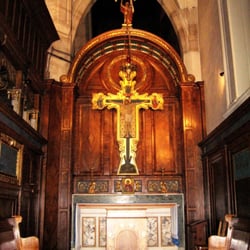
What a beautiful church in the heart of Kensington. Open to the public and only asks for a donation. You can contribute coin, paper money or tap to donate with your watch or phone. Well Preserved and original this church has so many memoriums that show how much history is within the walls. War memorials are sprinkled throughout and deserve your time and attention. Amazing stained glass and wood beam construction within. read more


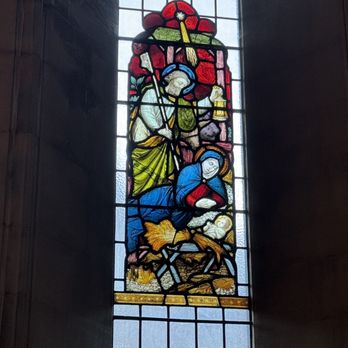


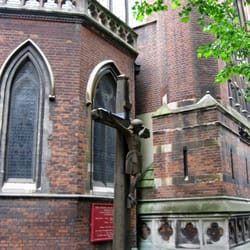
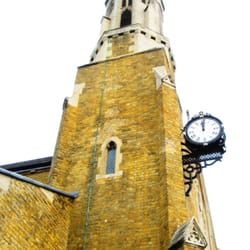
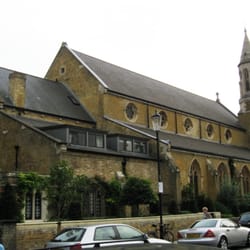
The church of St Mary Abbots Kensington holds what should be an imposing position, on the busy junction of Kensington High Street and Kensington Church Street, but somehow contrives to hide itself from the bustle of the traffic, the shoppers and office workers hurrying past. The present church, built in 1872, is not the first on the site. Kensington derives its name from the Saxon sons of Cynesinge, who founded a settlement or 'tun' in 700 AD near or on the land where St Mary Abbots now stands - 'Cynesingetun' developed into modern 'Kensington'. Little is known about whether there was a church here in Saxon times, but there was definitely a church here after the Norman conquest. The church was bequeathed in the 1100s to the great Benedictine Abbey of St Mary at Abingdon, and in 1260 the abbey established a parish in Kensington, dedicated to St Mary and possibly then given the epithet of 'Abbots'. The line of vicars can be traced directly back to this foundation in 1262. The Norman church was rebuilt in 1370, but the Dissolution of the Monasteries led to the confiscation by the Crown of the Abbey's Kensington lands. Subsequently, the establishment of the Court at Kensington Palace by King William III led to a considerable growth in the local population, and the small medieval church was replaced by a larger Renaissance-style church in the 17th century. This in turn was considered too small for the growth of the local population during the 18th and 19th centuries and, despite the establishment of other parishes in the area, a new church on a grand scale was commissioned in the mid 19th century. The architect was no less than the great Sir George Gilbert Scott, who built a fine neo-Gothic church in the Early English style, and this is the building we see to-day. The church has a standard floor plan of a long nave, with generous aisles, but with short, broad transepts, and a relatively small chancel and choir. The entrance is via a long cloister from Kensington Church Street itself. The quality of workmanship and the grand scale - it is nearly 180ft long, and the nave roof is 72ft high - make this an impressive building. Its spire, at nearly 200ft, is said to be London's highest. The church contains many fittings from the earlier churches, especially funeral monuments from the mid 1600s onwards. Notable among these is a memorial in the form of an angel, to Alfred, Duke of Edinburgh and Saxe-Coburg (d.1899), and Leopold, Duke of Albany (d.1884), by their sculptor sister, Princess Louise (daughter of Queen Victoria) who died in 1939. The pulpit dates from 1697, and was a gift from William III. Given its location, it is no surprise that the church has had a long list of impressive parishioners. These have included Sir Isaac Newton (commemorated in a window in the north transept), Joseph Addison, William Wilberforce, George Canning, William Thackeray and Lord Macaulay. More recent parishioners have included the late Princess Alice, Countess of Athlone and the late Princess Diana. The church is the centre of a very lively parish life, with an long tradition of church music and a fine choir (regular concerts are held here), a busy Sunday School, and an associated Primary School. For details of services and special events, see the web-site. read more


13 years ago