Cancel

Open app

Search

Holy Trinity Church

5.0 (1 review)

Holy Trinity Church Photos

Recommended Reviews - Holy Trinity Church

Your trust is our priority, so businesses can't pay to alter or remove their reviews. Learn more about reviews.
Yelp app icon
Browse more easily on the app
Review Feed Illustration
Photo of David J.
96
2344
11912

18 years ago

Helpful 2
Thanks 0
Love this 0
Oh no 0

Verify this business for free

Get access to customer & competitor insights.

Verify this business

St Cuthbert's Church, Earl's Court

St Cuthbert's Church, Earl's Court

4.0(1 review)
1.1 mi•Earls Court

St Cuthbert's is tucked away off the main Warwick Road in Earl's Court, a quiet spot away from the…read moretraffic. From the outside, it looks like another unremarkable Victorian red-brick church: there isn't even an East Window, in its place a decorative gothic arch with empty niches, waiting for statues. But inside is one of England's outstanding collection of Anglo-Catholic arts and crafts furnishings. Opened in 1883, the interior space is tall and dark, the nave running continuously into the chancel, its proportions modelled on the picturesque ruins of Tintern Abbey in Gwent. The elegant pier shafts and wall panels are made of coloured Torquay marble (apparently the largest shipment ever made of this stone). The windows include lovely examples by Kempe, but it is the arts and crafts which steal the show. The elaborate lecturn is a beautiful piece in copper, brass and wrought iron, but even this is overshadowed by the huge rood beam, with its saints and crucifix, dominating the interior space - modelled on that in the cathedral at Granada. The reredos is also impressive, taking up the whole of the east end, with elaborate carvings of Christ, angels and saints. Unfortunately the interior is rather dusty, and needs some refurbishment: the south wall has been cleaned on the outside, and shows just how colourful the interior could be. Although seldom open in the day for visitors, the space is best appreciated at services, when the rising clouds of incense provide a dramatic spectacle.

Photos
St Cuthbert's Church, Earl's Court - St Cuthbert & St Matthias - exterior, East End

See all

St Cuthbert & St Matthias - exterior, East End

St Mary Abbots

St Mary Abbots

3.7(3 reviews)
0.6 mi•Kensington

What a beautiful church in the heart of Kensington. Open to the public and only asks for a…read moredonation. You can contribute coin, paper money or tap to donate with your watch or phone. Well Preserved and original this church has so many memoriums that show how much history is within the walls. War memorials are sprinkled throughout and deserve your time and attention. Amazing stained glass and wood beam construction within.

The church of St Mary Abbots Kensington holds what should be an imposing position, on the busy…read morejunction of Kensington High Street and Kensington Church Street, but somehow contrives to hide itself from the bustle of the traffic, the shoppers and office workers hurrying past. The present church, built in 1872, is not the first on the site. Kensington derives its name from the Saxon sons of Cynesinge, who founded a settlement or 'tun' in 700 AD near or on the land where St Mary Abbots now stands - 'Cynesingetun' developed into modern 'Kensington'. Little is known about whether there was a church here in Saxon times, but there was definitely a church here after the Norman conquest. The church was bequeathed in the 1100s to the great Benedictine Abbey of St Mary at Abingdon, and in 1260 the abbey established a parish in Kensington, dedicated to St Mary and possibly then given the epithet of 'Abbots'. The line of vicars can be traced directly back to this foundation in 1262. The Norman church was rebuilt in 1370, but the Dissolution of the Monasteries led to the confiscation by the Crown of the Abbey's Kensington lands. Subsequently, the establishment of the Court at Kensington Palace by King William III led to a considerable growth in the local population, and the small medieval church was replaced by a larger Renaissance-style church in the 17th century. This in turn was considered too small for the growth of the local population during the 18th and 19th centuries and, despite the establishment of other parishes in the area, a new church on a grand scale was commissioned in the mid 19th century. The architect was no less than the great Sir George Gilbert Scott, who built a fine neo-Gothic church in the Early English style, and this is the building we see to-day. The church has a standard floor plan of a long nave, with generous aisles, but with short, broad transepts, and a relatively small chancel and choir. The entrance is via a long cloister from Kensington Church Street itself. The quality of workmanship and the grand scale - it is nearly 180ft long, and the nave roof is 72ft high - make this an impressive building. Its spire, at nearly 200ft, is said to be London's highest. The church contains many fittings from the earlier churches, especially funeral monuments from the mid 1600s onwards. Notable among these is a memorial in the form of an angel, to Alfred, Duke of Edinburgh and Saxe-Coburg (d.1899), and Leopold, Duke of Albany (d.1884), by their sculptor sister, Princess Louise (daughter of Queen Victoria) who died in 1939. The pulpit dates from 1697, and was a gift from William III. Given its location, it is no surprise that the church has had a long list of impressive parishioners. These have included Sir Isaac Newton (commemorated in a window in the north transept), Joseph Addison, William Wilberforce, George Canning, William Thackeray and Lord Macaulay. More recent parishioners have included the late Princess Alice, Countess of Athlone and the late Princess Diana. The church is the centre of a very lively parish life, with an long tradition of church music and a fine choir (regular concerts are held here), a busy Sunday School, and an associated Primary School. For details of services and special events, see the web-site.

Photos
St Mary Abbots - Church interior

Church interior

St Mary Abbots
St Mary Abbots

See all

Church of St Philip

Church of St Philip

4.0(2 reviews)
0.8 mi•Kensington

St Philip, Earl's Court Road, is technically in Kensington (being north of Cromwell Road) but is so…read moreclose to Earl's Court, that it is usually thought of as serving the latter. The church is celebrating its 150th anniversary this year, and it has had an interesting, not to say fairly chequered, history over the years. It was built in 1857-8 to the designs of Thomas Johnson of Lichfield, and substantially enlarged in 1863. Its origins are tied up in the complex pattern of church building in 19th century Kensington, which saw Church of England churches built at an extraordinary density, even for London: as the area grew, existing churches of different styles of worship vied with each other to establish new church plants: the Survey of London lists no fewer than seven in the area between Earl's Court and Kensington Square, an area of rather less than two square miles. St Philip's was an offshoot of St Barnabas, Addison Road, and began life as a rented room at the corner of Warwick Gardens and Pembroke Gardens, to cater for the area's rapidly growing population. A church seating 1,000 - for a population of 2,500 (!) - was proposed, and built in under a year. The style is late Decorated Gothic, and executed in yellow stock brick with stone dressings. As built, it had a five-bay nave with north and south aisles, and a south porch, and a thin bell tower. The clerestory has attractive circular windows, variously with sexfoil, trefoil or rosette tracery. As the population expanded, Johnson was called upon to design an enlarged south aisle with a gallery, to provide an extra 400 seats. This was completed in 1863, the south aisle being enlarged to the same size as the nave. A reredos of Caen stone and alabaster was also installed at this point, along with a font. The church entered a period of decline after 1877, partly due to the unpopularity of the Vicar, Walter Pennington, described by a contemporary source as 'a disgrace to his sacred office'. However, the decline must also be attributed to the building of two new churches within the parish: St Matthias's, Warwick Road, and St Cuthbert's, which inevitably attracted some of St Philip's congregation. After his departure, the new vicar, William Smale, paid for repairs and improvements, including decoration of the sanctuary. Further improvements came just before the First World War, when a new organ was installed, along with an impressive reredos in a late mediaeval style by Sir Walter Tapper (1861-1935), an assistant of the famous Church architect G F Bodley, and architect of The Annunciation, Marble Arch. The only major change thereafter was the replacement in 1966 of those stained glass windows destroyed during the Second World War. The church underwent a major rebuilding programme in 2005 to convert the chancel and various outbuildings to housing, and the south aisle to provide a parish hall below and offices above, and the brick interior has been painted cream throughout. This has radically altered the internal appearance, although key features of the architecture, such as the nave arcades, have been retained. The East Window has been installed as a 'false window' above the High Altar, and backlit; elsewhere, the original windows and their glass have been retained, and the impressive reredos - easily the best furnishing - now forms the backdrop of a Chapel in the north aisle. Modern (and comfortable) seating has been installed, along with (slightly more dubiously) very futuristic high-tech grey metal chandeliers. But, overall, it presents an attractive worship space, if one which is very different in feel from the original. The style of worship is traditional middle-of-the-road Anglican, with a very active Sunday School and a small but friendly congregation. The church is now organised as part of the team ministry of St Mary Abbots, Kensington.

I used to worship here when I lived in London, although I left before the changes were made in the…read moreredevelopment. The rebuilt interior is intimate as a worship space and the congregation are friendly and welcoming, with refreshments on offer after the main Sunday service. The worship style is 'low' and middle-of-the-road Anglican - something it seems is getting harder to find these days! There's also a Sunday School for children. The church is about a five minute walk from Earl's Court tube, and the C1 bus stops close by in both directions.

Photos
Church of St Philip
Church of St Philip
Church of St Philip

See all

Holy Crinity - Holy Trinity, Sloane Square: Nave, general view

Holy Crinity

5.0(1 review)
1.0 mi•Belgravia

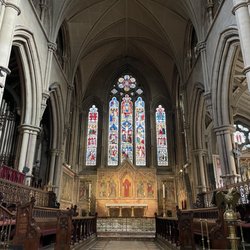
Located just off busy Sloane Square, Holy Trinity is one of the Churches most closely associated…read morewith the Arts & Crafts movement in the UK, and is a stunning monument to late 19th century decorative art. Inspired by people like John Ruskin and William Morris, the movement triumphed hand-made craftsmanship in an age of emerging mass-production. Alongside aesthetic considerations was the belief that such skills were the hallmark of human creativity and endeavour, and the desire to provide work for artisans displaced by industrialisation. Their message was to make everyday objects beautiful, and to revere nature through crafts, painting and architecture. The church was built for the 5th Earl Cadogan by the architect John Sedding, and decorated and furnished by the likes of William Morris, Edward Brunes-Jones and Henry Wilson. The handsome west frontage is in orange-red brick with banded stone decoration, with a huge perpendicular window. The interior plan is straightforward: a wide nave (wider than St Paul's Cathedral) and spacious north aisle, and a smaller south aisle. These lead to a short chancel and sanctuary, which sits beneath an enormous East Window. But it is the rich fittings and furnishings which catch the eye. No expense was spared: there is an abundance of marble, porphyry, alabaster, bronze and gilt. As well as astonishing stained glass - the East Window is William Morris's largest - every item, from the light fittings to the screens and railings - is elaborately conceived and executed. A visit is a must if you are in the area - and a welcome distraction from the retail temptations close by. The church also has a very active worship and music programme - see website for details. At Christmas, it is also renowned for selling one of the best selections of charity Christmas Cards in London.

Photos
Holy Crinity - Holy Trinity, Sloane Square: Pulpit stairway, detail

Holy Trinity, Sloane Square: Pulpit stairway, detail

Holy Crinity - Holy Trinity, Sloane Square: Altar rails by Sedding, with flowers and leaves.

Holy Trinity, Sloane Square: Altar rails by Sedding, with flowers and leaves.

Holy Crinity - Holy Trinity, Sloane Square: Memorial Chapel by F C Eden, dedicated 1922

See all

Holy Trinity, Sloane Square: Memorial Chapel by F C Eden, dedicated 1922

St. Mary's Church, Putney

St. Mary's Church, Putney

4.5(2 reviews)
3.0 mi•Putney

St Mary's is the old parish church of Putney, and is a distinctive local landmark, located at the…read moresouth end of Putney bridge. History The parish dates back to at least 1292, although there may have been a church here earlier. But the most important historical period was during the English Civil War, when the headquarters of Cromwell's army was briefly located at Putney. In 1647, meetings of the Army Council were held in the Chancel of the church. These discussions - known as the 'Putney Debates' - covered subjects connected with the future government of the country. Although their contemporary impact was modest, some view them as foreshadowing modern Parliamentary democracy, and they may have influenced the American Declaration of Independence and the subsequent US Constitution. The church The church today is a mixture of styles from over the centuries: the most distinctive external feature is the tower, which dates from the mid 15th century, as do some of the arcades in the nave. However, the church was substantially rebuilt in 1836, when the nave was widened, and new aisles built in yellow brick. The windows also date from this period, albeit in a Perpendicular Gothic style in keeping with the nave arcade. An interesting feature is the Bishop West chapel, which dates from the 16th century. This was moved from the south side to the present north side in the 1836 rebuilding. Though whitewashed, it has attractive fan vaulting, with bosses of the Bishop's Coat of Arms. However, the present internal appearance of the church dates from 1973, when it was severely damaged by an arson attack. Rebuilding was not completed until 1982. As part of this work, the opportunity was taken to re-orientate the church through 90 degrees, so the altar is now on the former north wall, and the pews have been replaced by modern chairs. The resulting space now feels very contemporary, despite the essentially mediaeval and 19th century structure around it. On the south wall is a small room displaying the history of Putney Debates. To the south of the church is the Brewer centre, a recent addition which includes community space and, on the ground floor, a modern cafe, which serves light meals and snacks. This also allows entry into the church when the main direct entrance is closed. St Mary's is part of the busy (and large) parish of Putney which also includes All Saints church on Putney Common. Worship at St Mary's is inclusive, using a modern language Eucharist, with a quieter service in the evenings.

Love Putney pantry right next to the st. Mary's church . It's like a sanctuary place where I come…read moreconstantly to relax and work and drink tea. Their tea ware is so classy and Victorian-esque and I like the smell of oriental lilies ... Relaxing ~~~~~~~~

Photos
St. Mary's Church, Putney

See all

Holy Trinity Church - churches - Updated May 2026

Loading...
Loading...
Loading...