Cancel

Open app

Search

St. Johann Baptist Photos

St. Johann Baptist Reviews in Other Languages

Franziskanerkirche

Franziskanerkirche

4.6(5 reviews)
72.2 km

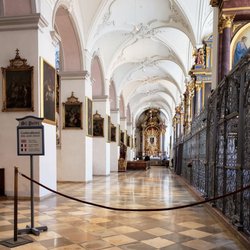
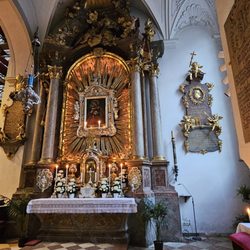
During my year stint living and loving Salzburg, Austria, this was the church I decided to attend…read moreeach Sunday for worship. Fashion and everyday dress in Europe is more formal than in the U.S. and in Salzburg, it's even more so. Being a sporadic church-goer throughout the year, it had to have been the grandeur of this place that motivated me to get up early each Sunday morning, dress my best and catch the StadtBus to church. An itinerary I miss until this day. There has been a church on this site since the 8th century, which was rebuilt in the Romanesque era. A Gothic choir replaced the Romanesque choir in 1408-50; a slender Gothic tower was added in 1468-98. The building served as a parish church, dedicated to the Virgin Mary, until 1635. In 1670 the top of the church's tower had to be removed because the archbishop objected to it being higher than that of the cathedral. In 1866 it was restored in a Neo-Gothic style. The church interior received a Baroque makeover in the 18th century. The Franziskanerkirche is an especially fascinating church to visit due to its unique mixture of architectural styles: The Romanesque nave is still visible inside the church, and a 12th-century marble lion from that period is set into the pulpit steps. The tall, well-lit Gothic choir (1408-50) is supported by slender purplish columns, which reach up to an elaborate rib vault. The choir shelters nine chapels, each decorated in an elaborate Baroque style by Johann Bernhard Fischer von Erlach in the 18th century. The easternmost chapel, behind the high altar, contains a winged marble altar of 1561 from the old cathedral. The high altar, also by Erlach, is an ornate creation of red marble and gold. The Madonna statue in the center predates the rest - it is a Late Gothic sculpture by Michael Pacher of Tyrol. Christmas Eve. It was midnight mass that was the most powerful. The church was pitch black except for the light of thousands of candles lit everywhere throughout; casting shadows that appeared to dance across the ornate and towering ceiling. The combination of the resounding pipe organ and choir was intoxicating, as if my spirit was awoken and rising out of my chest. A profound moment and connection I will never forget. O come, O come, Emmanuel And ransom captive Israel That mourns in lonely exile here Until the Son of God appear Rejoice! Rejoice! Emmanuel Shall come to thee, O Israel. Merry Christmas! May the Spirit of the season bring you much love and hope throughout the new year! Peace be yours!

Franziskanerkirche is very ornate church in Salzburg with one of the most visible steeples in the…read moreold town part of the city. Massive columns support a very high arched ceiling. Angelic carvings are everywhere. There are beautiful paintings and masterpiece reliefs too. The sheer scale of European churches is mind boggling. Franziskanerkirche delivers! It's a nice 15-20 minute walk through....

Photos
Franziskanerkirche
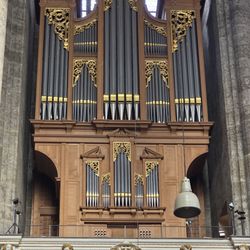
Franziskanerkirche - Orgel

Orgel

Franziskanerkirche

See all

St. Peter und Paul - Skulptur

St. Peter und Paul

3.7(3 reviews)
79.8 km

It is the Catholic parish church of Oberammergau in the Garmisch-Partenkirchen District (Bavaria),…read moreis an important example of the southern German Baroque. It was built from 1735 to 1749. The sculptures were created by Franz Xaver Schmädl, the pictures and frescoes by Matthäus Günther. A pre-Romanesque predecessor church was probably built as early as the ninth century, possibly replacing an even older wooden church. At this time, the Welfe Ethiko withdrew here with twelve companions to a life in a monastic community. In 1167, the Kempten monastery was given twelve courtyards with the right to present themselves through the church. In 1295 and 1362 they became the property of the Augustinian monastery in Rottenbuch. All pastors of Oberammergau can be completely documented from 1432 to the secularization of the monastery in 1802; they all were Augustinian Canons. The Oberammergau parish was founded in the 12th century by the Rottenbuch canon monastery, with which it remained pastorally connected until secularization. The first church was replaced by a Gothic building in the High Middle Ages. This had become so dilapidated at the beginning of the 18th century that the new baroque building was tackled. The middle picture of the high altar shows the Mother of God as the heavenly helper of those who ask for intercession and contribute gifts. It is replaced by a figure of the risen Christ during Easter and the Passion Play. The statues of the apostles Peter and Paul as well as the outside of St. Joseph and Joachim with their attributes are remarkable. The Lamb of God is enthroned on the book with seven seals above the tabernacle . The two side altars on the choir arch are dedicated to the theme of redemption through Christ's sacrifice on the cross. The left altar shows in a rare representation God's decision to salvation as an "inner conversation" of the Trinity. The saints Martin and Gregory the miracle worker appear at the side. The right altar shows Christ on the cross -- this cross is considered to be the one in front of which the Oberammergau residents took their vows of the Passion Play in the year of the plague in 1633 -- with Mary and John and, on the outside, the "good thief" Dismas and Mary Magdalene . The altars in the side extensions are dedicated to the holy clan (left; altarpiece by Günther) and Saint Anthony of Padua (right; picture by Johann Jakob Zeiller ). It's a very gorgeous sanctuary to say the least (photos).

Photos
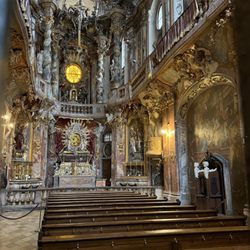
St. Peter und Paul - Hauptaltar, Nebenaltare und Deckengemälde

Hauptaltar, Nebenaltare und Deckengemälde

St. Peter und Paul - Kirche St. Peter und Paul

Kirche St. Peter und Paul

St. Peter und Paul - Nebenaltare und Hauptaltar

See all

Nebenaltare und Hauptaltar

St. Johann Baptist - landmarks - Updated May 2026

Loading...
Loading...
Loading...