Cancel

    Open app

    Search

    St Georges Church

    5.0 (2 reviews)

    St Georges Church Photos

    Recommended Reviews - St Georges Church

    Your trust is our priority, so businesses can't pay to alter or remove their reviews. Learn more about reviews.
    Yelp app icon
    Browse more easily on the app
    Review Feed Illustration

    17 years ago

    Helpful 0
    Thanks 0
    Love this 0
    Oh no 0

    17 years ago

    Helpful 0
    Thanks 0
    Love this 0
    Oh no 0

    Verify this business for free

    Get access to customer & competitor insights.

    Verify this business

    Belmont Abbey - Belmont abbey Hereford

    Belmont Abbey

    4.5(2 reviews)
    28.6 mi

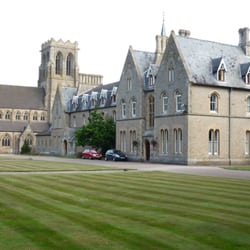
    Belmont Abbey is a community of Benedictine monks founded in 1859…read more They lead a life of work study and prayer. Attached to the monastery is a first class guest house 'Hedley Lodge' which has a excellent standard of service most rooms have TV, phone are en-suite and have a tea and coffee tray. The rooms are warm and comfortable and the food is excellent. I have attended several 'retreats' at the abbey and have found them of great value for 'getting away from it all 'for a few days The abbey although within walking distance from the town of Hereford is situated in quite countryside the only sound at night is the abbey clock chiming the hours This cannot be heard from many rooms. On one occasion when it was a popular retreat I was offered a room in the abbey itself. This was an interesting occurrence as there was no sound at all during the night A complete silence. A very unusual experience ! Even though I live in a fairly noiseless rural area a there is always some faint sounds. to be heard at night. The retreats which are usually for a weekend are given mostly by one of the monks of the community and obviously have a Christian basis. A complete list can be downloaded from their website As a sample there is in June a workshop on painting Icons where beginners and more experienced artists are welcome to try their hand at the art This year the subject will be the icon of Elijah.

    While Hedley Lodge offers a good standard of hotel accomodation for those attending retreats or…read morecourses it is also possible to sample monastic life itself. These stays of typically 3 or 4 days can be arranged through the Guestmaster of the monastery; one of the monks. Accomodation is simple but sufficient - no en suite. You are invited to join the monks in their daily Benedictine routine. Morning prayers at 6am; Mass at 8am; help yourself breakfast; rest of the morning free to read or walk; prayers before lunch then formal served lunch. Afternoons free. Evening prayers at 6pm; help yourself dinner at 7pm. Night prayers at 8.30 or so, then the end of day bell rings. All meals are taken in silence. If you are 'stressed out' by the world and life's troubles and looking for peace of mind I can recommend the structure and discipline of the Benedictine routine. It is hard work but very effective therapy. The monks are nice guys and will look after you: they are allowed to communicate :-). You don't have to be catholic but it helps I suppose. I was going south after a major bereavement and this routine got me back on the front mental foot in 3 days. Great result. They should invoice the NHS really.

    Photos
    Belmont Abbey
    Belmont Abbey
    Belmont Abbey

    See all

    Malmesbury Abbey

    Malmesbury Abbey

    4.3(3 reviews)
    18.4 mi

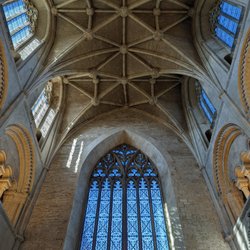
    Founded as a small monastic community in 672AD by the Irish monk Maidulph, Malmesbury is England's…read moreoldest borough (880), one of England's oldest Christian sites, and one of its greatest mediaeval monasteries. To-day it survives as a parish church, and contains one of the masterpieces of European Romanesque art. After Maidulph's death in 675, the leadership of the community was given to St Aldhelm, nephew of the Saxon King Ine, who is generally regarded as the founder of the Abbey proper, in 676. The present church was consecrated in 1180, and expanded as the monastery grew in prestige and wealth, especially in the period from 1260 under William of Colerne. Royal visits by Henry III and Edward I demonstrate the importance of the Abbey by the 13th century, and at its zenith in the 14th century, it featured a spire over 431ft (131m) high, greater even than that of Salisbury. Alas, this achievement was also its undoing, as at the turn of the 15th and 16th centuries, the tower collapsed, taking the crossing, transepts and chancel with it. All that remains of this area are two great crossing arches, and a wall of the south transept. Further disaster came with the Dissolution in 1539, when the Abbey was sold to a local clothier, and given to the townspeople as their parish church, and the other monastery buildings demolished. The Abbey continued to decay further, not helped by another disaster the collapse of the Western tower in the 16th century, demolishing the first two bays of the nave. In the Civil War, Malmesbury is said to have changed hands between the Royalists and Roundheads seven times, and the church walls are riddled with pock-marks from the bullets and shot. By the 18th century, it was being used for storing hay, and housing pigs and donkeys. The church was saved by thorough restoration in the 20th century, and it is once again a busy and well-loved parish church, albeit just one third of the size of the original building. The church is now best approached from the car park by the river at the foot of the hill to the north of the town. The silhouette of the Abbey complete with ruined arches dominates the hillside. Once at the top, it continues to dominate the little town, which otherwise has a slightly sad air of neglect about it. The structure is, as you might expect, hard to decipher from the outside, thanks to the variety of ruined walls and empty arches. Approached from the south side, you first come to the original Norman south porch, built around 1130. Unremarkable from a distance, close up you can begin to see the delicate carvings that make this one of the masterpieces of European Romanesque: the main entrance has eight arches of carving, depicting biblical scenes, enclosed in roundels formed by twisted branches. And there is more inside the porch: two huge panels depict the apostles at Pentecost. There are six on each side, seated with flowing robes in stylised poses, angels overhead, sitting above blind arcading with dog-tooth decoration. Finally, the inner doorway has a tympanum with Christ seated and supported by two flying angels, with three arches of curving motifs around the door. After all this drama, the nave can still hold its own: the nave has robust Norman arcades and a triforium, both with dogtooth decorative carving, with a decorated gothic clerestory and a spectacular vaulted roof, replete with huge carved bosses. The south arcade has an abbot's oratory set in the triforium, and the other feature of interest is in the north aisle, the tomb of King Athelstan, (895-937) who united England, Wales and Scotland for the first time between 927 and 937. The tomb is late gothic perpendicular in style, though badly damaged. The south aisle contains the chapel of its founder, St Aldhelm, as well as a bright Burne-Jones window depicting Faith, Courage and Devotion. Another window depicts England's first aviator, an intrepid monk named Eilmer, who flew in a primitive sort of hang glider from one of the abbey towers in 1010. he glided an impressive 200m before landing, breaking both legs (but he lived to tell the tale). Before you leave, be sure not to miss the small museum housed above the porch. Accessed by a steep and narrow spiral staircase, this contains illuminated manuscripts, prints and other items from the abbey's historic past.


    Very beautiful abbey. A must see when visiting Malmsbury.. You can't miss it anyways. They abbey…read morealso has events like roller blading and silent cinema.. If you live in the area keep you eyes and ears open.

    Photos
    Malmesbury Abbey
    Malmesbury Abbey
    Malmesbury Abbey

    See all

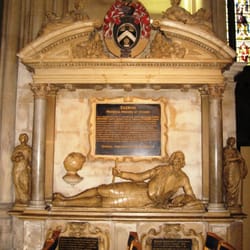
    Bristol Cathedral - Tomb of Abbot Newberry, d. 1483, Eastern Lady Chapel.

    Bristol Cathedral

    4.4(23 reviews)
    33.4 mi

    Bristol Cathedral, formally the Cathedral Church of the Holy and Undivided Trinity, is the Church…read moreof England cathedral in the city of Bristol, and was built 1220-1877. it is located at the bottom of the steep hill In Clifton an sits majestically n the green there, and opposite the City Hall of Bristol.

    We came to Bristol Cathedral as the meet-up place and 1st stop on our Bluebeard to Banksy walking…read moreTour of Bristol. The Cathedral is located in this gorgeous open square, and overlooks the Bristol City Council buildings. For me, the curlicue fanciful Victorian Architecture was most dominant, but our guide pointed out the Chapter House is dated from the medieval period and various restoration and expansion efforts were continuously pretty much undertaken over various centuries, so that now the Bristol Cathedral is a beautiful and harmonious blend of Gothic - Medieval, Tudor, Restoration and Victorian architecture. Luckily its still standing as it wasn't damaged during the WWII blitz of the city. An interesting fact our guide told us was that no member of the Bristol City Council ever comes to worship here. Instead they go to a church, which is located directly opposite this Cathedral, because back at the turn of the 19th century, the then-Councillors requested the Bristol Cathedral Bishop for them to be seated closer to the front. The Bishop refused and so they Councillors decided to build their own Church, where they could be given more prominence. If in Bristol, I definitely recommend coming to check this Cathedral out. Yelp 157/ 2019

    Photos
    Bristol Cathedral - A wall of the Chapter House, dated to 1165. This is one of the best surviving examples of Norman Romanesque in Britain.

    A wall of the Chapter House, dated to 1165. This is one of the best surviving examples of Norman Romanesque in Britain.

    Bristol Cathedral - The vault outside the inner Chapter House door, dated to 1165. This is one of the best surviving examples of Norman Romanesque

    The vault outside the inner Chapter House door, dated to 1165. This is one of the best surviving examples of Norman Romanesque

    Bristol Cathedral - Tomb of Sir Charles Vaughan, d. 1630.

    See all

    Tomb of Sir Charles Vaughan, d. 1630.

    St John's Church

    St John's Church

    4.5(2 reviews)
    43.3 mi

    Frome's large parish church fitting for a town that was larger than Bath until 1650 lies a short…read moredistance up a hill from the town centre. From the outside, much of what the visitor sees is Victorian, but inside are substantial elements from a complex mediaeval building. History The church was founded around 685AD by St Aldhelm, Abbot of Malmesbury, and this Saxon building survived until the Norman period. It was replaced late in the 12th century, and fragments of the new Romanesque church can be found in the present fabric. Around 1300, the nave was replaced, and the lower stages of the tower were built. The nave was extended late in the 14th century (or early 15th), and the northern transept rebuilt and the tower completed. In addition, chantry chapels added to the east of the tower (around 1412) and to the west of the north transept (1517). The clerestory was also raised in the 15th century but, like much of the fabric, rebuilt in the 19th century, as it was said to be in very poor condition. These works included rebuilding the chancel (1847-9), the north porch (1862), the north and south aisles (1862-5), and the west front (1865). The church The two approaches to the church could not be more different: from the end of King Street and Cheap Street, a series of steep steps rises alongside a stone wall with sculpted stations of the cross, forming a processional way (or Via Crucis) to the North door; to the west a spacious forecourt is closed off from Bath Street by a five arched screen, designed in 1814 by Jeffry Wyatt. Once inside, one is struck by the scale of the building, and particularly by the long nave. Here, the division between the earlier and later 14th century parts is clear in the design of the arcades. Both the clerestory and the rather intrusive sculpted roundels are Victorian. The north chantry chapel is entered through a fine panelled arch. This is now a baptistery and, besides the font, contains many wall monuments. An attractive round-arched doorway with continuous mouldings (ie no capitals) from the Norman church opens into the north transept. Another Norman fragment is the round-headed piscina on the north wall of the chancel. Architecturally, the ornate Victorian chancel is less interesting than the south chantry chapel and the room beneath the tower, both of which have elaborate rere arches. The church has many interesting furnishings. In the baptistery chapel are a 13th font in the shape of a quatrefoil, with four shafts; fragments of 15th century stained glass and an unusual wall monument to Richard Stevens (d. 1796), depicting an urn with two orphan boys on one side and an elderly man the other, with an asylum in the distance. The north transept has more 18th and 19th century monuments, but more striking is the large table tomb with a cadaver underneath, to a member of the Leversedge family. The elaborate rood screen is by Kempe, and the reredos in the chancel (of Carrarra marble) by the prolific sculptor, James Forsyth (1826-1910), beneath an East Window by Clayton & Bell. Finally, in the tower room opposite are two fragments of Saxon sculpture, depicting a monster and interlaced carving. The accompanying description postulates that they may have been from a cross, one of several erected where St Aldhelm's funeral procession stopped as it moved to Malmesbury for burial. It admits there is no evidence for such a claim but says, 'we at St John's like to think it is a reasonable assumption'.

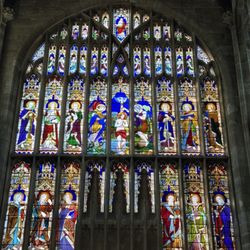
    The church of St John the Baptist is probably the most significant church, historically speaking,…read morein the town. A church was first founded here in 685 AD by St Aldhelm, and has grown and developed into the fine imposing building that sits half way up Bath Street today. Inside, there are still a few examples of Saxon stone carvings to be seen, and the stained glass windows are stunning. Definately somewhere to browse for those interested in ecclesiastical architecture and local history, as well as being a stately and spiritual place of worship for the CoE parishioneners.

    Photos
    St John's Church
    St John's Church
    St John's Church

    See all

    St Georges Church - religiousorgs - Updated May 2026

    Loading...
    Loading...
    Loading...