Ever hear of King Philip's War? It was fought between the New England colonists and their Indian…read moreallies against other hostile (and British backed) Indian tribes from 1675-78.
New England took on terrible losses (especially in the Massachusetts and Rhode Island colonies) and a dozen of their young towns were destroyed.
I read that this War was a leading contributor in the case for an independent American identity, because the colonists were fighting more or less on their own, with no outside support -giving them a "shared identity" as a group different and distinct from the British. Pretty interesting, isn't it?
Anyway, this marker taught me that Montville's Mohegan tribe fought on the British side during the war.
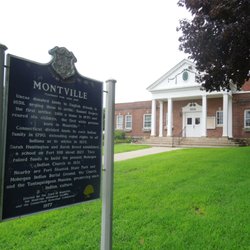
Located in front of Town Hall is this 2-sided marker from the CT Historical Commission, in the familiar white lettering on a blue background. It has different inscriptions on both sides.
The marker is in pretty good condition with side two being in better shape than side one. The colors are brighter on side two with none of the peeling seen on the bottom of side one.
The full inscription reads:
This area was long the home of the Mohegan Indians, by settlement before the Colonial period, and by reservation until more recent years. Prominent Indian sachems were Owaneco and his father Uncas, who defeated the chief Miantonomoh, a Narragansett, destroying that tribe's will to fight and opening the land to occupation by the whites. Uncas aided the English in King Philip's War of 1675-76, their most difficult and widespread conflict with the Indians.
John Mason, about 1723, erected a school to educate and teach Indians the Christian religion. Samson Occum, a student trained at the Reverend Eleazer Wheelock's school in present-day Columbia, taught in New London and became the first ordained Indian minister. He was a missionary to the Indians of New York colony. Visiting England, he raised a sum of $50,000, which was used to found Dartmouth College.
Uncas donated lands to English friends in 1658, urging them to settle. Samuel Rogers, the first settler, built a home in 1670 and reared six children, the first white persons born in Montville.
Connecticut divided lands to each Indian family in 1790, extending equal rights to all Indians as to whites in 1872.
Sarah Huntington and Sarah Breed established a school on Fort Hill about 1827.
They raised funds to build the present Mohegan Indian Church in 1831.
Nearby are Fort Shantok State Park and Mohegan Indian Burial Ground, the Church, and the Tantaquidgeon Museum, preserving much Indian culture.
Erected 1977 by Town of Montville, Montville Historical Society and Connecticut Historical Commission.
Four stars for one of the more interesting accounts I've seen on a marker, and for prodding me to go learn something about King Philip's War
159 CT towns done, 11 to go