Cancel

    Open app

    Search

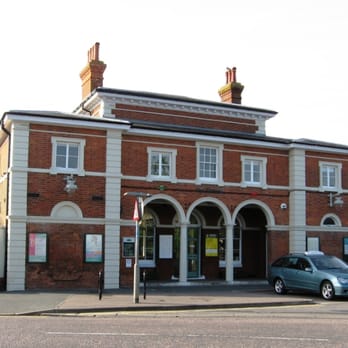
    Rye Railway Station

    4.0 (1 review)

    Rye Railway Station Photos

    Recommended Reviews - Rye Railway Station

    Your trust is our priority, so businesses can't pay to alter or remove their reviews. Learn more about reviews.
    Yelp app icon
    Browse more easily on the app
    Review Feed Illustration
    Photo of David J.
    96
    2344
    11912

    17 years ago

    Helpful 1
    Thanks 0
    Love this 1
    Oh no 0

    Verify this business for free

    Get access to customer & competitor insights.

    Verify this business

    Kent and East Sussex Railway

    Kent and East Sussex Railway

    4.5(6 reviews)
    8.2 mi

    The Kent and East Sussex Railway is a preserved steam railway which makes for an excellent family…read moreday out. Formerly a classic rural branch line, it has an interesting history and runs through stunning scenery. History Plans to link the ancient inland port of Tenterden to the rest of the railway network were made throughout the 19th century, but it was not until 1900 that a line from Robertsbridge (on the Hastings main line) to Tenterden was opened, extended to Headcorn on the Ashford main line in 1905. The line was built under what was then new legislation as a cheaply engineered 'Light Railway', running along the beautiful Rother Valley past Bodiam Castle to reach Tenterden. The engineer was the famous Colonel Holman Fred Stephens, who built and/or managed some 16 light railways in rural parts of the UK. The line survived as an independent operation after the First World War which saw most of Britain's railway companies amalgamated into the 'Big Four', but struggled financially from the 1930s onwards. After nationalisation in 1948, traffic ebbed away even faster, and the line was closed to passengers in 1954, and the Headcorn to Tenterden section closed completely. The Tenterden to Robertsbridge section survived until 1961 for freight. Preservationists fought hard to secure this unique line, which reopened in stages from 1974, to its present length in 2000. The Route The line runs from its headquarters in the attractive market town of Tenterden down through the valley of the River Rother to Bodiam, just five minutes' walk from the famous castle. The line follows marshland for much of its length, and part of it is even below sea level! Tenterden has a car park, shop, cafeteria, carriage shed and a small museum. The next stop is Rolvenden, the original terminus in 1900 and home to the loco shed. The next stop, Wittersham Road, really is in the former marshlands, and the ditches alongside the railway were once part of a crayfish farm. The line now joins the Rother Valley proper, towards the station at Northiam. This too has a large car park. The line then continues, with fine views of Bodian castle, to the small country station of Bodiam. Plans are afoot to reopen the section to Robertsbridge, but this is a significant undertaking (with a river and three road crossings to reinstate). The work is being undertaken by the Rother Valley Railway (http://www.rvr.org.uk) . The railway has an eclectic array of rolling stock: in keeping with its rural background, all but one loco are tank engines, and there are diesel locos and railcars as well. One of the best features is the prevalence of pre-war passenger coaches, including rare pre World War One 4-wheeled main line stock, and some very comfortable former Southern railway coaches from the 1930s. The railway lays on a number of regular events, including popular 'Thomas the Tank Engine' days, gala days with extra locomotives in steam, and Pullman dining trains - a good excuse to dress up! Practicalities There are car parks at Tenterden and Northiam, but not at the other stations, and refreshment facilities, a shop and museum at Tenterden. For information about disabled access and facilities, (including car parking, toilets and trains) see their website. All in all, this makes for an excellent day out.

    This is a fantastic day out for the family. We drove here from East Sussex, lots of parking! We…read morecame for a Thomas Day which is when they have various steam engines dressed up as characters from the Thomas books. A show is put on for the children with the troublesome trucks, the fat controller and so on. Whilst we were there Christopher Awdley, the son of Rev.Awdley was signing his own books(he has carried on the family business, as it were) and his fathers. There is face painting and a bouncy castle included in the ticket price. You then have a short ride on a steam engine(thomas). There is a tent selling Thomas merchandise at low prices! The station also has a cafe(licensed) selling hot meals and snacks. The railway also does a range of other journeys for the enthusiast, fish and chip nights on a steam train etc. Good day out.

    Photos
    Kent and East Sussex Railway
    Kent and East Sussex Railway
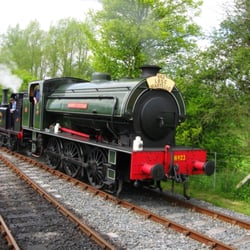
    Kent and East Sussex Railway - Class 14 D9504

    See all

    Class 14 D9504

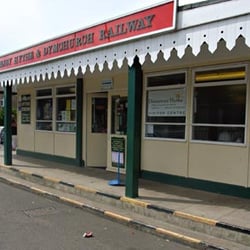
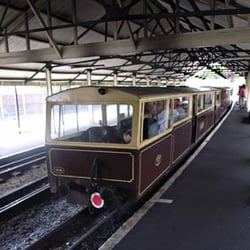
    Romney Hythe & Dymchurch Railway - No, these aren't giants, its the trains which got small . . .

    Romney Hythe & Dymchurch Railway

    4.2(6 reviews)
    10.0 mi

    A delightful and charming time is to be had riding this marrow gauge railway. We took a journey…read morefrom Dymchurch to Dungeness and then back again. A delight from start to end and this from an avowed non trainspotter! The views are stunning and varied, looking inland across green fields and verdant lushness to the views at Dungeness across pebble and shingle stretching away for what feels like miles . . . The staff are helpful and hugely courteous, dedicated to fault, and all the more remarkable for being volunteers. Do take a trip on this railway if you can, the memory of it will stay with you for quite a while.

    This is listed in two places, so I thought I'd copy my review across!…read more This is a 1/3 (15 inch guage) railway that runs from Hythe to Dungeness (13 miles). It was conceived by two rich men; Captain Howey and Count Louis Zborowski. It was opened in July 1927, but sadly the Count had died at the Monza Grand Prix before he could see his dream realised. It is really fascinating, with both diesel and steam trains running on the line. The station at New Romney gives a wonderful view of these old, small steam trains from the footbridge that crosses the platforms. It's a lot of fun to take the train from New Romney to Dungeness with kids. The carriages are tiny - there is no standing or moving about in them! There are both covered and open carriages depending on the weather and preference. The gift shop is very train orientated and there are lots of interesting things to buy at all ranges of the budget. I particularly love this train service, as it passes right across the end of my father's garden! It looses a star for being just so expensive though! If you were to take two adults and three children on it for the full 13 miles (Hythe to Dungeness) and back, it would cost over 50 quid! For more information... Webiste: http://www.rhdr.org.uk Tel: 01797 362353
    Photos
    Romney Hythe & Dymchurch Railway
    Romney Hythe & Dymchurch Railway
    Romney Hythe & Dymchurch Railway

    See all

    Ashford International Station

    Ashford International Station

    3.7(3 reviews)
    14.6 mi

    Ashford International is a major rail interchange in south east Kent, and since 1996, has also been…read moreserved by the London-Paris/Brussels Eurostar service. The station is used by 2.8 million passengers a year, with a further 400,000 changing between trains. History The station opened in December 1842 by the South Eastern Railway on its line from London to Dover via Redhill, which was completed through to Dover in 1844. A line through Canterbury to Ramsgate opened in 1846, and to Hastings via Rye in 1851. The current 'main line' via Maidstone was opened in 1884, initially to a separate station, by the London, Chatham and Dover railway; services were diverted into the present station in 1899. The station was connected into the line to the Channel Tunnel in 1996, and to the high-speed line to London St Pancras in 2007. The present station dates from a rebuilding to accommodate the beginning Eurostar services in 1996, and is entirely of modern design in steel and glass, with a large multi-storey car-park in a matching style. The station essentially comprises three island platforms: platforms 1 & 2 and 5 & 6 handle domestic traffic, with 3 & 4 handling Eurostar trains. Platforms 3 & 4 have separate, controlled access to meet immigration and customs requirements. Domestic Services The station has regular services to London Charing Cross and London Victoria, and to Dover Priory, Ramsgate, Canterbury West, Margate, and Brighton via Hastings and Eastbourne. Many services divide or attach carriages here. Since December 2009, the station has also had 140 mph (225kph) high-speed domestic services to London via Ebbsfleet International and Stratford International, taking 37 minutes to St Pancras International. International Services The initial service of 7 trains to Paris and 5 to Brussels was reduced on the opening of Ebbsfleet International in 2007. There are now three return services to Paris, one to Brussels and one to Disneyland Paris via Lille. Services Passenger facilities are surprisingly basic for so busy a station: the station has large car parks (charges apply) and covered storage for 148 cycles, and there are small cafe outlets on each of the domestic island platforms (1/2 and 5/6). There is also a small tourist information office. The station has level access throughout and a disabled toilet.

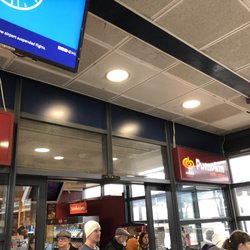
    its a very busy station with poor facilities. We sometimes use this station when we stop off from…read morevisiting family in Folkestone at the Ashford Designer Outlet (http://www.qype.co.uk/place/68597-McArthur-Glen-Ashford--Ashford) - a few minutes walk away. Poor facilities for an International Station nowhere for coffee except the really grim and overpriced Pumpkin station cafes on two of the platforms and a couple of independent cafes on site. Disinterested staff and overpriced dull food and very average coffee. Nothing else around it so they have a captive market. Really not good enough for an International Station.

    Photos
    Ashford International Station
    Ashford International Station
    Ashford International Station

    See all

    Polegate Station

    Polegate Station

    4.5(2 reviews)
    23.0 mi

    Polegate station serves the town of the same name on the northern edge of the Eastbourne…read moreconurbation, and is served by trains on the West Coastway line. It handles around 0.9m passengers a year. The first station on the site opened in 1846 on the Lewes to St Leonards railway line. It became the junction for Eastbourne and for the line northwards to Hailsham in 1849, with the Hailsham line being extended northwards to Eridge on the Uckfield-Groombridge Junction line in 1880. In 1881, to avoid Eastbourne-Hailsham trains having to reverse, a new station was opened further east. The Hailsham line closed in 1968, and the short direct line to Hastings has also closed, necessitating the reversal of all eastbound trains at Eastbourne. In 1986, the 1881 station was closed (it is now a restaurant) and a replacement opened on the site of the original 1846 station, on Polegate High street, and this is the station in use today. It has two platforms, with the main buildings on the north, Eastbourne-bound line. Facilities include a car park, ticket office, waiting rooms or shelters, ticket machines, and cycle storage, but no toilets. There is step-free access both to the ticket office and via short steep ramps to each platform. Between the platforms, there is a footbridge: level access is via the High Street level crossing (allow 5 minutes). Services are provided by Southern; there are two trains an hour to each of Brighton and London Victoria, both via Lewes; and four eastbound to Eastbourne, two of which continue to Hastings and Ore, and one to Ashford.

    Just your average train station. Nice long and wide platforms with two waiting rooms (which are…read moreheated!) Good barrier system, although I was sad when the old signal box was removed. Great direct links to London, Brighton, Eastbourne and many more. Staff are nice, there are three (I think) ticket buying machines and two kiosks inside the station. Information packs readily available, you can buy Railcards from here too. I like the welcoming feeling of this station, which also has a night gate for late exits when the barriers are off. I'd recommend this to families, commuters and just about anyone due to the wide platforms and nice service.

    Photos
    Polegate Station
    Polegate Station
    Polegate Station

    See all

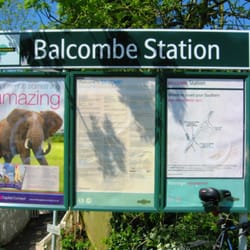
    Balcombe Railway Station - The main station noticeboard at London Road

    Balcombe Railway Station

    4.0(1 review)
    38.4 mi

    It's a surprise to find a station serving as a small village as Balcombe, especially on a main…read moreline. However, the lack of good roads to and from the village, and its proximity to London, ensures a healthy flow of commuter traffic, with Balcombe acting as a rail-head for several villages around - it is used by just over 100,000 passengers a year. It's an attractive small station, the east side nestling in a cutting, and surrounded on all sides by mature trees and shrubs, and is very popular at week-ends with walkers exploring the surrounding woodlands. The station opened on 12 July 1841 as an intermediate station on the then London and Brighton Railway, later amalgamated into the London, Brighton and South Coast Railway. The 1841 census shows that there were 550 railway labourers living in the village at the time - which must have been challenging for the locals! The station has been rationalised over the years, but retains a small building on the down (Brighton) platform, complete with Victorian canopy, ticket office and toilet. The office is only open at peak times (the toilet is also closed when the office is shut). If this is the case, you need to buy a 'permit to travel' from the machine and buy a ticket on board. The up platform (for London) has a small waiting shelter with step-free access from the car park, and there are car parking spaces and a cycle rack on this side of the station. A footbridge provides access between the platforms, and also provides the exit to London Road at the top of the cutting. Note that there is no step-free access to the Brighton platform. An oddity is the extension of the Brighton platform under the small tunnel at the south of the station: this is only used to board and alight from trains, and a sign warns not to enter the tunnel when a through (ie non-stopping) train is approaching which they do, at some speed. The service is fairly sparse: off-peak, Monday to Saturday there is one train an hour in each direction, on the First Capital Connect service from Bedford to Brighton via London Bridge. On Sundays, an hourly service is provided by Southern on the Brighton to London Victoria line. Additional services stop during rush hours in both directions. To the north of the station is Balcombe tunnel, 800 yards long, and to the south the famous Ouse viaduct, the first long railway viaduct in southern Britain. At 1,475 ft (450m) long, faced with Caen stone and with four Italianate pavilions at each end, it is regarded as one of the most attractive in the UK.

    Photos
    Balcombe Railway Station - A fast through train for Brighton rushes past platform 2.

    A fast through train for Brighton rushes past platform 2.

    Balcombe Railway Station - Main station building on platform 2 (for Brighton). It contains a ticket office, sheltered seating and toilet.

    Main station building on platform 2 (for Brighton). It contains a ticket office, sheltered seating and toilet.

    Balcombe Railway Station - A Bedford-bound train leaves platform 1.

    See all

    A Bedford-bound train leaves platform 1.

    Haywards Heath Station - General view with a Victoria train leaving platform 3

    Haywards Heath Station

    3.3(3 reviews)
    36.5 mi

    Haywards Heath is one of the principal stations on the main line between London and Brighton,…read moreserving the commuter town of the same name which has grown up around it. It's not an architectural gem, but it's functional and has a good range of train services. The station opened in July 1841 as the temporary southern terminus on the London to Brighton Railway, and became a through station when the line to Brighton opened in its entirety in September of that year. In 1847 a line was opened from Wivelsfield, just south of Haywards Heath, to Lewes, providing direct lines to Newhaven and Hastings, and 1864 another line opened, to the north, towards Horsted Keynes on the Lewes to East Grinstead line. The line to Horsted Keynes closed in 1963. The station was rebuilt with two long, spacious island platforms in 1933, when the Brighton line was electrified. The street-level buildings are in an unremarkable version of the Modernist style, of brick with concrete canopies. The platforms level buildings are similarly functional and have deep awnings. Since electrification the station has become an important station for dividing trains heading respectively on the lines east towards Lewes and west to Hove and the 'West Coastway' line (avoiding Brighton) and for the same trains joining when heading north. Indeed, it is now the busiest station for this practice in the UK. The station has a regular off-peak service each hour as follows: Northbound Bedford via London Bridge and St Pancras 4 per hour London Victoria 2 per hour Watford Junction - hourly Southbound Brighton 5 trains per hour Littlehampton via Hove and Worthing 2 per hour Eastbourne 2 per hour (one extended to Hastings and Ore) Note: the half-hourly fast Victoria-Brighton trains do not stop here in the off-peak. In the peak hours all Brighton trains call here, providing an intensive service. All northbound trains stop at Gatwick Airport. The station is staffed 24 hours a day, and has a ticket office, waiting rooms, toilets and a large buffet, and step free access is available across the whole of the station (via lifts). There is also storage for over 60 bicycles and a 630-space car park. A limited number of local buses call at the station: see http://www.compass-travel.co.uk .

    Whilst I may be living in Haywards Heath, I spend much of my time in Brighton for study,…read moresocialising and shopping. Hence, I am a frequent user of the station. It's one of the main connectors of the south, so is a featured stop for fast services as well as the stop at every station trains. This makes it handy for getting to Gatwick, Brighton and London and you end up waiting less time for a train than at other stations in the area. I think that this is a reason why Haywards heath has become such a popular commuting town and the large station car park attests to this claim! Being a busier station, you also find coffee/snack bars and waiting rooms that are actually open. Now whilst not a fault of the station I do find that a higher percentage of trains get delayed than I would like, so these waiting features are really appreciated. The station staff are helpful for any traveling inquiries or suggestions of cheaper way to get from a to b (sadly, I never seem to qualify for such savings). There are also 3 self service ticket machines if you want to save some time or are cutting your arrival a bit fine before your train departs. There is also a covered area to store bicycles if you are feeling like a healthy commute. All in all, you could do far worse if you have to kill 15-20 minutes waiting for a train than Haywards Heath!

    Photos
    Haywards Heath Station - General view of the station, with the long canopies over the platforms.

    General view of the station, with the long canopies over the platforms.

    Haywards Heath Station - Taken by me

    Taken by me

    Haywards Heath Station - The 18:46 Southern service to Hastings leaves Haywards Heath on 4th July 2008.

    See all

    The 18:46 Southern service to Hastings leaves Haywards Heath on 4th July 2008.

    Rye Railway Station - trainstations - Updated May 2026

    Loading...
    Loading...
    Loading...