Romsey Abbey Photos


Recommended Reviews - Romsey Abbey
Start your review...



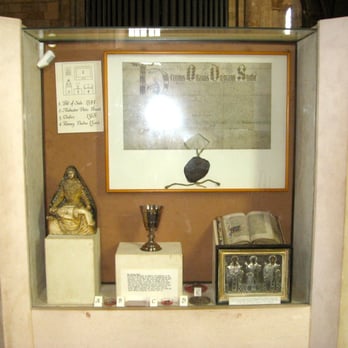
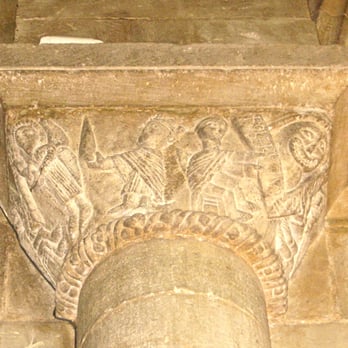
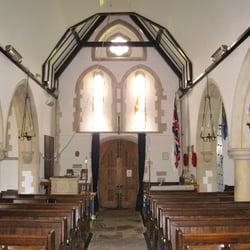
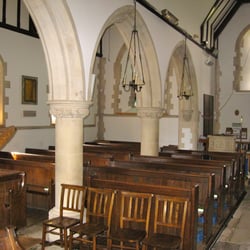
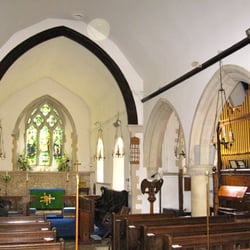
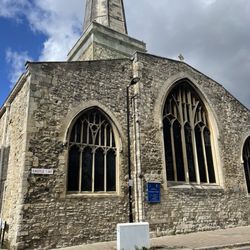
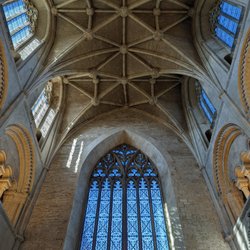
Romsey Abbey is one of England's outstanding Norman churches, with some fascinating survivals from the Saxon and mediaeval periods. It is dedicated to St Mary and St Ethelflæda, one of its early abbesses. History The first community on the site was founded in 907AD, by King Edward, son of Alfred the Great, under his daughter Elflaeda. The abbey was refounded as a Benedictine house by King Edgar in 960AD, with St Ethelflæda as the second abbess. The first stone church was built around 1000AD, but after the Norman conquest the abbey as rebuilt on a much larger scale, starting around 1120. By 1140 the Choir, Transepts, a Lady Chapel at the East end and first three bays of the Nave had been completed. A fourth bay was added in 1150-80. The nave took its present form in 1230-40, when the last three arches and the present west end were added in the Early English style. The upper tiers of the clerestory must also have been completed at this time, as they are also in the Gothic style. Although the abbey declined during the time of the Black Death, by the Dissolution a second aisle had been added to the north to accommodate the townspeople, who used the north aisle and transept as their parish church. After the Dissolution, the townspeople purchased the church for £100 for use as their parish church, removing the second north aisle. The late 13th century Lady Chapel was also demolished in 1539, and over subsequent years the cloisters and other abbey buildings were demolished. Although the Abbey was restored in the 19th century, the Victorians sensibly left most of the fabric well alone, and the church today is one of the best preserved large Norman churches in England. The church From the outside, the church retains its largely Norman (and rather severe) appearance. The decoration is relatively restrained, with rounded arches and some interesting decorated corbels, and a very squat central crossing tower. The best features are on the west wall of the south transept; first, is the famous Romsey Saxon Rood, showing Christ in majesty with the hand of God pointing down from above. Adjacent is a fine Romanesque doorway, which once opened from the nave into the cloister. None of this prepares you for the magnificent interior, which is flooded with light from the clear west windows. The proportions are those of a cathedral, with the eye drawn to the tall, rounded crossing arches. At the west end, the three west bays of the nave and the clerestory have pointed arches in the Early English Gothic style, and the east windows are late 13th century Decorated Gothic work. But essentially, this is a Norman building. Nave, transepts and chancel all have tall rounded arcades surmounted by triforium and clerestory, and the aisles and chancel are vaulted. Most of the capitals are scalloped, but many have the kind of intricate designs of foliage and figures typical of Norman work: one depicts two kings fighting, one pulling the other's beard; another has two scenes, one of two crowned men either side of an angel and a second of two seated men either side of a grotesque monster: banners proclaim the names Robertus and Robert. The interior is also full of interesting fittings and furnishings. The south transept has an impressive 13th century effigy of a woman under a 14th Century Decorated Gothic canopy of ogee arches; a tall and colourful mid-17th Century memorial to the St Barbe family, and the simple floor tablet of Earl Mountbatten of Burma (1900-1979). The south chancel aisle leads to an ambulatory with chapels; the first has a reredos formed of a Perpendicular screen framing a precious (and now partly gilded) Saxon carving of the crucifixion, dated to c. 960AD. This shows Christ with two angels and two soldiers, one offering Christ the sponge soaked in vinegar, the other piercing Christ with a spear. Next to this is St Ethelflaeda's Chapel, with an ancient tomb of an abbess, and a painted kneeling figure of a monk on wood, from around the early 16th century. St Mary's Chapel has a wall painting of the 12th century, with medallions featuring the life of a Saint. Returning past the chancel in the north aisle is an opening in the floor, revealing part of the foundations of the apse from the 10th century Saxon church. The south transept has yet another treasure, this time a rare painted reredos, featuring Christ and saints, dated to c. 1525, with two rather flamboyant censing angels. At the west end of the nave is a beautiful lead memorial to Alice Taylor, who died of scarlet fever in 1843, clutching a rose her father had picked for her. Nearby is another tomb chest of an abbess, and a case of curiosities, including a well preserved scalp of hair with a plait, all that remained of the corpse of a Saxon woman whose lead coffin was opened in 1849. The church has a busy life of daily worship and regular concerts, and there is a bookstall selling gifts, crafts, music and souvenirs. read more