Cancel

    Open app

    Search

    Robert Cooke Buckner Photos

    Recommended Reviews - Robert Cooke Buckner

    Your trust is our priority, so businesses can't pay to alter or remove their reviews. Learn more about reviews.
    Yelp app icon
    Browse more easily on the app
    Review Feed Illustration

    2 years ago

    Helpful 4
    Thanks 1
    Love this 2
    Oh no 0

    Verify this business for free

    Get access to customer & competitor insights.

    Verify this business

    Lightfoot-Coleman House - Lightfoot-Coleman House, Paris

    Lightfoot-Coleman House

    (1 review)

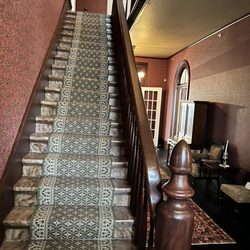
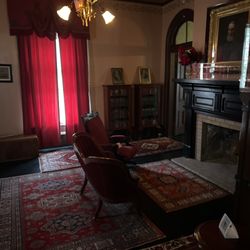
    It's a treat to find a marker that is located adjacent to the point of interest to add some…read moreadditional context to the site. Too many markers are "Oh, and the site is 2 miles east" or such. So this was nice. The marker stands at the street in front of a beautiful two story home in the Paris historic district. It was built in the Victorian style and still retains much of those original design elements. The marker reads, "Alabama native Henry William Lightfoot, a Confederate veteran of Forrest's Cavalry, came to Paris in 1872 as a law partner of Sam Bell Maxey. Two years later, he married Maxey's adopted daughter, Dora Rowel Maxey, and soon the young couple had this house built across the street from the Maxey home. Built of lumber hauled from Jefferson, its outstanding architectural feature is a double gallery decorated with Eastlake-style millwork. Lightfoot served as a state senator and as chief justice of the 5th Court of Civil Appeals. He died while traveling in Alaska in 1901, and his heirs later sold the house to the Rodgers Coleman family, early preservationists who oversaw restorations of the house in the 1950s. Recorded Texas Historic Landmark - 1965." The marker was erected in 1965 by the Texas Historical Commission and is marker number 12012. There is a sign indicating that the home is occasionally open to the public for tours but today was not that day. [Review 725 of 2024 - 485 in Texas - 21756 overall]

    Paris Fire of 1916 Historical Marker - Paris Fire of 1916 Historical Marker

    Paris Fire of 1916 Historical Marker

    (1 review)

    Located on one side of the Square in downtown Paris, this marker provides the history of the big…read morefire that destroyed much of the city in 1916. The marker is in excellent condition and is easy to read. There is metered street parking nearby and some lots. The marker reads, "Although Paris was founded in the mid-1840s, many of its historic structures were lost in a fire that destroyed almost half the town in 1916. The blaze started about five o'clock on the afternoon of March 21, 1916, at the S. J. Long Warehouse near the southwest city limits. Its cause is unknown, but one theory is that a spark from a switch engine ignited dry grass near the warehouse. Winds estimated at 50 miles per hour soon blew the fire out of control as it burned a funnel-shaped path to the northeast edge of Paris. "Firemen from Bonham, Cooper, Dallas, Honey Grove, and Hugo, Okla., helped the Paris Fire Department battle the flames, which were visible up to 40 miles away. The blaze destroyed most of the central business district and swept through a residential area before it was controlled at about sunrise on March 22. "Property damage from the fire was estimated at $11,000,000. The structures burned included the Federal Building and post office, Lamar County Courthouse and Jail, City Hall, most commercial buildings, and several churches. Rebuilding was begun quickly as townspeople collected relief funds and opened their homes to the victims. A railroad and market center before the disaster, Paris soon regained its former prosperity." This is marker number 8216 and it was erected in 1976 by the Texas Historical Commission. [Review 715 of 2024 - 477 in Texas - 21746 overall]

    Burial Site Of John Chisum - Burial Site Of John Chisum, Paris

    Burial Site Of John Chisum

    (1 review)

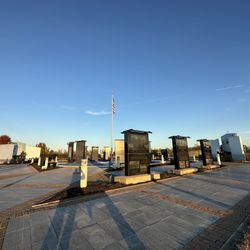
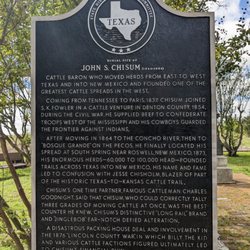
    I first heard the story of John Chisum in 2022 when I was passing through New Mexico. A historical…read moremarker that told the story of Sallie Chisum Robert, the first Lady of Artesia (near Roswell) and Chisum's niece. And in Roswell, the John Simpson Chisum Equestrian Statue, the Cattle King of the Pecos. "One of the West's consummate cattlemen, he helped develop both modern cattle breeds and the fledgling town of Roswell." So at that time, I bookmarked this spot because I wanted to stop in and pay my respects to this great man. It is a quiet spot along the railroad at the edge of a residential neighborhood. A small circle where you can drive in and stop to read the marker and walk up to the stone. The historical marker reads, "Cattle baron whose herds, moving from east to west Texas and into New Mexico, expanded into one of the greatest cattle spreads in the west. "Coming from Tennessee to Paris, 1837, Chisum joined S. K. Fowler in a cattle venture in Denton County, 1854. During the Civil War, he supplied beef to Confederate troops west of the Mississippi and his cowboys guarded the frontier against Indians. "After moving in 1864 to the Concho River, then to "Bosque Grande" on the Pecos, he finally located his spread at South Spring near Roswell, New Mexico, 1873. His enormous herds-- 60,000 to 100,000 head-- pounded trails across Texas into New Mexico. His name and fame led to confusion with Jesse Chisholm, blazer of part of the historic Texas-to-Kansas cattle trail. "Chisum's onetime partner, famous cattleman Charles Goodnight, said that Chisum, who could correctly tally three grades of moving cattle at once, was the best counter he knew. Chisum's distinctive "Long Rail" brand and "Jinglebob" ear-notch defied alteration. "A disastrous packing house deal and involvement in the 1876 "Lincoln County War," in which Billy the Kid and various cattle factions figured, ultimately led to Chisum's financial ruin." [Review 705 of 2024 - 467 in Texas - 21736 overall]

    Paris Post Office Historical Marker - Paris Post Office Historical Marker

    Paris Post Office Historical Marker

    (1 review)

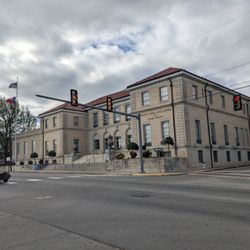
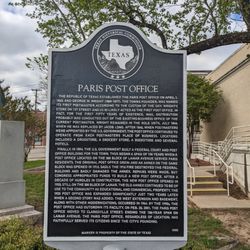
    This marker is located in downtown Paris in front of the "United States Post Office and Court…read moreHouse" building. An impressive structure, I toured the outside and did see that there is an accessible entrance on the side. The marker was unveiled in 2024 by the Lamar County Historical Commission. It is in excellent condition and easily legible with a lot of text. It reads, "The Republic of Texas established the Paris Post Office on April 1, 1843, and George W. Wright (1890-1877), the town's founder, was named its first postmaster. According to the custom of the day, Wright's store on 1st street and US 82 likely acted as the first post office. In fact, for the first fifty years of existence, mail distribution probably was conducted out of the existing business office of the current postmaster. Wright remained in the role until July 1844, when he was replaced by Jacob Long. After 1845, when postmasters were appointed by the U.S. government, the post office continued to operate from each postmaster's place of business. Locations included a drugstore, a grocery store, a bookstore and several hotels. "Finally, in 1894, the U.S. Government built a federal court and post office building for the town. Thus began a span of 106 years when a post office located on the 300 block of Lamar Avenue served Paris residents. The original post office grew, and an annex on the same block was opened in 1915. Sadly, the 1916 fire destroyed the federal building and badly damaged the annex. Repairs were made, but Congress appropriated funds to build a new post office. After a decade of hurdles in construction, the new post office opened in 1925, still on the 300 block of Lamar. The old annex continued to be of use to the community as educational and commercial property. The 1925 post office was expanded significantly just two years later when a second story was added. The west extension and basement, along with other modernizations, occurred in 1964. By the 1990s, the post office had outgrown its facility. On Feb. 20, 2001, the Paris post office moved to Clarksville Street, ending the 106-year span on Lamar Avenue. The Paris post office, regardless of location, has faithfully served its citizens since the city's founding." There is a parking lot across the way and metered parking on the street. [Review 712 of 2024 - 474 in Texas - 21743 overall]

    Paris Public Schools Historical Marker - Paris Public Schools Historical Marker

    Paris Public Schools Historical Marker

    (1 review)

    Located in downtown Paris near the post office and the community park, this marker points out the…read moreeducational history of the town. There is plenty of parking nearby if you'd like to stop to read the marker. It reads, "Although attempts to provide a public school system in Paris were made as early as 1877, it was not until 1884 that the system as it is known today was organized. Under the strong leadership of Mayor John C. Gibbons, W.B. Aikin, E.L. Dohoney, and Travis Henderson, the city council appointed a board of trustees to supervise the first full session of the newly organized school system. "Three schools comprised the system in 1884, the Aikin Institute, later known as Aikin High School and as Paris High School, was located at this site. The second facility was the Graham School, originally known as the Paris Female Institute. A school for black students was located on North Jefferson Street in 1884. It later was moved to another site and was named Gibbons High School in honor of the former mayor. "J.C. Brooks of Tennessee served as first superintendent of Paris Public Schools. A later superintendent, J.G. Wooten, served for 37 years and was responsible for much improvement and expansion, including the 1924 addition of Paris Junior College, which remained part of the public school system until 1949. "Through its years of growth and development, the Paris Public Schools have educated and influenced thousands of students throughout the community." This is marker number 8219 and it was erected in 1984 by the Texas Historical Commission. [Review 711 of 2024 - 473 in Texas - 21742 overall]

    Paris Cotton Compress Historical Marker - Paris Cotton Compress Historical Marker

    Paris Cotton Compress Historical Marker

    (1 review)

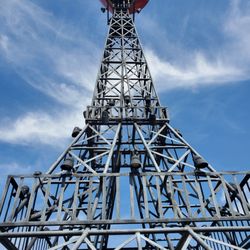
    Located on a slow corner not far from the Eiffel Tower, this marker points out some of Texas…read morefarming history in this area. It reads, "In the early 1880s, cotton began to dominate Texas agriculture as a principal cash crop, with over two million cultivated acres producing 800,000 bales of cotton per year. With the 1876 arrival of the first railroad line to Paris, local businessmen John Martin, W. B. Wise, and Frank Fitzhugh saw an opportunity to press cotton locally into transportable bales by building a cotton compress located next to the Texas and Pacific Railroad line on what became a twelve-acre complex, the Paris Cotton Compress (variously known as the Transcontinental Compress Company and the Farmers and Merchants Compress Company) opened in 188 and operated for almost 100 years. "In 1884, the owners added a warehouse to the complex. By the 1890s, the Paris compress had two steam presses operating 24 hours a day in season for shipment to domestic and European markets. The compress compacted ginned bales of cotton to a specific density. In 1895, state rules set that density at 22.5 pounds per cubic foot for domestic use. The firm of Martin, Wise, and Fitzhugh became one of the largest cotton buyers in the South, with offices in New York, New Orleans, and Liverpool, England. Operating under various owners and managers over the decades, the business stimulated the local economy, helping to make Paris a thriving regional commercial center. "Production topped out at around 100,000 bales per year in the 1920s. The compress remained viable despite the post World War II decline in local cotton production, until the 1973 cotton boll weevil infestation decimated local crops. In 1978, the compress shut down and in the 1980s, the complex was dismantled." The marker is on a quiet corner near the rail tracks. There is room to stop and park so that you can read the marker. There is a large concrete pad here. Was that the warehouse? [Review 706 of 2024 - 468 in Texas - 21737 overall]

    Robert Cooke Buckner - landmarks - Updated May 2026

    Loading...
    Loading...
    Loading...