The Estate has been in the ownership of many families of mixed fortunes over the past two centuries.
The park as we know it today, with the addition of Dove Park in 1907, has developed over the past years and now stands within the boundaries of the 1929 bequest. Unusually for its period the 14-acre park has not been eroded by land sales and provides a key asset to the immediate local community.The original parkland was of fairly modest proportions until that date having been sub-divided in accordance with the requirements of the Enclosures Act 1805, to provide common grazing lands.
Several mansions have stood on the site adjacent to Church Road over the past 200 years. In many cases they were owned by great 'Victorians' who contributed in a variety of ways to the development of the City of Liverpool and its heritage, which enhanced its reputation as being 'the Second City of the Empire'.
The Park has had many owners includind:
John Weston, a slaver at the commencement of the 19th century,
Samuel Weston, a bankrupt Liverpool merchant,
John Crosthwaite, Director of the Great Western Railway, who set the standard rail gauge for the British Rail system, still in use today,
George Cope, who made his fortune in the tobacco trade,
and finally the Reynolds family.
James Reynolds was a wealthy cotton broker, owning not only Reynolds Park but also a welsh castle and Levens Hall Cumbria.
James Reynolds, although beyond military age, served in France during the Great War and was awarded the DSO. He was knighted in 1920 and was bestowed with a Baronetsy. During the 1920s he was elected as MP for Liverpool Exchange and died in 1932, being buried in St Mary's Churchyard, Woolton.
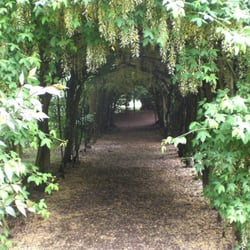
Leila Reynolds continued to live at the park and together with Prof. Sir Charles Reilly (Head of the School of Architecture at Liverpool University 1904-33) designed the Yew Garden and the outdoor dining area, in a fashionable 'European Modernism' style.
The park was bequeathed to the City in 1929 as a 'thank you' to the people of Liverpool for their contribution, through trade, to the wealth of the family.
The mansion was destroyed by fire, and was rebuilt to provide a function suite. The footprint of this building is now redeveloped into a quality 'sheltered housing' accommodation, the residents of which still benefit from the beauty of the park and its walled garden.
The main park buildings were demolished following a significant fire circa 1975. These have recently been replaced with a pleasant housing accommodation for retired/elderly residents, who now enjoy the park as 'an extension to their gardens'.
The Lodge, Church Road - a listed building dated 1883
This very attractive building came into the ownership of the Cope family, and provided, a home for the head gardener, from 1907. The Lodge formed part of the bequest of the Park to the council as did the head gardener, James Lowe, whom the City retained as a Parks Superintendent. On his death his wife retained the tenure and still occupies the premises.
The Lodge, Woolton Hill Road
Of less architectural interest The Lodge was also bequeathed to the council who retained the property until the tenant exercised their 'Right to Buy' option under the Housing Act. The council resisted the request to close the entrance to the Park from this gateway, and a public right of way has now been established.
Over the past 150 years several substantial features including a summerhouse, and a 'Donkey shelter' have been lost. Other features are being considered for restoration/change of use, eg pigsties, ex-boiler-house etc.
The Park has been gradually acquired over the past 200 years, with its current boundaries and artefacts remaining mainly unchanged since the original bequest.
The 14 acre park is bounded by Church Road, Woolton Park and Woolton Hill Road, Liverpool 25. It contains listed features including the Walled Garden, Gatehouse, and perimeter walls and is set within the Woolton Conservation Area. It could well be described as a 'hidden gem', providing an area of passive recreation and contemplation, with the capacity to absorb limited informal recreation for families, and a safe and secure haven for young children.
The main feature of the park is a walled garden, which probably serviced the mansion house with kitchen produce. The garden was constructed with the ha-ha by 1840. During the period 1925-35 the council took pride in converting several ex-kitchen gardens into decorative flower gardens. These included those at Calderstones, Greenbank Park and Sudley Estate. The garden at Reynolds Park is known as being a prestigious area for summer bedding plants, herbaceous borders and in particular is noted for its Dahlia displays.
In 2001 the park and walled garden was awarded the Best Public Landscape Award by the North West Britain in Bloom Panel. Together with Woolton Woods both parks added to the success of Woolton Village in the 2001 competition. The village and its environs was awarded read more