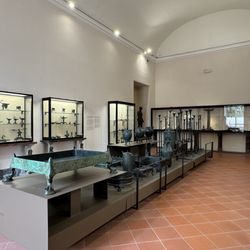
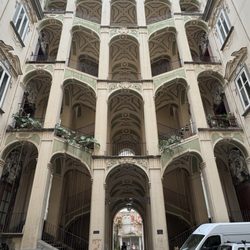
One of Naples' crowning museums, the artifacts here complement a visit to Pompeii in the same trip,…read moresince the collections span archaeological finds from Pompeii, Rome and beyond. From sculpture, sacred and funerary objects, mosaics, paintings, household items and furniture, to architectural models and decorative elements, there's plenty of intriguing objects to pique various interests.
On a grey Sunday morning in April, I arrived at 10am, and was glad I didn't come later! There were two lines, one for those purchasing tickets at the entry and those with pre-booked tickets online in advance. The latter was a fairly short line, maybe about 10 people, while the former was about 20ish. When I left a couple hours later both lines had more than doubled in length.
Inside, the exhibit halls begin with sculptures unearthed during archaeological finds, with the direction of visit encircling one of the smaller inner courtyards. They do an excellent job of providing Italian and English translations for didactic labels and descriptions, and I was able to learn much about a) the background and provenance of sculptures and other finds, b) key figures in archaeological excavations which discovered many of the pieces now housed here, and c) the history of this museum.
The route of visit continues to a columned hall with some waiting area seating and contemporary local art pieces, (apparently where school groups rest before touring the museum with docents), which lead up a pair of curved stone staircases where you can look upwards at a central dome.
On the second floor highlights include a collection of watercolor works from watercolorist Luigi Bazzani, who captured colorful paintings of Pompeii at the turn of the 20th century, a collection of elaborate furniture, and many rooms of artifacts from steles, ceramics, blown glass and tableware. Many colorful wall paintings found in villas and homes were transferred from archaeological sites to this museum. There's a curious collection of erotic art from antiquity called the Secret Cabinet* too.
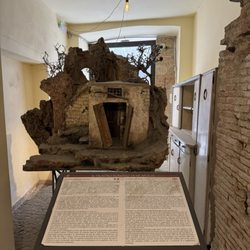
Unfortunately both these sections were closed: a) the mosaic floor where they previously allowed visitors to enter wearing cloth covers over shoes, and b) the sprawling mini replica of Pompeii that looked to be at least 12 x 15 feet. The latter I glimpsed thru a walkway that was cordoned off.
The Sundial Hall, named after (you guessed it) a functional sundial installed in the SW corner of the room, was one of the most impressive rooms in the museum, originally serving as the Bourbon** Royal Library of Naples, then later as the National Library. The beautifully restored ceiling fresco depicts the Bourbon royalty as patrons of the arts.
Among the most famous group of objects here are items from the Farnese Collection, begun by then Cardinal Alessandro Farnese (1468-1549), who later became Pope Paul III. Theses works were displayed in various settings notably the Farnese palace, villa and gardens in Rome, then subsequently passed down to descendants. Farnese Hercules, Farnese Artemis, the Farnese Bull and the Farnese Cup are all sublimely sculpted pieces.
The total time recommended is easily 2.5-3 hours, additional if you want to read more of the placards. Free lockers, coat check and bathrooms are available.
Admission is €20.00 for regular tickets, €2.00 for 18-25 year olds, free for teachers, disabled and those with certain city passes including Artecard and Naples Pass.
Hours: 9.00 am - 7.30 pm with last entry at 6.30 pm
Closed Tuesdays.
*did not post these pics as I didn't want to get flagged for posting explicit content! lol
**Bourbon as in the royal dynasty that ruled southern Italy from 1734 until 1860. Not the whisky made with a higher percentage of corn from the southern United States. =)