Cancel

Open app

Search

Piazza del Plebiscito Photos

Recommended Reviews - Piazza del Plebiscito

Your trust is our priority, so businesses can't pay to alter or remove their reviews. Learn more about reviews.
Yelp app icon
Browse more easily on the app
Review Feed Illustration

Reviews With Photos

Maruko X.

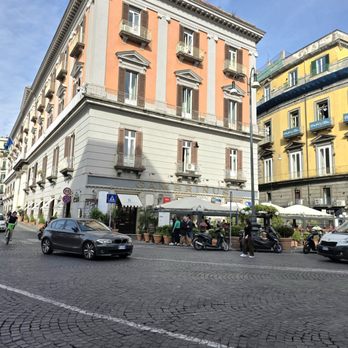
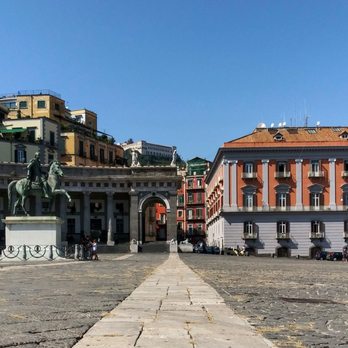
This plaza is one of the most elegant spots in Naples and hosts a large number of the city's cultural events. It's a bit sketchy at night, a lot of people hanging around on the stairs.

Piazza del Plebiscito, Napoli
Bruce K.

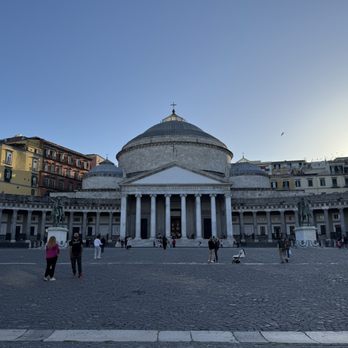
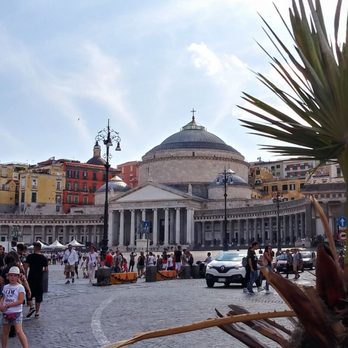
One of the large open spaces and if all of Naples looked as clean as this, it would be a much nicer city. This piazza is massive and beautiful. With the Royal Palace on one side and the church of San Francesco di Paola in the center, this is a beautiful spot. Not much going on today - it's late January - but there are usually events and festivals here in the warmer months. [Review 19219 overall - 370 in Italy - 189 of 2023.]

Piazza del Plebiscito
Joanna V.

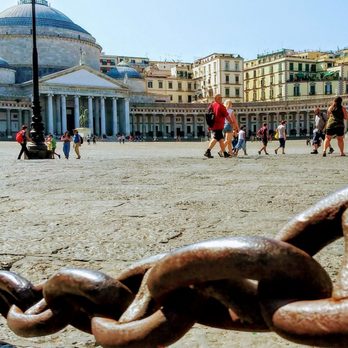
Massive! I'm sure this entire space was much more useful over 172 years ago. I was hanging around this plaza for their La Notte della Tammorra festival. Lotsa people just gathered listening to music, having conversations, munching on pizza and birre. It's a friendly community for locals and visitors. I even had a small conversation with someone where we both were using Google Translate to communicate. It didn't halt our attempts to talk, despite our language barrier. Hospitality and humanity is an art of a person's soul. Day time and night there always seems to be people hanging around, especially on the steps. The building directly faces Palazzo Reale di Napoli. Piazza del Plebiscito is a perfect landmark to know you're a short walk away to the ocean views. Keep on gallavanting! There's more to see and live.

See all

2 months ago

Helpful 40
Thanks 11
Love this 33
Oh no 0

1 year ago

Helpful 6
Thanks 2
Love this 7
Oh no 0

7 months ago

Helpful 3
Thanks 2
Love this 3
Oh no 1

2 years ago

Helpful 3
Thanks 1
Love this 5
Oh no 0
Photo of Dave B.
128
1748
2636

8 months ago

Huge piazza. I can imagine that concerts here are very good. It was very quiet on our Monday morning visit.

Helpful 1
Thanks 0
Love this 0
Oh no 0
Photo of Bruce K.
2415
25937
76046

3 years ago

Helpful 8
Thanks 1
Love this 11
Oh no 0

8 years ago

Helpful 42
Thanks 0
Love this 42
Oh no 0

7 years ago

Helpful 3
Thanks 0
Love this 2
Oh no 0

8 years ago

Helpful 1
Thanks 0
Love this 4
Oh no 0
Photo of P J.
38
111
0

9 years ago

Helpful 0
Thanks 0
Love this 0
Oh no 0

9 years ago

Magic! One of the most beautiful squares in Napoli. From there you can walk to the seafront and enjoy its beauty.

Helpful 0
Thanks 0
Love this 0
Oh no 0

Piazza del Plebiscito Reviews in Other Languages

Review Highlights - Piazza del Plebiscito

I was hanging around this plaza for their La Notte della Tammorra festival.

Mentioned in 4 reviews

Read more highlights

Verify this business for free

Get access to customer & competitor insights.

Verify this business

Piazza San Domenico Maggiore

Piazza San Domenico Maggiore

4.6(11 reviews)
1.4 kmCentro Storico

You can't miss it. It's the public square in back of the Church of San Domenico Maggiore, and just…read moreoff of Spaccanapoli (or Via Benedetto Croce). This is also where you'll find the beautiful Obelisk of San Domenico which towers over the square. It's a symbol of resilience & hope, but I couldn't help but feel like it's also protecting everyone. It was erected after the plague of 1656 that devastated Naples. So, maybe its purpose is to make you feel that way. There are also former palaces on each side of it. The Palazzo Petrucci currently houses a Michelin Star restaurant of the same name. You'll also see the outdoor terrace of their pizzeria in the plaza. On the opposite side is the Palazzo Corigliano. It's currently occupied by a college of a university that teaches languages. There's history and worldliness all around this piazza. It's a lively public area that is frequented by locals, tourists, parishioners, and students. You'll see the young, the elderly, and all ages in between enjoying the shops & restaurants. You can ideally spend a couple of hours here just watching how Naples lives. It's a cool place to be when near this historic city center.

Located on the edge of Spaccanapoli, (now renamed Via Benedetto Croce,) a main tourist promenade in…read morethe historic center of Napoli. At the center of this square is a 18th-century obelisk monument dedicated to San Domenico (Saint Dominic, founder of the Dominican Order), credited for eradicating the 1656 plague. On the northern edge of the square is the Chiesa di San Domenico Maggiore, a gothic church with a beautiful interior, completed in 1324, altered to a Baroque style in 1670 then back to Gothic in the 19th century. Sepulchers located in the sacristy house members of the royal family of Aragon. The neighboring buildings are comprised of former palaces of the aristocracy now repurposed for other uses. Palazzo Petrucci houses a pizzeria, B&Bs, and a cafe, Palazzo di Sandro is home to a lute maker, Palazzo Corigliano a library and cafes. The original location of Scaturchio, one of Naples' oldest pasticcerias (see my separate review) sits along the southern edge of the piazza. Walking around this oldest quarter of the modern city, you'll inevitably pass by, hopefully when it's not too crowded. I enjoyed walking through early morning while most stores were just opening up, a glimpse of the city's daily clockwork before the bustle sets in.

Photos
Piazza San Domenico Maggiore - Obelisk of San Domenico in the piazza.

Obelisk of San Domenico in the piazza.

Piazza San Domenico Maggiore - Obelisco di San Domenico in Piazza San Domenico

Obelisco di San Domenico in Piazza San Domenico

Piazza San Domenico Maggiore

See all

Maschio Angioino - Castel Nuovo - Palatine Chapel

Maschio Angioino - Castel Nuovo

4.5(29 reviews)
0.4 kmPlebiscito/Centro

You're greeted with beautifully carved pillars and arches with details that tell you stories. The…read moremassive doors are dramatic! Do some neck and shoulder stretches before visiting because looking up and around is required. It's a castle on the outside and a Civic Museum inside. For €6 entry, you get a lot for your visit. An audio guide is optional for €4 more. Note that you're able to get a brochure with a map in English. After entry, you step into a huge courtyard. It appeared an event was being set up the day of my visit. I headed to the left toward the stone steps to start my self-paced tour into the: BARON'S HALL - it looks like a courtroom. Awesome ceiling architecture! Tried to follow the map; forget about going in alphabetical order. On the ground level you'll find the: PALATINE CHAPEL - closed doors for preserving artwork; so full of emotion. No flash photography. Place your camera glass to glass against the doors. Up more stairs to the: 1st FLOOR - find a bronze door with a cannon ball stuck in it. This floor has a lovely collection of religious paintings from 15th-18th centuries. 2nd FLOOR - you'll see more of paintings with war stories and lifestyles from 18th-20th centuries. 3rd FLOOR - modern day collections. Note that these floor exhibits are not directly above each other. Refer to the map and legend on the brochure for your preferred route. Art lovers and appreciators can take their time. Definitely a recommended visit for tourists. Don't forget to catch a breeze and take in views of the Tyrrhenian sea.

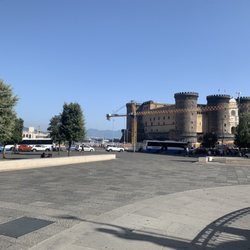
Constructed in 1279, and for centuries the Royal residence of Naples' kings into the 16th century,…read morethe gothic exterior of this massive fortress with five towers is a magnificent reminder of Napoli's medieval history and maritime prowess, with an entrance over the largest man-made moat I've seen. Arriving at 5pm on a weekday afternoon, I scrambled (ie. speed walked for half a mile) to make it before their assigned last entry time, which I thought was 5pm for a 6pm closing time, though apparently it's last entry at 5:30pm. Well...I got an extra workout. There's a small ticket window to the left inside the main doors, which takes cash or card, and can also validate your city/museum pass (I had a Naples Pass). Regular admission is €15, tickets for local residents €10, free for children under 18. However because of ongoing renovations to major sections, they were offering reduced admissions of €10 and €6 respectively. Inside what's available to view as of mid-April 2026 are several components. To me each stands alone and feels a bit disjointed to the others, though given its lengthy history and different functions over time perhaps the range of spaces truly embodies the story of the castle, one embued with varied relevance and purpose. - Palatine Chapel: an austere chapel with stone block floors, inset with ledger stones.* - Archaeological route and former Armory room: this is where the ruins can be viewed below a glass floor--of what's believed to be past of a lavish Roman villa from 1st century BCE beneath the castle. Tours need to be pre-booked in advance if you want to descend to the underground level to visit these. - Hall of the Barons: this is the kind of grand hall I'd imagine medieval royalty to preside over, with a massive octagonal star-shaped arched stone ceiling and central round skylight, though it was actually a later construction in the 15th century. The layout includes a U-shaped wooden seating arrangement where the current Napoli city council meets. - Chapel of the Souls of Purgatory: single room with entrance off the courtyard to the right of the entrance to the Palantine Chapel, the frescos are colorful though space is small. - First floor Civic Museum - Art Gallery: this is up a flight of steps (aka the second floor for those of us across the pond), a gallery of about 50 works ranging from 15-18th century religious Neapolitan art, transferred here from other historic buildings that are no longer in use. - terrace on second floor with partial view of the port: I was a little disappointed since I thought the roof of the castle would be accessible though I'm glad I didn't rush here on my first day in Naples and instead went to Monte Echia nearby where the views were much better, more panoramic. It took about 30 minutes to walk around the parts that were open, there are more extensive galleries on the upper stories that were under renovation. I felt it made sense to reduce the price since some portions were closed. For more info: https://www.comune.napoli.it/vivere-il-comune/luoghi/castel-nuovo-maschio-angioino/#orari_apertura https://www.naplesinsider.com/en/e/castel-nuovo-maschio-angioino *an inscribed stone slab usually laid into the floor of a church to commemorate or mark the place of the burial of a deceased person. (as per Wikipedia)

Photos
Maschio Angioino - Castel Nuovo - Construction underway

Construction underway

Maschio Angioino - Castel Nuovo - Upstairs on the 2nd floor is a small gallery

Upstairs on the 2nd floor is a small gallery

Maschio Angioino - Castel Nuovo - "Natura merta con pesci" by Giuseppe Reco

See all

"Natura merta con pesci" by Giuseppe Reco

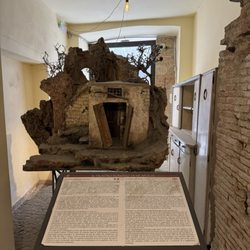
Napoli Sotterranea - A few placards with miniature house models

Napoli Sotterranea

4.7(52 reviews)
1.8 kmCentro Storico

Checks the box off for interesting tour to take in a foreign city. Tour itself was 5 stars, the…read morewait and the crowds dropped it a star. Underground tours in Naples are very popular with multiple sites and entry points, this one being the main location. Entrance is via an alley along Via dei Tribunali, one of the main stretches in the historic center, and on a Sunday noon it was packed with visitors waiting for their tour times. Like probably 70-80 people waiting in a 12 x 20 foot area...a fair number of staff on hand wrangling the lines, telling people/groups with pre-bookings to line up in front of those without. Each person basically has to talk to a staff member to figure out exactly who they should be standing behind. Then there are staff members calling out times for each tour at the front, Italian then English alternately. I'm not sure why they don't implement an easier, more straightforward system, for each language--one line for prebooked and one line without. Tickets can be booked in advance online by tour language and they ask you to be there 15 minutes prior to your time slot. This is most certainly not only recommended, but required if you want to avoid inadvertently missing your timeslot due to the confusing line as mentioned above. Also their website refers to the online tickets as "skip-the-line" though to be clear you are essentially just booking a spot in advance, you still need to wait in line at the entrance. And hands down book in advance. They "guarantee" entry at the door (as I heard a few different staff members mention to certain people in line), however what they don't initially mention is this is only after all pre-booked visitors enter, so this could mean an indefinite wait of 30 minutes, an hour, 1.5 hours...who knows. For safety reasons entry is only possible via guided tour, and there are limits to the size of each group. They definitely push it though, considering my group of about 35ish was one of several groups to go down in staggered times of about 15-20 minutes apart. Once the guide directs the group to enter the pathway leading underground, they make you line up along the stairs while another group exits, then your group can enter. It's several flights down (then back up) so I saw some elderly with walking handicaps and families with strollers struggling. Honestly I wouldn't recommend coming here if you fall into either group. I imagine it could be dangerous for the former (think slippery stone in some areas) and there was a toddler crying during two-thirds of my tour that made for a very distracting experience if you consider the cavernous reverberations. After waiting in line for about 15-20 minutes outside, then another 10-15 minutes on the stairs inside, the tour itself lasted about an hour and fifteen minutes after we finally got downstairs. It was very informative and our guide tried her best to crack jokes and maintain a light-hearted atmosphere while at the same time projecting her voice as loud as possible and telling other nearby groups to keep their voices down (yes, bc there were a few different groups in close proximity sometimes so she had to practically yell to be heard). She shared about the history, functions (aquifer, munitions storage, landfill, war bunker, etc) and unique conditions (cool temps and high humidity) that makes this subterranean complex such an integral part of Naples' story. The last 20 minutes was dedicated to visiting the ruins of an ancient Roman amphitheater only a few minutes walking from the Sotterranea entrance/exit. It's in a separate building altogether on a residential street and it was intriguing to see the intersection of antiquity and modern life. Tickets are €18 for adults, €15 for students 11-24 yrs old, €10 for children 5-10 yrs old. Time slots available on the hour from between 10am to 7pm daily, last entry at 6pm. For more info: https://www.napolisotterranea.org/en/

The underground tour itself is interesting and one of the kind of experience in Naples. It takes…read moreabout one hour and twenty minutes, approximately one hour under the ground, and two more exhibit rooms above the ground. The staff working here is terrible though, unfortunately you can only go through with their tours. The woman organize the lines and sells the tickets is absolutely the worst. She yells at people and gave misleading information, while said only 15 people in the tour group when selling the tickets, but it ended up filling near 35 people in the same group once you get into the line for your time stamped tickets, and you can imagine how crowded it could be. This tour is not recommended for claustrophobic people.

Photos
Napoli Sotterranea - Setup depicting how space was used to store war munitions during WWII

Setup depicting how space was used to store war munitions during WWII

Napoli Sotterranea - Entrance to the underground levels

Entrance to the underground levels

Napoli Sotterranea - Entrance to the underground area in the middle of the city/Eingang zu den unterirdischen Gängen mitten in der Stadt

See all

Entrance to the underground area in the middle of the city/Eingang zu den unterirdischen Gängen mitten in der Stadt

Catacombe di San Gaudioso

Catacombe di San Gaudioso

4.8(25 reviews)
2.6 kmCentro Storico

Quite different from San Gennaro, these catacombs have a claustrophobic space. We entered to the…read moreright side of the original catacomb entrance. It's inside the church. The church was built around and over the catacombs to protect it. Another history lesson you'll have to hear about on this tour. You'll find the church's interior really beautiful and grand with gates that guard the original entrance. Put away or secure all your loose belongings like cellphones, cameras, sunglasses or hats cuz you're gonna need to hold on to the sides making your narrow way downstairs to the underground. You can take pictures once you're safely flat on two feet. Oh and hopefully you ladies are wearing flats or tennies cuz it is not the kind of platform to walk pretty. The stone paths further in are just right for one person, cozy for two. Making your way through, there are more turns. There's an area we stopped to learn about how the rich back in those times, were the only ones who can afford the service where their loved ones whom have passed away were "treated" in the section that drains body fluids into a container placed beneath the corpse. When the flesh deteriorated the skeleton's skull would often fall. And so the skull would be placed on a stone shelf just above their bones; lined up across. (A scene you may find familiar in many Latin cultures especially during Dia de Muertos.) It wasn't a sanitary practice, but we're talking history, and change came with time. Giovanni Balducci was a Tuscan artist who was hired to be the only one that painted skeletons at San Gaudisio catacombs. These are the only catacombs known to have placed the skulls of the dead in the concrete (see photos)... again, for the rich who were able to afford the service. Along the shorter gallery (in comparison to San Gennaro's larger expanse), the painted skeleton of the men are on left; women are on the right painted with skirts. P.S. your entrance ticket to San Gennaro gets you into these catacombs for free - two for one.

Tour would have been great if they had staggered the English speaking and Italian speaking tours…read more They started at the same time so all you could hear was the loud Italian speaker screaming behind us. Would not recommend. Two stars is being generous.

Photos
Catacombe di San Gaudioso

See all

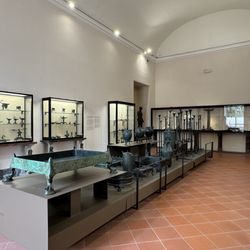
Museo Archeologico Nazionale - Lighting and heating instruments collection

Museo Archeologico Nazionale

4.4(59 reviews)
1.8 kmCentro Storico

One of Naples' crowning museums, the artifacts here complement a visit to Pompeii in the same trip,…read moresince the collections span archaeological finds from Pompeii, Rome and beyond. From sculpture, sacred and funerary objects, mosaics, paintings, household items and furniture, to architectural models and decorative elements, there's plenty of intriguing objects to pique various interests. On a grey Sunday morning in April, I arrived at 10am, and was glad I didn't come later! There were two lines, one for those purchasing tickets at the entry and those with pre-booked tickets online in advance. The latter was a fairly short line, maybe about 10 people, while the former was about 20ish. When I left a couple hours later both lines had more than doubled in length. Inside, the exhibit halls begin with sculptures unearthed during archaeological finds, with the direction of visit encircling one of the smaller inner courtyards. They do an excellent job of providing Italian and English translations for didactic labels and descriptions, and I was able to learn much about a) the background and provenance of sculptures and other finds, b) key figures in archaeological excavations which discovered many of the pieces now housed here, and c) the history of this museum. The route of visit continues to a columned hall with some waiting area seating and contemporary local art pieces, (apparently where school groups rest before touring the museum with docents), which lead up a pair of curved stone staircases where you can look upwards at a central dome. On the second floor highlights include a collection of watercolor works from watercolorist Luigi Bazzani, who captured colorful paintings of Pompeii at the turn of the 20th century, a collection of elaborate furniture, and many rooms of artifacts from steles, ceramics, blown glass and tableware. Many colorful wall paintings found in villas and homes were transferred from archaeological sites to this museum. There's a curious collection of erotic art from antiquity called the Secret Cabinet* too. Unfortunately both these sections were closed: a) the mosaic floor where they previously allowed visitors to enter wearing cloth covers over shoes, and b) the sprawling mini replica of Pompeii that looked to be at least 12 x 15 feet. The latter I glimpsed thru a walkway that was cordoned off. The Sundial Hall, named after (you guessed it) a functional sundial installed in the SW corner of the room, was one of the most impressive rooms in the museum, originally serving as the Bourbon** Royal Library of Naples, then later as the National Library. The beautifully restored ceiling fresco depicts the Bourbon royalty as patrons of the arts. Among the most famous group of objects here are items from the Farnese Collection, begun by then Cardinal Alessandro Farnese (1468-1549), who later became Pope Paul III. Theses works were displayed in various settings notably the Farnese palace, villa and gardens in Rome, then subsequently passed down to descendants. Farnese Hercules, Farnese Artemis, the Farnese Bull and the Farnese Cup are all sublimely sculpted pieces. The total time recommended is easily 2.5-3 hours, additional if you want to read more of the placards. Free lockers, coat check and bathrooms are available. Admission is €20.00 for regular tickets, €2.00 for 18-25 year olds, free for teachers, disabled and those with certain city passes including Artecard and Naples Pass. Hours: 9.00 am - 7.30 pm with last entry at 6.30 pm Closed Tuesdays. *did not post these pics as I didn't want to get flagged for posting explicit content! lol **Bourbon as in the royal dynasty that ruled southern Italy from 1734 until 1860. Not the whisky made with a higher percentage of corn from the southern United States. =)

It was the highlight of our visit to Naples. We skipped it after seeing Pompeii over 10 years ago…read more There was no way that we were going to pass it up this time. This is where you'll find the original statues, artifacts, and frescoes unearthed from Pompeii, Herculaneum, Ancient Rome, and even more archeological sites in Italy. The experience was everything that I imagined it would be and more. Some people wonder whether they should visit it before or after seeing Herculaneum or Pompeii. In my opinion, it should be after. The location of where some of these pieces were found is still fresh in my memory. It all came back to me when reading the descriptions. I was also very amazed with the Farnese Collection. These statues are colossal in size. The Farnese Bull has to be the largest sculpture ever unearthed. It's so incredible when you see it up close and personal. Very impressive! It's a very well organized museum. Well worth the admission fee. There's a nice café inside as well as a bookstore. My only disappointment was that they had sold out of the English museum guides that I collect when traveling. They did have the Italian version. Do purchase your tickets online in advance. There was a line of people trying to buy tickets. The situation gets worse when a tour group arrives. Especially when there are 4 cruise ships in port. Also, make sure you scan the QR code to download the museum app for free audio guides and maps. It makes it so easy to find everything. Give yourself more than an hour. There is so much to see. It's a popular attraction for a reason.

Photos
Museo Archeologico Nazionale - Museum cafe

Museum cafe

Museo Archeologico Nazionale - Paintings from early 1st century AD

Paintings from early 1st century AD

Museo Archeologico Nazionale - Stairs to second story

See all

Stairs to second story

Piazza del Plebiscito - landmarks - Updated July 2026

Loading...
Loading...
Loading...